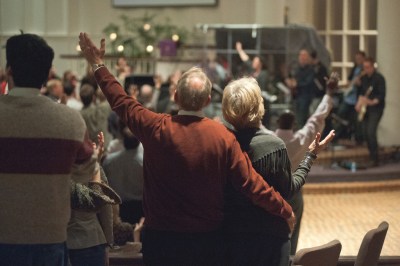
Ten Ways Anglican Churches Can Grow in Worship – Pt. II

Last week I posted some funny ways Anglican churches could grow in worship. Like institute 40 days of cheesecake. Then I proceeded to not post anything the rest of the week. I’m sorry for being a terrible blogger and letting it get pretty quiet around here.

I did want to share the serious stuff that I shared in my seminar a couple of weeks ago when I encouraged Anglican worship leaders/pastors/congregations how they can grow in worship. I think most of this applies to other churches too.

1. Worship God out of love, not duty
We don’t worship God because he needs it, we worship God because we need it. God demands praise because we won’t be happy until we give it. God isn’t needy. We are. When people come to church because they think God needs it, or because God will be impressed, they’re doing it out of duty. Encourage people to come hungry, thirsty, and expectant to receive.

2. Appreciate all styles of music as God’s handiwork
There is not one style of music that can contain God’s glory. There is not one style of music that is unable to be used for God’s glory. Music is God’s handiwork, therefore we can and should use all of it, with care, for the glory of God. Therefore, we shouldn’t be protective, defensive, or suspicious. We should be glad to see God’s glory reflected in variety.

3. Expressiveness as the norm
When is the last time you’ve taught/offered encouragement on biblical expressiveness? Teach it from the bible and let people know they’re safe to feel free to worship with their bodies. Finally, model it. People won’t go beyond what they see up front. Expressive worship is the norm in scripture. So it should be in our churches too.

4. Clergy as worship leaders
The pastor, or the priest, or the rector of a church is being studied at all times. Especially during a service. If he’s not interested or engaged in what’s going on, people notice. If your congregation isn’t expressive or engaged in worship, look at your pastor. Most often, he isn’t either. The picture at the top of this post is of my church’s pastor worshipping with his wife at our CD recording a month ago.

5. Lay Eucharistic ministers, acolytes, ushers, etc., as worship leaders
If you were to walk into a new church for the first time and see people up front, you would understandably assume that those people were in leadership. And if those people look bored during the service, you would understandably get the idea that worship isn’t terribly important. In Anglican/liturgical churches, most often, the people that we put up on the platform look bored. And I think this is a major reason why our congregations do too.

6. Do contemporary well
I remember when I was visiting England and I ordered a burger at a restaurant. I could tell it wasn’t the real deal. I remember when I was a kid and my Mom tried to sneak store-brand Cheerios in the name-brand box. I could tell it wasn’t the real deal. People have sharp antennae for fakeness. Sadly, in many Anglican churches, classical music is supported with skilled leaders and some sort of budget, while the contemporary music is not. This should not be so.

7. Go for it: celebration
On a scale of 1 – 10, 10 being a party, and 1 being asleep, most Anglican churches settle around a 3. They’re not totally asleep, but they’re leaning that direction. I think I can get away with saying this stuff since I’ve grown up in this tradition.

Don’t expect a congregation that’s at a 3 to all of the sudden go to a 10. But maybe one Sunday with some explanation and love you can encourage them to a 3.5? Nudge people to celebrate God’s glory with more enthusiasm.

8. Wait for it: stillness
Most people have very few (if any) extended times of stillness during their day. We can give them that space on Sunday. But it’s not enough to just leave silence and expect people to figure out what to do. Imagine you’re stuck on a plane on the tarmac. What do you want? The pilot to give you an update. So apply this principle to times of silence on Sunday: give people a bit of direction and explain what’s going to happen, and encourage them to be still and listen to the Lord and enjoy his presence. It might make people uncomfortable but it’s good for them.

9. See liturgy as a tool not an idol
I’ve written and spoken extensively on this here.

10. Leave room for the prophetic
Which of these two questions are you asking yourself the most throughout the service: (1) where does the liturgy have us going? Or (2) where is the Holy Spirit leading us? Both are important questions. But one is more important than the other. And that’s the latter question.

For goodness sakes, God can read. If all we do is read words off a page off of a screen, we might as well hold it up to God and say “read this”. We have a responsibility as worship leaders and pastors to keep people from honoring Jesus with their lips while their hearts are far from him. The active ministry of the Holy Spirit in our midst, during the singing, during the reading and preaching of the word, at the Eucharist, in the prayers, and in the silence, needs to be pursued and encouraged. And then we must be willing to follow his direction above the liturgy’s. He will not lead into error or disorder. He will lead to Jesus, and the more of that we experience on Sundays, the better for all of us.

Don’t Give Me That Look

I had a good conversation with a singer on the worship team at my church a few days ago when she asked me whether I want singers on the team to (a) close their eyes, (b) keep their eyes open, or (c) look people in the eye as they’re singing up front. She had heard different thoughts on this from different people and wanted to know what I thought.

If there’s one thing that really bugs me about most worship teams that I watch on the internet these days, it’s when they have a front line of 5 – 10 singers, and each one seems to be some sort of Disney robot. No offense, of course. I’m sure they’re nice people who love to sing. But they stand there and look straight out at people, smiling and pointing and nodding their heads, making direct eye contact (I’ve even seen some of these singers wink) and I can’t understand what this is supposed to accomplish.

My answer to the singer from my worship team was to (a) be engaged with God in heartfelt worship and (b) be aware of the people you’re standing before. This does NOT mean working the crowd, making direct eye contact, smiling at people and employing cheerleading tactics.

When I look out on the congregation when I’m leading worship, I’m looking out as if I’m looking through a periscope on a submarine. I’m scoping out what’s happening but I’m not staring directly at people. I am confidently cocooned inside of myself, worshipping God, aware of my surroundings and my fellow musicians, and I make sure to regularly scan the room with the goal of seeing what’s going on.

I’m trying to make this as uncomplicated as I can. So I’ll try to phrase it differently.

Worship leaders/singers/musicians should avoid the kind of eye contact that performers are taught to employ. This is what I mean when I describe a Disney robot. It’s an uber-happy, I-am-singing-right-at-you-right-now, are-you-feeling-good-too?, disingenuous, direct eye contact.

Instead, we (a) should definitely avoid squeezing our eyes closed the entire time, (b) open them regularly, and (c) when we do open them, scan the room broadly, continuing to engage with God, not the people, and adjust our leading if necessary.

It’s a subtle but important distinction. We are seeking to model engagement with God. If we model engagement with the congregation, it changes the whole dynamic and makes people feel like they’re an audience at a show. So definitely open your eyes, but don’t try so hard to engage with people directly. Hope this is helpful. 

Ten Ways to Make it Hard for People to Follow You

This past Saturday morning we had a breakfast at my church for a bunch of volunteer worship leaders. After we shared about ourselves, I shared on how important it is as a worship leader to be easy for people to follow. I did this by modeling and talking about 10 ways to make it hard for people to follow you. I’ve listed them below.

1. Be timid
Timidity begets timidity. Confidence begets confidence. If you’re timid, unsure of yourself, and insecure, the people in the room are going to feel sorry for you, want to help you, think you were put up front too soon, and will pull back. As my old professor Steve Brown says, do some self-talk before you get up front and say to yourself, “I have been commissioned by the High King of Heaven…” and lead with boldness.

2. Play too much
If you overplay, you come across like you’re angry. If people in the room sense that you’re angry or intense, their defense mechanism is going to be to want to protect themselves and they won’t let themselves trust you. Don’t play too much. And back to the first point, don’t play too little. Find the right balance.

3. Sing the wrong melody
I once sat in a church full of people while the worship leader sang the wrong melody (on purpose) for every line of the chorus of “How Great is Our God”. This was ironic since the chorus says “…sing with me…”. They couldn’t sing with him because he wasn’t making it easy. We want to make it easy for people to sing along with us. Sing the melody, sing the right melody, and sing it consistently throughout the song. If you veer into harmony, you must (1) make sure someone else has taken clear leadership of the song from you, and (2) use a different “voice” (i.e. breathier, softer, back from the mic). (I wrote a post on this a while ago here.)

4. Sing/play impressively
Leading worship requires most of us to set aside most of what we are really capable of doing, for the sake of serving the congregation and serving the song. If every singer and instrumentalist on stage was demonstrating the full scope of their respective skill-sets, it would be a disaster. Your job is to insert yourself into people’s consciousness as seldom as possible during a time of singing. So stay simple.

5. Sing the wrong keys
C to shining C is a good rule of thumb. Guys are mostly comfortable from a low C to middle C. They can dip lower and pop up higher, but do best in that octave range. The same principle applies for women, but up an octave. If you want people to sing with you, you’ll need to think through keys carefully, often taking songs down from where they were recorded, into more singable keys. (I wrote a post on this a while ago here.)

6. Mumble
“What did he/she say?” is one sure way to distract people. Speak slowly and articulate well when you’re speaking. And don’t try to say 4 sentences in the space of 2 measures.

7. Inconsistent tempo
The average person in the room can’t identify specific things/instruments/notes that are “off” during a time of worship. But they can identify that something is off. Tempo is one of those somethings that, if not consistent, and if unpredictable, can make people feel like something is wrong. Set the right tempo for a song either by using a metronome or by singing a quick section of the song in your head before you start to establish the tempo of the song. Once you’ve established it, stick with it.

8. All over the map themes
Songs should connect with each other. Don’t try to pick a song list in 5 minutes. Give yourself time, chew over it, pray over it, consider the scripture passages and sermon theme, and come back to it a few times during the week if you have to. You want your songs to go somewhere – not just all say the same thing, and not all be randomly placed.

9. The worship leader voice
Seriously. Just use your normal voice. Don’t contort your vowels, get growly, get breathy, raise or lower your pitch, or talk differently than you’d talk if you were greeting someone at your door. You might not realize you do this, so ask people who know you. Or record yourself leading and listen back. You might be surprised. People can spot fake-ness from a mile away. (I wrote a post on this a while ago here.)

10. No clear leadership
In the absence of leadership, people don’t feel safe. With too much leadership, people want to shut down. It’s a tricky balance, but it’s really a simple biblical principle. We want to say to people, in the words of David, “O magnify the Lord with me, and let us exalt His name together!”. That’s what our role is: to call people and to help people magnify and exalt the name of the Lord together.

Things to Pray for Before a Service

If you’re anything like me, and if your worship team is anything like mine, sometimes when you gather to pray (and I hope you do) before a service, you can either blank on what to pray or you can tend to pray the same sort of thing. What kinds of things are we supposed to pray for before a service? Here are some ideas:

That your worship team would be unified in the Spirit
All of us have different gifts, but we all belong to the same body (1 Corinthians 12:12-13). Your worship team needs the Spirit’s help to act as one body, not a bunch of individual members.

That Jesus would be made central
John the Baptist said in John 3:30 that “(Jesus) must increase, but I must decrease”. The Psalmist wrote in Psalm 115:1, “Not to us… but to your name give glory…”. These are our prayers, and we need the Holy Spirit to help us decrease and to help Jesus to increase (John 16:14).

That God’s word would be preached faithfully
The “sword of the Spirit” mentioned in Ephesians 6:17 isn’t a synthesizer pad or a cool transition. The sword of the Spirit is the word of God. We should be praying that God’s word is preached boldly and faithfully, and that what we do supports it.

That people would sing from their hearts
In Matthew 15:8 Jesus lamented the people who honored him with their lips but whose hearts were far from him. One of our jobs is to help prevent lip-service to Jesus. We need the Holy Spirit for this, since he is the only one who can search our hearts (Romans 8:27).

That you would lead with Spirit-inspired excellence
If I wanted to, I could play an excellent guitar solo. But it wouldn’t do any good. Excellence on its own is useless. Excellence for the purpose of God’s glory and the congregation’s edification is commanded (Psalm 33:3). We need God’s help to discern the difference between being impressive for the sake of impressing, or excellent for the sake of serving.

That unbelievers would be convicted by the Holy Spirit
Here’s an understatement: there are certain things God can do that you can’t do. You might be a great worship leader but you can’t convict unbelievers of sin. In 1 Corinthians 14:24-25, Paul says that one advantage of prophecy is that an unbeliever can be “convicted… and declare that God is really among you”. This is why you should pray that God helps you lead prophetically, in the power of the Holy Spirit, so that even unbelievers will see God’s glory.

That you would be led by the Holy Spirit
Don’t just plow through your song list and rush through it without taking time to let God lead you to repeat, underline, emphasize, or even skip certain things. If the Holy Spirit lives in you, then (this is amazing) you can know the very thoughts of God (1 Corinthians 2:11). What you’re thinking is important. But what God is thinking is more important. Pray that the Holy Spirit speaks clearly to you what’s on God’s heart as you lead.

That the time of singing would bear fruit
It’s not enough to give people a pleasant singing experience on Sunday mornings. We should be changed every time we encounter God individually or corporately. One of the main ways our time of singing can bear fruit is for the words we sing to sink deep down in our hearts and stay there during the week, reminding us of the truths we’ve sung (Colossians 3:16).

That your sound engineer will have wisdom and energy
Seriously, pray for your sound engineer(s) anyone else on the AV team at your church. Too often worship teams treat their audiovisual colleagues like second-class citizens. Pray for them, honor them, thank them, and be understanding when something goes wrong. They need God’s help to stay attentive, to be able to engage in worship, and to maintain servants hearts while in the background.

That you would lead, sing, and play beyond your natural abilities
There are many instances in scripture when the Holy Spirit enables someone to operate beyond their normal ability (Moses in Exodus 31:3, David in 2 Samuel 12:32, Ezekiel (all throughout the book), Micah in chapter 3:8, Zechariah in Luke 1:67, Stephen in Acts 6:10, and Peter in Acts 11:12). These are normal people to whom God gives supernatural strength for the demonstration of his power and the proclamation of his good news. Worship leaders would be wise to ask for that same supernatural strength, every single Sunday.

The Power of Worship in the Midst of Trials

A few weeks ago my church got word that we will most likely lose our building. This means we’ll give up our Historic Church (“the” Falls Church, after which the city was named), our offices, classrooms, meeting space, fellowship space, and Main Sanctuary (built in 1992, holds 900 people, 3 services per weekend) and all property acquired prior to January 30th, 2007, to the Episcopal Church (from whom we separated five years ago).

You would think that on Sunday mornings the congregation would be fearful, anxious, discouraged, or downcast. Not so. Since the ruling, our times of worship have been vibrant, heartfelt, and Christ-exalting. I haven’t seen this much freedom in worship in my 7 ½ years here.

We know we have difficult days ahead. The prospect of losing our campus and our property, relocating to temporary worship and office space, and perhaps building a new building is exciting but also daunting. I’m sure the excitement might wane after a few months (years) of not having a permanent space. Many of you reading this blog deal with this every week and I now have a new appreciation for you.

But this time of uncertainty (and others that our congregation has weathered over the years) has reminded me of the power of worship in the midst of trials. The words on the screen now become the cries of our hearts. The Jesus about whom we’re singing is now our very present help in time of trouble. The Gospel that we’re declaring is now our common assurance and defense. The Holy Spirit in whom we believe is now actively pointing us to Jesus and giving us peace.

Rahm Emmanuel, a former congressman from Illinois, White House Chief of Staff, now the mayor of Chicago, and an infamously shrewd politician is notorious for his statement, “never let a good crisis go to waste”. This is the unspoken creed of most politicians.

Overlooking the sneakiness of that statement, I see a morsel of truth and a lesson for worship leaders who serve churches experiencing crises or trials. Don’t let a time of trial go to waste. It is an opportunity for your congregation to experience so much more of the power of worship to point us to the glory of God in Jesus Christ. This can be taught, but it takes a while. In the midst of trials it can be caught, and this doesn’t take as long.

I’m not suggesting that you pray for a crisis for your church so that they can grow in worship. It’s also probably not a good idea to covertly create one.

But when trials come to your congregation (and they will), don’t pick phony triumphalistic songs, or pull back and treat Sunday mornings like they’re funerals, or ignore the elephant in the room. Follow Rahm Emmanuel’s advice to “never let a good crisis go to waste”. The power of worship in the midst of trials to point individuals and a congregation to Jesus can transform your church’s time of singing.

And whether we stay in this building or worship in a barn, we’ll keep exalting Jesus higher and higher. The power is in his name, not in our trappings.