The Embrace of Musical Convergence (And Its Implications for Traditional Church Choirs)

Convergence

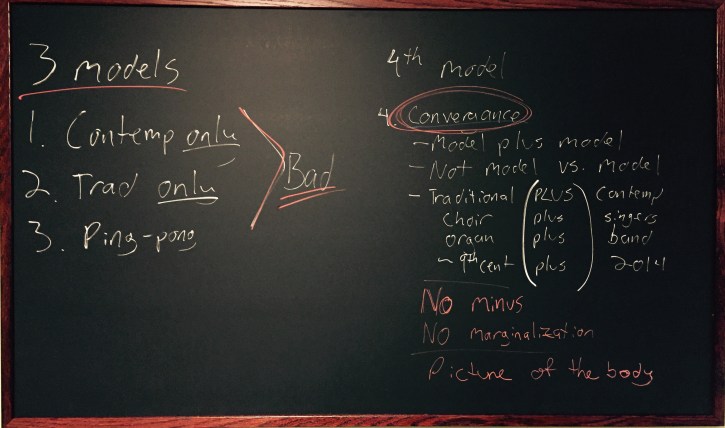
There are three common music models in western/protestant/liturgical churches these days:

1. The traditional model. The music is almost exclusively classical, and any contemporary elements are on the fringes.

2. The contemporary model. The music is almost exclusively modern, and any traditional elements are on the fringes.

3. The ping-pong model. There’s a traditional side and a contemporary side. Each side gets its turn, at its own service, or with its own songs, and there isn’t a whole lot of unity or cooperation.

Is it possible for a church with a history of a traditional music program (choir, organ, hymnals, handbells, etc.) to embrace modern forms of music (bands, vocalists, projected lyrics, “worship teams”, etc.) without the traditional music dying as a result?

Yes, it is possible. And that’s what my church, our congregation, our choir, our instrumentalists, and I are pursuing these days.

We’re pursuing a fourth model, which is called “convergence”. Maybe you call it “blended”. It allows for vibrant traditional music, and vibrant contemporary music, and it puts them together in one combined expression. Choir plus singers. Organ plus band. Traditional plus contemporary. 6th century plus 21st century. Liturgy plus spontaneity. We can play ping-pong when it’s called for, but we play together most of the time.

This “convergence” model accomplishes several things:
1. It’s faithful to our past
2. It builds a bridge to the future, and to those from outside our traditions
3. It’s a picture of the body (independence and interdepence)
4. It’s alive and messy and risky and new and exciting
5. It’s about addition, not about subtraction

Most importantly,

6. It demonstrates our unity in Christ

What does this model mean for a traditional church choir?

This model embraces the choir and calls them further up and further in. Is it different? Yes. Is it the traditional model? No. Is it calling more or less out of the choir than before? More!

In this model of musical “convergence”, being a member of the choir is not just about singing the anthem. It’s about singing and leading all of the songs in a service from beginning to end. From the call to worship to the final hymn. Every note of every song being an opportunity for the choir to fulfill a worship leading role, a congregational-singing-cultivating role, a visible role, an audible role, and a pastoral role. From challenging repertoire, to simple liturgical responses, to contemporary songs that will only (and should only) be in our repertoire for shorter seasons, the choir is being called to be an integral worship leading presence on all of it.

Here’s the kicker about “convergence”:

The addition of new things does not mean the subtraction of older things.

The experimentation with new forms does not mean the elimination of older forms. The birth of new songs does not mean the death of old songs. New singers and musicians on the platform don’t mean the replacement of other singers and musicians. We must force ourselves to think in terms of addition and multiplication, not subtraction and division.

The motto of “convergence” is “More! Older! Newer! All of it!” It’s leaning into what God’s doing, it’s being willing to be messy and make mistakes, and it’s trusting that the foundations are strong enough to handle adding some new structures. This isn’t demolition, it’s expansion. There aren’t any wrecking balls in sight, only more bricks.

And the Cornerstone isn’t going anywhere.

Classical musicians need not run in fear at the sight of an electric guitar. A drummer need not be banished to the youth room, hidden behind plexiglass, and surrounded by foam. Traditional choral repertoire need not be thrown into the trash can. There has to be a way for musical convergence to work. It can work when we love one another, when we keep the congregation singing along, when we exalt Christ above all things and above all preferences, and when we’re willing to take risks in an atmosphere permeated with God’s grace.

Here’s to keeping on trying to make musical convergence work!

Pointing At The Same Thing From Different Angles

1In his book Christ Centered Worship, Bryan Chappel suggests eight components to a “gospel structure” for corporate worship, drawing from the narrative of Isaiah 6:

  1. Adoration (recognition of God’s greatness and grace)
  2. Confession (acknowledgement of our sin and need for grace)
  3. Assurance (affirmation of God’s provision of grace)
  4. Thanksgiving (expression of praise and thanks for God’s grace)
  5. Petition and Intercession (expression of dependence on God’s grace)
  6. Instruction (acquiring the knowledge to grow in grace)
  7. Communion/Fellowship (celebrating the grace of union with Christ and his people)
  8. Charge and Blessing (living for and in the light of God’s grace)

Worship leaders need to keep this structure in their minds when they’re planning services. To think through the placement of songs and different elements in such a way that coherently and cohesively tells the story of the gospel, it’s helpful to frame it against the narrative from Isaiah 6, like Bryan Chappel’s “eight components” so helpfully do.

Within this gospel structure there is a large amount of freedom. That’s the beauty of it. For worship leaders, it allows for all sorts of songs, kinds of songs, topics of songs, and “moods” of songs. It’s not so narrow that it’s limiting, and it’s not so broad that it’s maddening. Amazingly, yet not surprisingly, the gospel works.

And so it’s unfortunate when worship leaders, seeking to faithfully lead worship within this wonderful gospel structure, get stuck in an every-four-minutes spin-cycle, which re-sets with every song, and by the end of the progression of songs, hasn’t actually progressed anywhere at all.

If I had to summarize this spin-cycle, it would be:
1. Confession (I am a worm)
2. Assurance (God saved me through Christ)
3. Thanksgiving (I’m grateful!)

And then that song ends, and the next one begins, and we sing the same three points again. It’s like we’re afraid of betraying the core of the gospel if we dare to have a progression from point A to any point between B and Z, and take the risk of having our congregation articulate responses to the gospel, within an Isaiah 6 gospel structure, that might go beyond the bulletproof safety zone that requires fairly little ingenuity from week to week.

It seems like some worship leaders get the idea that every song needs to say the same thing, in the same way, using the same formula, following the same trajectory, and focusing on the same pillars of the gospel. The pillars are there for a reason: to provide a structure. So let the gospel structure free you and inform you, but not constrain you. Focusing on the same pillars in the same way from song to song is what I’m describing as the spin-cycle which can end up robbing our people of the opportunity to explore the unsearchable greatness of God.

If we sing the same three (or so) structural points, starting over with every song, we portray the gospel as myopic, the glories of God as describable, the implications of Christ’s finished work as easily summarizable, and our response as containable. Instead, we should feel free to use as wide a musical/lyrical/thematic vocabulary as possible, clearly within a gospel structure, but expansively and robustly broad, helping our people exalt a God whose glories couldn’t be fittingly exalted even if we had a thousand tongues.

It’s a huge and tragic problem when churches have no structure to their theology of worship, jump from theme to theme, follow no recognizable progression, and occasionally happen to land on the gospel when a song conveniently mentions it.

But it’s also a problem when churches/worship teams get stuck in a worship spin-cycle, failing to show any other angle of the indescribably beautiful gospel besides the one they’ve come to believe they grasp. Healthy gospel structures, like the one derived from the account in Isaiah 6, free us to exalt a God of grace, who redeemed us through his Son, and has sent his Spirit. Unhealthy gospel structures, and yes, I’m saying there can be such things, constrain us and limit us to see the bullet points instead of the masterpiece.

A tour guide at the Grand Canyon is always pointing to the Grand Canyon. And to help his group see more of the beauty of the Grand Canyon, he takes them on a journey from overlook to overlook. They don’t just stand in one place and look at it from the same angle. The scope of the Grand Canyon can’t be captured from one spot.

Similarly, a worship leader is always pointing to Jesus. And to help his congregation see more of the beauty of Jesus, he takes them on a journey from song to song. They don’t just stand in one place and sing from the same angle. The glory of God, revealed in the face of Jesus Christ, can’t be captured from one spot.

You can point to the same thing from different angles. That’s what a gospel structure ensures!

So let’s avoid the false security of the every-four-minute spin cycle, saying the same thing, and saying it in the same way. Turn the seat-belt sign off and move around the cabin!

Getting Into a Worship Leading Career After College

1

Last week I received an email from a senior in high school who’s discerning a possible call to a career in worship ministry, and is experiencing some push-back and questioning from her family who tell her she’s crazy. She asked a lot of good questions, basically trying to find out whether or not she’s… well… crazy.

Here’s what I said:

There are always churches looking to hire full-time worship leaders. Churches all across the country, in any city of any state. There are lots of employment options for people looking for worship leader jobs, but in order to be attractive to a potential church, you’ll need to able to show that you can do several things.

First, can you manage a music program? The budget/volunteers/scheduling/rehearsals/long-term planning/meetings/emails/auditions/Christmas/Easter/administrative/etc? To prove this, I’d recommend you start getting your hands dirty as soon as possible. Intern with a music program at a church somewhere. Start getting as much experience as you possibly can!

Second, can you lead worship well? Are you able to plan a cohesive service, effectively using songs to help people glorify God? Can you lead a band, or a choir, or an orchestra? You don’t need to be able to lead all of those types of ensembles, but if you can’t lead any of them, you’ll have a hard time getting a job. Again, the best way to prove this to a potential church is to do it consistently and well in some sort of setting. Most churches will not hire a worship leader with no regular worship leading experience. An internship somewhere can provide this, or better yet, enter into the “market” via an assistant/part-time/associate position, where you can gain experience, show your skills, learn your craft, make mistakes, and become more polished.

Third, are you a leader? Do people want to follow you? Will a congregation respond positively to your leadership and your musical abilities? Will a pastor look at your application and think “she’d help my congregation grow” or think “next…” The stronger you become as a leader, the better the odds that you’ll get a good position somewhere.

Start small. Build a good foundation. Pursue your education. Study music. Study theology. Lead worship/rehearsals/services as much as you can. Say “yes” to whatever worship leading opportunities come your way. This will help you grow!

Don’t worry about the naysayers, but do listen to whatever wisdom they have to offer. If you’ve been called by God to this ministry, then he will equip you.

(Related post: Getting Experience Makes You Experienced.)

Thinking Like a Non-Musician

1It’s hard for musicians to turn off their musician brains. We hear, notice, and pick apart things that a non-musician would never notice. For example: the snare drum hitting on the wrong beat, the bass playing the fundamental instead of the 3rd, the alto singing the wrong fourth note of that measure, the electric guitarist using the wrong kind of delay, or (one of my favorite pet peeves that a non-musician or non-guitarist would never notice) an acoustic guitarist hitting the bottom E string when he/she shouldn’t be.

Our brains are trained over time, through lessons, and with practice, to pick up on mistakes, inconsistencies, tonal conflicts, rhythmic errors, or just an all around lack of cohesiveness. We learn to spot the problem and identify how to fix it: whether it’s fixing our own fingers/voices, or helping someone else fix their issue(s).

Musicians notice specifics. Non-musicians usually don’t (except for when they’re glaringly obvious). They notice generalities.

It’s good for worship leaders to think like a musician, and notice specifics. But it’s also good to think like a non-musician and notice generalities.

Most people in your congregation are non-musicians. And here are some things you need to know about them:

– They don’t notice the musical minutiae. They seriously don’t hear the things you hear.
– They do notice musical excellence. They can tell when something is working and gelling.
– They don’t notice the intricate details. Their ears aren’t trained to pick up on that stuff.
– They do notice when something (vague) feels off (generally). They don’t know what it was, though, until you tell them.
– They don’t notice tiny mistakes, especially when the musicians play them off graciously and cover for one another.
– They do notice when there’s tension between musicians on stage.
– They don’t spend all of Sunday afternoon/Monday morning going back over all the musical details in their minds.
– They do remember singable melodies and grasp-able lyrical phrases.

So, you go ahead focusing on the details, and the specifics, and the minutiae, and the intricacies that combine together to form musical excellence and skill. But don’t let all that work get to your head. One way to stay humble is to also be thinking like a non-musician. Most of what you’re obsessing over will not be noticed by most people in your congregation, except for a few. Instead, they’ll notice the final result and the general fruit.

Hopefully your musical brain can produce something in addition to musical things only musicians will notice. Aim to produce a clear and compelling invitation for people to feast on Jesus. A musical invitation that’s skillful, excellent, and aimed at engaging as many people in your congregation as possible. That’s an invitation that musicians and non-musicians alike can accept.

Lord I Need You… Really I Do

1This morning I led two songs of worship at our staff meeting. About 40 of us gathered in a circle, and after we read Psalm 135 responsively, I launched into “Come Thou Fount of Every Blessing”. The staff here loves to sing, and the song went well, with a few repeats thrown in here and there as it felt appropriate. That song ended and I transitioned into “Lord, I Need You”.

Everything was going fine. Good lyrics, good keys, the people were singing, I was relaxed, and there weren’t any issues.

One small problem. I forgot that “Lord, I Need You” is in 4/4, not 3/4. We sang a few lines of it in the wrong time signature and everything felt off. Really off. I wasn’t quite sure what I was doing wrong. So, I stopped. I said something like “so, I think I just forgot how this song goes…” Someone helpfully pointed out that I “left out an extra beat”. We laughed about it, we started over, and everything was fine. I felt silly, a bit embarrassed, and honestly, I felt humbled.

I had put together a fine 2-song set for an early morning staff meeting. I was doing a good job. But then I made a silly rookie mistake. And ironically, it was on a song titled “Lord, I Need You”.

So, two lessons:

1. Mistakes happen. Sometimes you can cover them up. But sometimes you can’t, so own up to them, laugh about them, and move on.

2. God has a sense of humor. I will never sing “Lord, I Need You” the same way. Now I’ll really mean those words!

Be careful out there, worship leaders. God is waiting just around the corner to teach you new lessons and keep you humble.