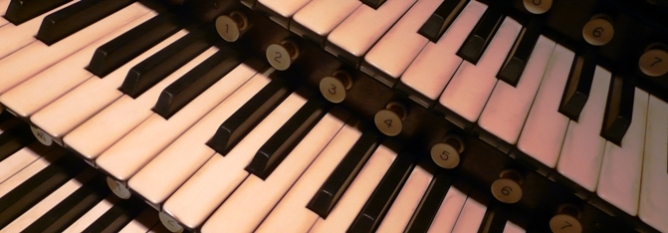
 One of my favorite organist jokes goes like this:
What’s the difference between an organist and a terrorist?
You can negotiate with a terrorist.
It’s a funny joke that quickly gets at the heart of the reputation organists have of being unbendable, inflexible, unwilling to take direction, and impossible to work with.
Many “contemporary” worship leaders would nod their heads at that last paragraph, immediately thinking of organists who have refused to play along either out of disdain for “pop” music or an inability to work off of chord charts or simple lead sheets. Because of this disconnect between organists and contemporary musicians, a dividing wall is built up (with varying levels of hostility depending on the egos involved) that results in the worship team standing on the side lines while the organist does his/her thing, and vice versa.
And because of this, when organists get together to tell their own jokes about guitarists, the punch lines in the other direction aren’t any more gracious than the one I told above. We each equate the other person to being (worse than) a terrorist and go on our own way not negotiating with them out of a matter of egotistical security.
It doesn’t have to be this way. Contemporary musicians and organists can (and should) play well together. There is no reason to take an “either/or” approach to organs and guitars, or organs and drums. Organs don’t have to be seen as a relic, and amplifiers don’t have to be seen as the enemy. We can laugh at our reputations (and sarcastic jokes) with good humor, reaching out to each other in mutual submission. The results might be a bit messy, and we might break some musical rules, but the Church will be edified, and the musical traditions that have been passed down won’t be abandoned.
As a life-long Anglican, almost every church I’ve ever attended has had an organ as a central instrument in its worship life. And in every one of those churches where organs have been central, I have come along with my guitar, (and usually my drums-playing brother too), and tried my hand at the “playing well together” approach.
I made some huge mistakes early on.
- I assumed the organist couldn’t/didn’t want to play along, so I didn’t even give them music or communicate with them.
- If I did give them music, they were simple chord charts (lyrics and chords), which, for many organists, are complete nonsense.
- I didn’t try to build a relationship with the organist.
- I secretly wanted to see the organ disappear.
- I looked at my (at that point) 1-2 years of experience leading worship for a youth group as being superior to their decades of playing, lessons, studying, and degrees.
- I saw things in terms of superior/inferior.
Needless to say, in those early years, the organists and I saw each other more like terrorists and less like partners.
There came a shift for me when I came (as a high schooler) to Truro Anglican Church in Fairfax, where I’m now (God has a sense of humor) the Director of Worship and Arts. It was the first time I had seen drums/organ/guitars/strings/descants/synthesizers all “blended” together without killing each other in the process. It was messy. But it was wonderful.
I drank it up for a few years before God called to me to another church, The Falls Church Anglican, where for a decade I would continue along as the contemporary guy attempting to bridge the divide with the classical guys. Sometimes it worked. Sometimes it didn’t. But most of the time it worked, and I learned some lessons about how to play well with organists.
Here are ten of them.
- Be humble. Organists have been taught (seriously) that you are the enemy. Disarm them (if they believe this) by being humble.
- Be winsome. Kill the elephant in the room by making fun of it. You’re a guitarist. You don’t read music. They’re an organist. They can play Bach for hours without messing up once. You’re trying to work together. It’s hilarious. Laugh about it.
- Ask them specifically for their help. You have a guitar. Or you have 88 piano keys. They have an entire orchestra at their fingertips for crying out loud. They have something to add, and the fact that you’re humbly and winsomely asking them for help is even more wonderfully disarming.
- Give them specific instructions. Don’t tell them how to play organ (since you have no idea), but at least try to walk them through the whole song and say “on the intro do something like this, on verse one don’t play, on the first chorus how about something like this…” and so on.Some organists like improvising. Most do not. But all organists are quite used to having very specific music with every single note, every dynamic change, and every volume swell specifically laid out. If all you give them is a chord chart strewn with mistakes, then they’re going to politely slide off the organ bench and be frustrated. They will appreciate (and do better) if you’re very specific about what you want.
- Embrace the awkward. It might sound a little muddled. There might be too much bass in the room if the pedals are walking all over the bass guitar. The organist might get a little loud. Whatever. Who cares. You’re demonstrating something very sweet and God-honoring. In ten years no one will remember how it sounded, but they will remember such a powerful display of musical unity.
- Music matters. If their brain is able to improvise off of a chord chart, then that’s wonderful (maybe). But organists usually like a little more than lyrics or chords, so be willing to go through the work to get them sheet music, and to tailor your arrangement to work with the sheet music they’ve been given. If the song you want to use is a hymn, you can use the hymnal arrangement and ask the organist to write out the chords for you. Or if the song is on CCLI’s SongSelect, you can print out the lead sheets or 4-part vocal score. Or (gasp) actually buy the actual sheet music.
- Include them as a member of your team. It’s hard for you all to consider each other enemies when you’re getting pizza together after rehearsal, or hanging out together in between services eating donuts. Mmm. Pizza and donuts. Now there’s a winning combo!
- Turn them loose. Let them do their preludes and postludes with as much bombast as they want. Give them hymns and anthems to accompany that let them use all their skills to their fullest. Then ask them to play with just as much intentionality (yet more constraints) on the songs you’re leading.
- Don’t talk, socialize, or set-up and tear-down equipment during their preludes or postludes. It annoys them.
- Learn from them. They probably have some really good arrangement ideas. They might be able to teach you a lot about music theory. Who knows – they might even be willing to give you organ lessons. Then you’ll become one of them and they will have won!
Do what you can to try to make this work. It will be awkward. You’ll be speaking different languages. But it just might be a wonderful blessing, and a practical demonstration of the reconciling power of the gospel.
 This picture is of me with Harold at about midnight in the kitchen in Bob and Julie Kauflin’s home. Having the privilege of spending time with those two men, both of them heroes of mine, is one that I will always remember and cherish. I was almost unable to attend the conference, but thanks to a friend’s generous gift of Delta SkyMiles, I was able to go at the last minute. God provided, if for no other reason, than so I could have the chance to say “thank you” to Harold Best.
 I’m afraid I might have started something…
 Ineffective and unenjoyable rehearsals are worship team morale killers and congregational engagement limiters. The more your team is out of sync with itself, the less your team is able to function like a healthy body, operating in the way that it should, and unable to meet its responsibility to the congregation it stands before on Sundays.
 I’m always on the lookout for good, congregational, theologically rich worship songs. It can be a challenge sometimes to fill this spot in my church’s repertoire. Last year I set out to write one, and got some ideas when I was reminded of the “Te Deum”, an ancient Christian prayer/hymn.
 Worthily Magnify