Worship Leaders, Love Your Families

1Just a little over ten years ago I started in full-time ministry as a single guy, with no children, and all the flexibility in the world to build my work schedule around my commitments and my interests.

Fast forward to today and I’m happily married with three little girls. Now, my schedule and my commitments have a direct impact on the four people who share a home with me. When I’m home, when I’m not home, what nights (and how many nights) I’m out of the house at bedtime, how early I leave in the morning, whether or not I miss dinner, whether or not I’m distracted by my emails/unfinished work on my laptop or phone, whether or not I have the time to unload the dishwasher before I leave for work, and whether or not I actually take time off, has ramifications that extend far beyond what I may feel like doing, or what I’m told I “need” to do.

Now I have a choice, I can continue to build my calendar based on what’s good for me, or based on what’s best for my family. And this choice is made in a hundred different ways, through little things that add up.

It’s all well and good for me to get to the church office, or get to rehearsal, or get to a service for which I’m leading worship, but if I prioritize these things over the needs of my family, then something isn’t quite right. The rubber meets the road with a spouse and/or kids at home. If my most valuable commodity really is my time, then how I decide to spend that time will determine what I value.

Yes, there are busy seasons, there are sacrifices you and your family make, and your work commitments will occasionally cause strain within your family.

But in order to value your family as you should, you simply have to protect your time with them, especially at the times that really (and practically) matter.

You have to say no to certain things. You have to guard your evenings and days off as the property of your family, and keep people from intruding on that property more than they should. You have to think of little things you can initiate that add up to big things like lunches or quick coffees with your family in the midst of a busy day. You have to love your families more than you love your job, and you have to realize that the loudest way you can proclaim this love for them is by your presence with them when they need it.

Back in July, my amazing wife Catherine shared her perspective as a ministry wife in her post “From a Worship Leader’s Wife“. She shared some good insight for wives about how to support their husbands in ministry, and I was glad to see it bless a lot of different readers.

A few days ago we got a question on that post from a worship leader’s wife who is struggling with the the demands of ministry, especially with a toddler at home. Catherine responded to her in the comment thread, and I’d encourage wives of worship leaders to check it out if they need encouragement.

But this post today is aimed at the men who, like me, have a family at home while we’re doing our worship leader thing. And my main point is this: prioritize time with your family over time at work. As much as possible, submit your own schedule to the needs of your wife and kids. Be physically present. Be home at bedtime and then rush back to church for evening meetings if you need to. Take Sundays off even if things won’t go as smoothly without you there. Be late to things. Have strong boundaries. Whatever it takes, for your particular family, and their particular needs. This might mean you’re not in your office as much as some other people around you. But who cares? Worship leaders, love your families.

Six Mistakes You Shouldn’t Make When Disciplining (or Correcting) a Worship Team Member

1One of the responsibilities of worship leaders is to build and cultivate a community of fellow musicians to help serve the congregation in leading worship. You can call that community a worship team, worship band, praise team, praise band, band, or whatever term you come up with. Whatever you call it, it can be a great joy to lead this kind of community of fellow-musicians. It can also be really difficult. 

Musicians have the infamous artistic temperament that makes them not only opinionated, and not only comfortable sharing those opinions, but turns those opinions into “rights”. Musicians then want to protect their rights and their territories against anyone who would seek to invade. Plus, they’re sinners like everyone else.

From time to time, if you’re a worship leader attempting to lead a healthy worship team, you will be faced with difficult situations when you’ll need to bring correction to one of your fellow musicians, or in more difficult situations, bring discipline. You will lose sleep over these situations, and you will want to avoid them. But sometimes it will be clear to you that you need to address an issue with a member of your team. 

Here are six mistakes I’ve made, that you shouldn’t make, when disciplining or correcting a worship team member.

1. Interact Primarily Over Email
If at all possible, avoid the use of email from beginning to end. The more difficult the type of interaction, the more healthy it is. A face to face conversation is crucial. If that’s impossible, then a phone call. Under no circumstances should you interact over email. Emails can be so much more easily misinterpreted, misread, forwarded, blind-copied, and saved forever. Pretend you’re handling this before the invention of the computer.

2. Insist On Meeting On Your Turf
Do not insist that the meeting take place on church property, or in your office. That’s your turf, not theirs, and it will immediately cause their defenses to go up. Not good. Find a neutral place, and a public place, for both of you. A coffee shop or a restaurant. This will level the playing field and increase the odds of a relaxed atmosphere.

3. Handle It All By Yourself
You have people over you. Take advantage of their covering. The single most stupid thing I’ve done when I’ve had to deal with a difficult issue is to keep it from my pastor until it had blown up. Consult him, ask him what you should do, have your pastor in the meeting with you, and keep him totally in the loop. Don’t put yourself in a position to take all the bullets or do/say something unwise. Use the covering God has put over you.

4. Let It Simmer
So a band member has a profanity-laced temper tantrum at rehearsal. The rest of the team is shocked. You’re shocked. They’re all wondering if you’re going to address it. Tension is building. Don’t let it simmer. You might not think stopping rehearsal is wise, but address it before the guy goes home. It might be easier in the short-term to let things slide, but in the long-term it will build tension and pressure in your team that will be unhealthy.

5. Don’t Know What Outcome You Want
On a scale of 1 – 5, 1 being minor correction (i.e. I can tell you didn’t practice one single bit and that’s why you ruined half of the songs) and 5 being major correction (i.e. I need to ask you to step down from the team for a while), you need to know what you want for the person. If you go into a meeting/conversation with the person without an acceptable outcome in mind, then you could very likely get trampled on. 

6. Be Unwilling to Apologize
You’re not perfect. You don’t communicate with your team as well as you could. You lead a rehearsal on an empty stomach and say something mean-spirited to your drummer. You ask a singer to sing a song you know he or she can’t pull off. It could be anything. Be the first to apologize, the first to show contrition and humility, and genuinely ask forgiveness for things you’ve done wrong. Even if your apology isn’t reciprocated, you’ve done the right thing and will get a better night’s sleep even if the meeting doesn’t end the way you hoped.

It’s a great joy to lead a worship team. It’s also hard work. If you’re faithful and consistent in the hard things, then the joy, morale, and unity on your team will increase. If you avoid the hard things, then no one will be happy.

The Problem with Gospel Amnesia

1Forgetting your identity in Christ will mess you up in lots of ways. Especially when you’re in ministry.

Paul Tripp describes a “gospel amnesiac” as someone who forgets their identity in Christ. And based on this definition, we’re all gospel amnesiacs. Every single one of us.

And this messes us up because, as Paul Tripp said at the Doxology and Theology conference this past November, when we forget what’s already been secured for us vertically (i.e. in Christ), we search for it horizontally (i.e. from the people around us).

We forget that we’re fully loved in Christ, and so we try to make everyone in our congregation like us (and it crushes us when they don’t).

We forget that we’re forgiven in Christ, and so we rehearse our mistakes in our minds and allow our failures to become chains around our ministry ankles.

We forget that in Christ, God speaks words of love over us, and so we’re haunted by angry, critical words hurled at us by hurting people.

We forget that we’re free in Christ, and so we become enslaved to performing a certain way, pleasing a certain power bloc, or perpetuating a certain system.

We forget that in Christ, we are adopted by God as sons and daughters, and so we’re constantly needy of affirmation and compliments in order to fill the father void.

Gospel amnesiacs are always looking around them to receive what’s already been given to them in Christ. Under the pressures of ministry, our insecurity becomes crippling. By forgetting our identity in Christ, we become walking beggars, looking for crumbs of horizontal approval, instead of remembering that we already have everything we need.

Look up to Jesus. Keep your eyes on him and walk straight ahead following his path through the valleys and peaks of ministry.

Look around you to Godly, grace-filled people. They will remind you of the gospel when (not if) you forget it.

Look past the distractions of temporary approval, fame, likability, status, or any other criteria you’ve set up to determine your identity.

Your identity is secure in Christ!

The Embrace of Musical Convergence (And Its Implications for Traditional Church Choirs)

Convergence

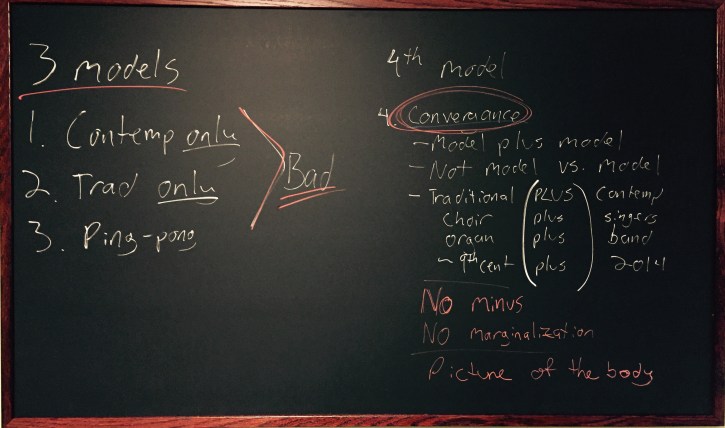
There are three common music models in western/protestant/liturgical churches these days:

1. The traditional model. The music is almost exclusively classical, and any contemporary elements are on the fringes.

2. The contemporary model. The music is almost exclusively modern, and any traditional elements are on the fringes.

3. The ping-pong model. There’s a traditional side and a contemporary side. Each side gets its turn, at its own service, or with its own songs, and there isn’t a whole lot of unity or cooperation.

Is it possible for a church with a history of a traditional music program (choir, organ, hymnals, handbells, etc.) to embrace modern forms of music (bands, vocalists, projected lyrics, “worship teams”, etc.) without the traditional music dying as a result?

Yes, it is possible. And that’s what my church, our congregation, our choir, our instrumentalists, and I are pursuing these days.

We’re pursuing a fourth model, which is called “convergence”. Maybe you call it “blended”. It allows for vibrant traditional music, and vibrant contemporary music, and it puts them together in one combined expression. Choir plus singers. Organ plus band. Traditional plus contemporary. 6th century plus 21st century. Liturgy plus spontaneity. We can play ping-pong when it’s called for, but we play together most of the time.

This “convergence” model accomplishes several things:
1. It’s faithful to our past
2. It builds a bridge to the future, and to those from outside our traditions
3. It’s a picture of the body (independence and interdepence)
4. It’s alive and messy and risky and new and exciting
5. It’s about addition, not about subtraction

Most importantly,

6. It demonstrates our unity in Christ

What does this model mean for a traditional church choir?

This model embraces the choir and calls them further up and further in. Is it different? Yes. Is it the traditional model? No. Is it calling more or less out of the choir than before? More!

In this model of musical “convergence”, being a member of the choir is not just about singing the anthem. It’s about singing and leading all of the songs in a service from beginning to end. From the call to worship to the final hymn. Every note of every song being an opportunity for the choir to fulfill a worship leading role, a congregational-singing-cultivating role, a visible role, an audible role, and a pastoral role. From challenging repertoire, to simple liturgical responses, to contemporary songs that will only (and should only) be in our repertoire for shorter seasons, the choir is being called to be an integral worship leading presence on all of it.

Here’s the kicker about “convergence”:

The addition of new things does not mean the subtraction of older things.

The experimentation with new forms does not mean the elimination of older forms. The birth of new songs does not mean the death of old songs. New singers and musicians on the platform don’t mean the replacement of other singers and musicians. We must force ourselves to think in terms of addition and multiplication, not subtraction and division.

The motto of “convergence” is “More! Older! Newer! All of it!” It’s leaning into what God’s doing, it’s being willing to be messy and make mistakes, and it’s trusting that the foundations are strong enough to handle adding some new structures. This isn’t demolition, it’s expansion. There aren’t any wrecking balls in sight, only more bricks.

And the Cornerstone isn’t going anywhere.

Classical musicians need not run in fear at the sight of an electric guitar. A drummer need not be banished to the youth room, hidden behind plexiglass, and surrounded by foam. Traditional choral repertoire need not be thrown into the trash can. There has to be a way for musical convergence to work. It can work when we love one another, when we keep the congregation singing along, when we exalt Christ above all things and above all preferences, and when we’re willing to take risks in an atmosphere permeated with God’s grace.

Here’s to keeping on trying to make musical convergence work!

How to Play Well with Organists

1One of my favorite organist jokes goes like this:

What’s the difference between an organist and a terrorist?
You can negotiate with a terrorist.

It’s a funny joke that quickly gets at the heart of the reputation organists have of being unbendable, inflexible, unwilling to take direction, and impossible to work with.

Many “contemporary” worship leaders would nod their heads at that last paragraph, immediately thinking of organists who have refused to play along either out of disdain for “pop” music or an inability to work off of chord charts or simple lead sheets. Because of this disconnect between organists and contemporary musicians, a dividing wall is built up (with varying levels of hostility depending on the egos involved) that results in the worship team standing on the side lines while the organist does his/her thing, and vice versa.

And because of this, when organists get together to tell their own jokes about guitarists, the punch lines in the other direction aren’t any more gracious than the one I told above. We each equate the other person to being (worse than) a terrorist and go on our own way not negotiating with them out of a matter of egotistical security.

It doesn’t have to be this way. Contemporary musicians and organists can (and should) play well together. There is no reason to take an “either/or” approach to organs and guitars, or organs and drums. Organs don’t have to be seen as a relic, and amplifiers don’t have to be seen as the enemy. We can laugh at our reputations (and sarcastic jokes) with good humor, reaching out to each other in mutual submission. The results might be a bit messy, and we might break some musical rules, but the Church will be edified, and the musical traditions that have been passed down won’t be abandoned.

As a life-long Anglican, almost every church I’ve ever attended has had an organ as a central instrument in its worship life. And in every one of those churches where organs have been central, I have come along with my guitar, (and usually my drums-playing brother too), and tried my hand at the “playing well together” approach.

I made some huge mistakes early on.

  • I assumed the organist couldn’t/didn’t want to play along, so I didn’t even give them music or communicate with them.
  • If I did give them music, they were simple chord charts (lyrics and chords), which, for many organists, are complete nonsense.
  • I didn’t try to build a relationship with the organist.
  • I secretly wanted to see the organ disappear.
  • I looked at my (at that point) 1-2 years of experience leading worship for a youth group as being superior to their decades of playing, lessons, studying, and degrees.
  • I saw things in terms of superior/inferior.

Needless to say, in those early years, the organists and I saw each other more like terrorists and less like partners.

There came a shift for me when I came (as a high schooler) to Truro Anglican Church in Fairfax, where I’m now (God has a sense of humor) the Director of Worship and Arts. It was the first time I had seen drums/organ/guitars/strings/descants/synthesizers all “blended” together without killing each other in the process. It was messy. But it was wonderful.

I drank it up for a few years before God called to me to another church, The Falls Church Anglican, where for a decade I would continue along as the contemporary guy attempting to bridge the divide with the classical guys. Sometimes it worked. Sometimes it didn’t. But most of the time it worked, and I learned some lessons about how to play well with organists.

Here are ten of them.

  1. Be humble. Organists have been taught (seriously) that you are the enemy. Disarm them (if they believe this) by being humble.
  2. Be winsome. Kill the elephant in the room by making fun of it. You’re a guitarist. You don’t read music. They’re an organist. They can play Bach for hours without messing up once. You’re trying to work together. It’s hilarious. Laugh about it.
  3. Ask them specifically for their help. You have a guitar. Or you have 88 piano keys. They have an entire orchestra at their fingertips for crying out loud. They have something to add, and the fact that you’re humbly and winsomely asking them for help is even more wonderfully disarming.
  4. Give them specific instructions. Don’t tell them how to play organ (since you have no idea), but at least try to walk them through the whole song and say “on the intro do something like this, on verse one don’t play, on the first chorus how about something like this…” and so on.Some organists like improvising. Most do not. But all organists are quite used to having very specific music with every single note, every dynamic change, and every volume swell specifically laid out. If all you give them is a chord chart strewn with mistakes, then they’re going to politely slide off the organ bench and be frustrated. They will appreciate (and do better) if you’re very specific about what you want.
  1. Embrace the awkward. It might sound a little muddled. There might be too much bass in the room if the pedals are walking all over the bass guitar. The organist might get a little loud. Whatever. Who cares. You’re demonstrating something very sweet and God-honoring. In ten years no one will remember how it sounded, but they will remember such a powerful display of musical unity.
  2. Music matters. If their brain is able to improvise off of a chord chart, then that’s wonderful (maybe). But organists usually like a little more than lyrics or chords, so be willing to go through the work to get them sheet music, and to tailor your arrangement to work with the sheet music they’ve been given. If the song you want to use is a hymn, you can use the hymnal arrangement and ask the organist to write out the chords for you. Or if the song is on CCLI’s SongSelect, you can print out the lead sheets or 4-part vocal score. Or (gasp) actually buy the actual sheet music.
  3. Include them as a member of your team. It’s hard for you all to consider each other enemies when you’re getting pizza together after rehearsal, or hanging out together in between services eating donuts. Mmm. Pizza and donuts. Now there’s a winning combo!
  4. Turn them loose. Let them do their preludes and postludes with as much bombast as they want. Give them hymns and anthems to accompany that let them use all their skills to their fullest. Then ask them to play with just as much intentionality (yet more constraints) on the songs you’re leading.
  5. Don’t talk, socialize, or set-up and tear-down equipment during their preludes or postludes. It annoys them.
  6. Learn from them. They probably have some really good arrangement ideas. They might be able to teach you a lot about music theory. Who knows – they might even be willing to give you organ lessons. Then you’ll become one of them and they will have won!

Do what you can to try to make this work. It will be awkward. You’ll be speaking different languages. But it just might be a wonderful blessing, and a practical demonstration of the reconciling power of the gospel.