Six Mistakes You Shouldn’t Make When Disciplining (or Correcting) a Worship Team Member

1One of the responsibilities of worship leaders is to build and cultivate a community of fellow musicians to help serve the congregation in leading worship. You can call that community a worship team, worship band, praise team, praise band, band, or whatever term you come up with. Whatever you call it, it can be a great joy to lead this kind of community of fellow-musicians. It can also be really difficult. 

Musicians have the infamous artistic temperament that makes them not only opinionated, and not only comfortable sharing those opinions, but turns those opinions into “rights”. Musicians then want to protect their rights and their territories against anyone who would seek to invade. Plus, they’re sinners like everyone else.

From time to time, if you’re a worship leader attempting to lead a healthy worship team, you will be faced with difficult situations when you’ll need to bring correction to one of your fellow musicians, or in more difficult situations, bring discipline. You will lose sleep over these situations, and you will want to avoid them. But sometimes it will be clear to you that you need to address an issue with a member of your team. 

Here are six mistakes I’ve made, that you shouldn’t make, when disciplining or correcting a worship team member.

1. Interact Primarily Over Email
If at all possible, avoid the use of email from beginning to end. The more difficult the type of interaction, the more healthy it is. A face to face conversation is crucial. If that’s impossible, then a phone call. Under no circumstances should you interact over email. Emails can be so much more easily misinterpreted, misread, forwarded, blind-copied, and saved forever. Pretend you’re handling this before the invention of the computer.

2. Insist On Meeting On Your Turf
Do not insist that the meeting take place on church property, or in your office. That’s your turf, not theirs, and it will immediately cause their defenses to go up. Not good. Find a neutral place, and a public place, for both of you. A coffee shop or a restaurant. This will level the playing field and increase the odds of a relaxed atmosphere.

3. Handle It All By Yourself
You have people over you. Take advantage of their covering. The single most stupid thing I’ve done when I’ve had to deal with a difficult issue is to keep it from my pastor until it had blown up. Consult him, ask him what you should do, have your pastor in the meeting with you, and keep him totally in the loop. Don’t put yourself in a position to take all the bullets or do/say something unwise. Use the covering God has put over you.

4. Let It Simmer
So a band member has a profanity-laced temper tantrum at rehearsal. The rest of the team is shocked. You’re shocked. They’re all wondering if you’re going to address it. Tension is building. Don’t let it simmer. You might not think stopping rehearsal is wise, but address it before the guy goes home. It might be easier in the short-term to let things slide, but in the long-term it will build tension and pressure in your team that will be unhealthy.

5. Don’t Know What Outcome You Want
On a scale of 1 – 5, 1 being minor correction (i.e. I can tell you didn’t practice one single bit and that’s why you ruined half of the songs) and 5 being major correction (i.e. I need to ask you to step down from the team for a while), you need to know what you want for the person. If you go into a meeting/conversation with the person without an acceptable outcome in mind, then you could very likely get trampled on. 

6. Be Unwilling to Apologize
You’re not perfect. You don’t communicate with your team as well as you could. You lead a rehearsal on an empty stomach and say something mean-spirited to your drummer. You ask a singer to sing a song you know he or she can’t pull off. It could be anything. Be the first to apologize, the first to show contrition and humility, and genuinely ask forgiveness for things you’ve done wrong. Even if your apology isn’t reciprocated, you’ve done the right thing and will get a better night’s sleep even if the meeting doesn’t end the way you hoped.

It’s a great joy to lead a worship team. It’s also hard work. If you’re faithful and consistent in the hard things, then the joy, morale, and unity on your team will increase. If you avoid the hard things, then no one will be happy.

The Embrace of Musical Convergence (And Its Implications for Traditional Church Choirs)

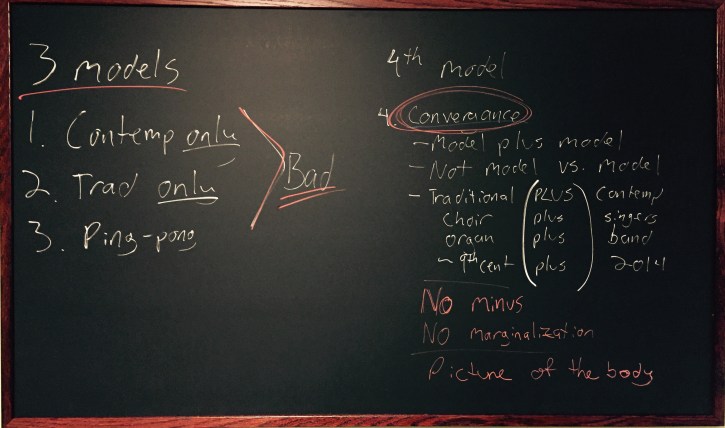
Convergence

There are three common music models in western/protestant/liturgical churches these days:

1. The traditional model. The music is almost exclusively classical, and any contemporary elements are on the fringes.

2. The contemporary model. The music is almost exclusively modern, and any traditional elements are on the fringes.

3. The ping-pong model. There’s a traditional side and a contemporary side. Each side gets its turn, at its own service, or with its own songs, and there isn’t a whole lot of unity or cooperation.

Is it possible for a church with a history of a traditional music program (choir, organ, hymnals, handbells, etc.) to embrace modern forms of music (bands, vocalists, projected lyrics, “worship teams”, etc.) without the traditional music dying as a result?

Yes, it is possible. And that’s what my church, our congregation, our choir, our instrumentalists, and I are pursuing these days.

We’re pursuing a fourth model, which is called “convergence”. Maybe you call it “blended”. It allows for vibrant traditional music, and vibrant contemporary music, and it puts them together in one combined expression. Choir plus singers. Organ plus band. Traditional plus contemporary. 6th century plus 21st century. Liturgy plus spontaneity. We can play ping-pong when it’s called for, but we play together most of the time.

This “convergence” model accomplishes several things:
1. It’s faithful to our past
2. It builds a bridge to the future, and to those from outside our traditions
3. It’s a picture of the body (independence and interdepence)
4. It’s alive and messy and risky and new and exciting
5. It’s about addition, not about subtraction

Most importantly,

6. It demonstrates our unity in Christ

What does this model mean for a traditional church choir?

This model embraces the choir and calls them further up and further in. Is it different? Yes. Is it the traditional model? No. Is it calling more or less out of the choir than before? More!

In this model of musical “convergence”, being a member of the choir is not just about singing the anthem. It’s about singing and leading all of the songs in a service from beginning to end. From the call to worship to the final hymn. Every note of every song being an opportunity for the choir to fulfill a worship leading role, a congregational-singing-cultivating role, a visible role, an audible role, and a pastoral role. From challenging repertoire, to simple liturgical responses, to contemporary songs that will only (and should only) be in our repertoire for shorter seasons, the choir is being called to be an integral worship leading presence on all of it.

Here’s the kicker about “convergence”:

The addition of new things does not mean the subtraction of older things.

The experimentation with new forms does not mean the elimination of older forms. The birth of new songs does not mean the death of old songs. New singers and musicians on the platform don’t mean the replacement of other singers and musicians. We must force ourselves to think in terms of addition and multiplication, not subtraction and division.

The motto of “convergence” is “More! Older! Newer! All of it!” It’s leaning into what God’s doing, it’s being willing to be messy and make mistakes, and it’s trusting that the foundations are strong enough to handle adding some new structures. This isn’t demolition, it’s expansion. There aren’t any wrecking balls in sight, only more bricks.

And the Cornerstone isn’t going anywhere.

Classical musicians need not run in fear at the sight of an electric guitar. A drummer need not be banished to the youth room, hidden behind plexiglass, and surrounded by foam. Traditional choral repertoire need not be thrown into the trash can. There has to be a way for musical convergence to work. It can work when we love one another, when we keep the congregation singing along, when we exalt Christ above all things and above all preferences, and when we’re willing to take risks in an atmosphere permeated with God’s grace.

Here’s to keeping on trying to make musical convergence work!

Pointing At The Same Thing From Different Angles

1In his book Christ Centered Worship, Bryan Chappel suggests eight components to a “gospel structure” for corporate worship, drawing from the narrative of Isaiah 6:

  1. Adoration (recognition of God’s greatness and grace)
  2. Confession (acknowledgement of our sin and need for grace)
  3. Assurance (affirmation of God’s provision of grace)
  4. Thanksgiving (expression of praise and thanks for God’s grace)
  5. Petition and Intercession (expression of dependence on God’s grace)
  6. Instruction (acquiring the knowledge to grow in grace)
  7. Communion/Fellowship (celebrating the grace of union with Christ and his people)
  8. Charge and Blessing (living for and in the light of God’s grace)

Worship leaders need to keep this structure in their minds when they’re planning services. To think through the placement of songs and different elements in such a way that coherently and cohesively tells the story of the gospel, it’s helpful to frame it against the narrative from Isaiah 6, like Bryan Chappel’s “eight components” so helpfully do.

Within this gospel structure there is a large amount of freedom. That’s the beauty of it. For worship leaders, it allows for all sorts of songs, kinds of songs, topics of songs, and “moods” of songs. It’s not so narrow that it’s limiting, and it’s not so broad that it’s maddening. Amazingly, yet not surprisingly, the gospel works.

And so it’s unfortunate when worship leaders, seeking to faithfully lead worship within this wonderful gospel structure, get stuck in an every-four-minutes spin-cycle, which re-sets with every song, and by the end of the progression of songs, hasn’t actually progressed anywhere at all.

If I had to summarize this spin-cycle, it would be:
1. Confession (I am a worm)
2. Assurance (God saved me through Christ)
3. Thanksgiving (I’m grateful!)

And then that song ends, and the next one begins, and we sing the same three points again. It’s like we’re afraid of betraying the core of the gospel if we dare to have a progression from point A to any point between B and Z, and take the risk of having our congregation articulate responses to the gospel, within an Isaiah 6 gospel structure, that might go beyond the bulletproof safety zone that requires fairly little ingenuity from week to week.

It seems like some worship leaders get the idea that every song needs to say the same thing, in the same way, using the same formula, following the same trajectory, and focusing on the same pillars of the gospel. The pillars are there for a reason: to provide a structure. So let the gospel structure free you and inform you, but not constrain you. Focusing on the same pillars in the same way from song to song is what I’m describing as the spin-cycle which can end up robbing our people of the opportunity to explore the unsearchable greatness of God.

If we sing the same three (or so) structural points, starting over with every song, we portray the gospel as myopic, the glories of God as describable, the implications of Christ’s finished work as easily summarizable, and our response as containable. Instead, we should feel free to use as wide a musical/lyrical/thematic vocabulary as possible, clearly within a gospel structure, but expansively and robustly broad, helping our people exalt a God whose glories couldn’t be fittingly exalted even if we had a thousand tongues.

It’s a huge and tragic problem when churches have no structure to their theology of worship, jump from theme to theme, follow no recognizable progression, and occasionally happen to land on the gospel when a song conveniently mentions it.

But it’s also a problem when churches/worship teams get stuck in a worship spin-cycle, failing to show any other angle of the indescribably beautiful gospel besides the one they’ve come to believe they grasp. Healthy gospel structures, like the one derived from the account in Isaiah 6, free us to exalt a God of grace, who redeemed us through his Son, and has sent his Spirit. Unhealthy gospel structures, and yes, I’m saying there can be such things, constrain us and limit us to see the bullet points instead of the masterpiece.

A tour guide at the Grand Canyon is always pointing to the Grand Canyon. And to help his group see more of the beauty of the Grand Canyon, he takes them on a journey from overlook to overlook. They don’t just stand in one place and look at it from the same angle. The scope of the Grand Canyon can’t be captured from one spot.

Similarly, a worship leader is always pointing to Jesus. And to help his congregation see more of the beauty of Jesus, he takes them on a journey from song to song. They don’t just stand in one place and sing from the same angle. The glory of God, revealed in the face of Jesus Christ, can’t be captured from one spot.

You can point to the same thing from different angles. That’s what a gospel structure ensures!

So let’s avoid the false security of the every-four-minute spin cycle, saying the same thing, and saying it in the same way. Turn the seat-belt sign off and move around the cabin!

How to Play Well with Organists

1One of my favorite organist jokes goes like this:

What’s the difference between an organist and a terrorist?
You can negotiate with a terrorist.

It’s a funny joke that quickly gets at the heart of the reputation organists have of being unbendable, inflexible, unwilling to take direction, and impossible to work with.

Many “contemporary” worship leaders would nod their heads at that last paragraph, immediately thinking of organists who have refused to play along either out of disdain for “pop” music or an inability to work off of chord charts or simple lead sheets. Because of this disconnect between organists and contemporary musicians, a dividing wall is built up (with varying levels of hostility depending on the egos involved) that results in the worship team standing on the side lines while the organist does his/her thing, and vice versa.

And because of this, when organists get together to tell their own jokes about guitarists, the punch lines in the other direction aren’t any more gracious than the one I told above. We each equate the other person to being (worse than) a terrorist and go on our own way not negotiating with them out of a matter of egotistical security.

It doesn’t have to be this way. Contemporary musicians and organists can (and should) play well together. There is no reason to take an “either/or” approach to organs and guitars, or organs and drums. Organs don’t have to be seen as a relic, and amplifiers don’t have to be seen as the enemy. We can laugh at our reputations (and sarcastic jokes) with good humor, reaching out to each other in mutual submission. The results might be a bit messy, and we might break some musical rules, but the Church will be edified, and the musical traditions that have been passed down won’t be abandoned.

As a life-long Anglican, almost every church I’ve ever attended has had an organ as a central instrument in its worship life. And in every one of those churches where organs have been central, I have come along with my guitar, (and usually my drums-playing brother too), and tried my hand at the “playing well together” approach.

I made some huge mistakes early on.

  • I assumed the organist couldn’t/didn’t want to play along, so I didn’t even give them music or communicate with them.
  • If I did give them music, they were simple chord charts (lyrics and chords), which, for many organists, are complete nonsense.
  • I didn’t try to build a relationship with the organist.
  • I secretly wanted to see the organ disappear.
  • I looked at my (at that point) 1-2 years of experience leading worship for a youth group as being superior to their decades of playing, lessons, studying, and degrees.
  • I saw things in terms of superior/inferior.

Needless to say, in those early years, the organists and I saw each other more like terrorists and less like partners.

There came a shift for me when I came (as a high schooler) to Truro Anglican Church in Fairfax, where I’m now (God has a sense of humor) the Director of Worship and Arts. It was the first time I had seen drums/organ/guitars/strings/descants/synthesizers all “blended” together without killing each other in the process. It was messy. But it was wonderful.

I drank it up for a few years before God called to me to another church, The Falls Church Anglican, where for a decade I would continue along as the contemporary guy attempting to bridge the divide with the classical guys. Sometimes it worked. Sometimes it didn’t. But most of the time it worked, and I learned some lessons about how to play well with organists.

Here are ten of them.

  1. Be humble. Organists have been taught (seriously) that you are the enemy. Disarm them (if they believe this) by being humble.
  2. Be winsome. Kill the elephant in the room by making fun of it. You’re a guitarist. You don’t read music. They’re an organist. They can play Bach for hours without messing up once. You’re trying to work together. It’s hilarious. Laugh about it.
  3. Ask them specifically for their help. You have a guitar. Or you have 88 piano keys. They have an entire orchestra at their fingertips for crying out loud. They have something to add, and the fact that you’re humbly and winsomely asking them for help is even more wonderfully disarming.
  4. Give them specific instructions. Don’t tell them how to play organ (since you have no idea), but at least try to walk them through the whole song and say “on the intro do something like this, on verse one don’t play, on the first chorus how about something like this…” and so on.Some organists like improvising. Most do not. But all organists are quite used to having very specific music with every single note, every dynamic change, and every volume swell specifically laid out. If all you give them is a chord chart strewn with mistakes, then they’re going to politely slide off the organ bench and be frustrated. They will appreciate (and do better) if you’re very specific about what you want.
  1. Embrace the awkward. It might sound a little muddled. There might be too much bass in the room if the pedals are walking all over the bass guitar. The organist might get a little loud. Whatever. Who cares. You’re demonstrating something very sweet and God-honoring. In ten years no one will remember how it sounded, but they will remember such a powerful display of musical unity.
  2. Music matters. If their brain is able to improvise off of a chord chart, then that’s wonderful (maybe). But organists usually like a little more than lyrics or chords, so be willing to go through the work to get them sheet music, and to tailor your arrangement to work with the sheet music they’ve been given. If the song you want to use is a hymn, you can use the hymnal arrangement and ask the organist to write out the chords for you. Or if the song is on CCLI’s SongSelect, you can print out the lead sheets or 4-part vocal score. Or (gasp) actually buy the actual sheet music.
  3. Include them as a member of your team. It’s hard for you all to consider each other enemies when you’re getting pizza together after rehearsal, or hanging out together in between services eating donuts. Mmm. Pizza and donuts. Now there’s a winning combo!
  4. Turn them loose. Let them do their preludes and postludes with as much bombast as they want. Give them hymns and anthems to accompany that let them use all their skills to their fullest. Then ask them to play with just as much intentionality (yet more constraints) on the songs you’re leading.
  5. Don’t talk, socialize, or set-up and tear-down equipment during their preludes or postludes. It annoys them.
  6. Learn from them. They probably have some really good arrangement ideas. They might be able to teach you a lot about music theory. Who knows – they might even be willing to give you organ lessons. Then you’ll become one of them and they will have won!

Do what you can to try to make this work. It will be awkward. You’ll be speaking different languages. But it just might be a wonderful blessing, and a practical demonstration of the reconciling power of the gospel.

Leading Effective and Enjoyable Rehearsals

1Ineffective and unenjoyable rehearsals are worship team morale killers and congregational engagement limiters. The more your team is out of sync with itself, the less your team is able to function like a healthy body, operating in the way that it should, and unable to meet its responsibility to the congregation it stands before on Sundays.

I’ve led all sorts of different kinds of rehearsals, on different days of the week, at different times of the day, in a variety of venues, and with different time constraints (or the lack thereof). I’ve made lots of mistakes in the process, and I’ve also learned some lessons that have come in handy. Learning how to lead rehearsals that are both effective and enjoyable, no matter what your setting or constraints, is crucial to your success and your team’s success at leading worship  with musical skill for the purpose of exalting Jesus Christ.

Here are some pointers:

Rehearsal should start before rehearsal. Communicate with your team before rehearsal, getting them the music well in advance, and giving them links to listen to/watch any new songs. Your expectation needs to be that your team is ready when they arrive.

Start on time. If rehearsal is at 7:30am on Sunday morning, ask your team to get into the habit of setting up at 7:20am. Start at 7:30am. Of course things happen, traffic is bad, people oversleep, or a boss makes someone stay late at work. But do your best to start when you said you’ll start.

Start with a proper sound check. If you’re rehearsing in your worship space, with a sound engineer, start with a sound check. This starts with letting the sound engineer set the gain levels on each channel, and then should progress with setting monitor levels. When you begin to have your sound engineer set monitor levels, do two things: first, have your drummer start to play and keep playing. Secondly, add different instruments one-at-a-time in a certain key.

For example, after we set gain levels and we’re ready to work on monitor mixes, I’ll say to my drummer “alright, can you play a rock beat in 4/4”. Then he’ll start to play. If we’re using in-ear monitors, and everyone’s belt pack is at the normal spot, I’ll say “raise your hand if you need more drums”. Then I’ll wait until the sound engineer has addressed the requests. Then “raise your hand if you need less drums”. Same drill. Then add bass. “Raise your hand if you need more bass”. Then, “raise your hand if you need less bass”. If you have any panning requests (i.e. put the bass in my left ear) you can do it now. Then add the different instruments on top, while the already-added instruments keep playing, but not overly so. Finish with the vocals. You’re running this whole sound check, keeping it moving, talking into your mic so everyone can hear you. It shouldn’t last any more than 3 or 4 minutes.

Then you’re ready to run through the songs.

Drive the bus. Lead the rehearsal with intentionality, with order, with decisiveness, and with authority. Yes, foster a “team” atmosphere by asking for ideas, feedback, etc. when it’s appropriate. But rehearsals aren’t the time for lots of free-for-alls. And when those moments come, unless you keep them moving, they can grind rehearsal to an ineffective and unenjoyable halt. Keep your hand on the wheel, respecting people’s time, and addressing the parts that need to be addressed.

Avoid playing every song through from start to finish several times. You should only play songs from start to finish if they’re brand new, or if you’re re-arranging them, or if you’re working with new musicians, or if you’re preparing for a live recording. Most of the time, playing through a verse and chorus (and then skipping the second verse and chorus) and jumping to the bridge before cutting it off at the final chorus. Get comfortable with the phrases “you guys know this one” or “when we get to this point in the song we’ll do it this way” or “we’re fine with this one, right”? Few things are as painful during rehearsals then getting bogged down for another 4 minutes playing a song all the way through again.

Work on transitions. Transitions are huge. Smooth transitions make such a positive contribution to the cohesion of a worship service. Instead of wasting time on unnecessarily playing through entire songs again, take time to work on how you’ll finish a song, how you’ll transition to the next song, and how the team will enter that next song. You can go over things like this several times. It will help you relax, and it will help the whole team be more in sync during the transitions, as opposed to just flipping pages on a music stand and looking around like confused tourists.

Make jokes. If you’re all-business and all-serious, then you’ll be missing out on the key ingredient of laughter. People love to laugh. And musicians love to laugh at themselves. Yes, keep the train moving down the tracks. But look for strategic moments to let the train stop, to make jokes, to have some fun banter, and to foster a sense of family.

Review. Don’t get to the last song in your list and let everyone go. Go back through the set list, have your team follow along in their music, and talk through what’s going to happen and when. Talk over key parts. Play through any tricky spots. This review time is key to reminding everyone what to work on between the rehearsal and the service.

Make rehearsals about Sundays. Rehearsals for the sake of rehearsal isn’t a compelling reason for people to care about rehearsals. Rehearsals for the sake of being ready for Sunday is a reason for people to be on their game.

Pray. Maybe it will work best for you to pray with your team at the end of rehearsal. Maybe at the beginning. Maybe after the sound check. Don’t worry so much about when to pray, but make sure that prayer is part of each rehearsal, no matter how tight your time constraints. Encourage the team to pray for the service, for the congregation, for the tech team (and have the tech team join you, by the way), for the pastor(s) (and have the pastor(s) join you too if they can), and for your role. Humbly ask the Holy Spirit to guide you, unify you, and empower you.

Maybe you rehearse in your worship space, with a sound engineer, and have the luxury of being able to go for 90 minutes (never go past 90 minutes even if you can!). Or maybe you’re downstairs in the choir room, gathered around a piano, with your drummer practicing on the bottom of a chair, with 15 minutes to talk through the songs before you can quickly set up for your service and launch right into it. Whatever your rehearsal situation, and however ideal or not-ideal, you can’t expect a rehearsal to run itself, or for a team to organize itself.

Lead rehearsals with clarity and strength, with good humor, with an eye on the clock and an ear tuned to the Spirit’s guiding. Your team will thank you and the congregation will ignore you and focus instead on Christ.