Last week I posted some funny ways Anglican churches could grow in worship. Like institute 40 days of cheesecake. Then I proceeded to not post anything the rest of the week. I’m sorry for being a terrible blogger and letting it get pretty quiet around here.
I did want to share the serious stuff that I shared in my seminar a couple of weeks ago when I encouraged Anglican worship leaders/pastors/congregations how they can grow in worship. I think most of this applies to other churches too.
1. Worship God out of love, not duty
We don’t worship God because he needs it, we worship God because we need it. God demands praise because we won’t be happy until we give it. God isn’t needy. We are. When people come to church because they think God needs it, or because God will be impressed, they’re doing it out of duty. Encourage people to come hungry, thirsty, and expectant to receive.
2. Appreciate all styles of music as God’s handiwork
There is not one style of music that can contain God’s glory. There is not one style of music that is unable to be used for God’s glory. Music is God’s handiwork, therefore we can and should use all of it, with care, for the glory of God. Therefore, we shouldn’t be protective, defensive, or suspicious. We should be glad to see God’s glory reflected in variety.
3. Expressiveness as the norm
When is the last time you’ve taught/offered encouragement on biblical expressiveness? Teach it from the bible and let people know they’re safe to feel free to worship with their bodies. Finally, model it. People won’t go beyond what they see up front. Expressive worship is the norm in scripture. So it should be in our churches too.
4. Clergy as worship leaders
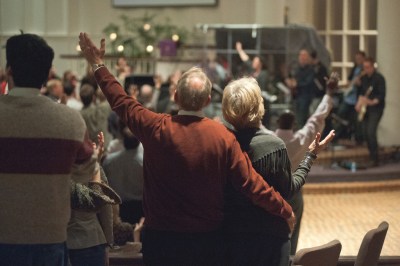
The pastor, or the priest, or the rector of a church is being studied at all times. Especially during a service. If he’s not interested or engaged in what’s going on, people notice. If your congregation isn’t expressive or engaged in worship, look at your pastor. Most often, he isn’t either. The picture at the top of this post is of my church’s pastor worshipping with his wife at our CD recording a month ago.
5. Lay Eucharistic ministers, acolytes, ushers, etc., as worship leaders
If you were to walk into a new church for the first time and see people up front, you would understandably assume that those people were in leadership. And if those people look bored during the service, you would understandably get the idea that worship isn’t terribly important. In Anglican/liturgical churches, most often, the people that we put up on the platform look bored. And I think this is a major reason why our congregations do too.
6. Do contemporary well
I remember when I was visiting England and I ordered a burger at a restaurant. I could tell it wasn’t the real deal. I remember when I was a kid and my Mom tried to sneak store-brand Cheerios in the name-brand box. I could tell it wasn’t the real deal. People have sharp antennae for fakeness. Sadly, in many Anglican churches, classical music is supported with skilled leaders and some sort of budget, while the contemporary music is not. This should not be so.
7. Go for it: celebration
On a scale of 1 – 10, 10 being a party, and 1 being asleep, most Anglican churches settle around a 3. They’re not totally asleep, but they’re leaning that direction. I think I can get away with saying this stuff since I’ve grown up in this tradition.
Don’t expect a congregation that’s at a 3 to all of the sudden go to a 10. But maybe one Sunday with some explanation and love you can encourage them to a 3.5? Nudge people to celebrate God’s glory with more enthusiasm.
8. Wait for it: stillness
Most people have very few (if any) extended times of stillness during their day. We can give them that space on Sunday. But it’s not enough to just leave silence and expect people to figure out what to do. Imagine you’re stuck on a plane on the tarmac. What do you want? The pilot to give you an update. So apply this principle to times of silence on Sunday: give people a bit of direction and explain what’s going to happen, and encourage them to be still and listen to the Lord and enjoy his presence. It might make people uncomfortable but it’s good for them.
9. See liturgy as a tool not an idol
I’ve written and spoken extensively on this here.
10. Leave room for the prophetic
Which of these two questions are you asking yourself the most throughout the service: (1) where does the liturgy have us going? Or (2) where is the Holy Spirit leading us? Both are important questions. But one is more important than the other. And that’s the latter question.
For goodness sakes, God can read. If all we do is read words off a page off of a screen, we might as well hold it up to God and say “read this”. We have a responsibility as worship leaders and pastors to keep people from honoring Jesus with their lips while their hearts are far from him. The active ministry of the Holy Spirit in our midst, during the singing, during the reading and preaching of the word, at the Eucharist, in the prayers, and in the silence, needs to be pursued and encouraged. And then we must be willing to follow his direction above the liturgy’s. He will not lead into error or disorder. He will lead to Jesus, and the more of that we experience on Sundays, the better for all of us.
 God reminded me of something very important yesterday.
 I was recently watching a well-known worship leader lead worship at a church that was broadcasting its service online. His leadership was excellent, the band was playing well, and the songs were really good. There was one problem, though. The keys were all way too high.
 This past weekend I had the privilege of leading worship in Southern California for the Diocese of Western Anglican’s Kingdom Conference. This diocese is made up of congregations that were once in the Episcopal church but have left to remain faithful to Jesus and Holy Scripture, and now belong to a new diocese together in the Anglican Church in North America. It’s exciting to see how God is reforming and working in the Anglican church.
 Worthily Magnify