I’ve noticed a lot of worship leaders (myself included) who can sometimes sing with a weird and unnatural affect, or worship leader voice (I wrote on this before). Here’s how it sounds and why it’s a bad idea.
Tag: Leading a congregation
God is Not Like Kim Jong Il

On Friday night I watched a fascinating National Geographic documentary on North Korea. Lisa Ling travels there with a camera crew accompanying a Nepalese eye surgeon. He’s allowed in on a humanitarian mission to perform 1,000 cataract surgeries in 10 days.
You might have seen the clips on the news from when Kim Jong Il died this past December. The mass display of mourning and weeping was, literally, unbelievable. This is an entire nation driven by indoctrinated fear to worship its “dear leader” or “great leader” or “supreme leader” or “eternal president”, whomever that may be. This documentary shows this worship up-close, even in the living room of a blind North Korean woman, who dreams of having her blinding cataract removed so she can gaze upon a portrait of the dear leader himself.
The final scenes are breathtaking. Filmed one day after the surgeries, when their eyes have had time to heal, and their eye patches are removed, one-by-one, the North Koreans approach the giant portraits of their dear leader and “eternal president” to, literally, praise him, thank him for healing their eyes, and promise to serve him even better.
I still can’t get past what one woman said. Immediately after having her eye patches removed and realizing she could see again she declared: “Great General, I will work harder at the salt mines to get more salt to bring you more happiness”.
I realized I was watching a worship service. It was unlike the services you or I are a part of every Sunday, but it was unmistakably a worship service. Kim Jong Il was God, the people in the room were his servants, they were there to praise him for what he had done for them, and the goal of it all was to make their dear leader happy. It was dutiful. You could tell they were afraid of him. It felt forced. But it’s what they have to do if they don’t want to get sent to a death camp.
It reminded me of John Piper’s letter to the atheist Michael Prowse who had written in a newspaper article of the absurdity (to him) of Christian worship. Prowse’s main objection was that if a morally perfect God did exist, then he surely wouldn’t demand praise. Isn’t it evil to demand praise?
Yes, if your name is Kim Jong Il. No if your name is God.
Piper wrote:
“…God’s demand for supreme praise is his demand for our supreme happiness. Deep in our hearts we know that we are not made to be made much of. We are made to make much of something great. The best joys are when we forget ourselves, enthralled with greatness. The greatest greatness is God’s. Every good that ever thrilled the heart of man is amplified ten thousand times in God. God is in a class by himself. He is the only being for whom self-exaltation is essential to love. If he ‘humbly’ sent us away from his beauty, suggesting we find our joy in another, we would be ruined.”
He continues:
“…the reason God seeks our praise is not because he won’t be complete until he gets it. He is seeking our praise because we won’t be happy until we give it. This is not arrogance. It is love.”
Our churches are full of people who, whether they realize it or not, think that God needs their worship. And this is why our churches are full of people who don’t enjoy it. Why should they? If it’s all for God and not for them, then why in the world are we singing for 25 minutes? Isn’t one song enough for God? Why should I clap or lift my hands to try to impress God? Why didn’t I just sleep in and run some errands or work on my lawn?
God is not like Kim Jung Il. Or any other “human tyrant puffed up with pride”. We don’t approach God to tell him how much harder we’ll work at the salt mines to bring him more happiness.
We approach God like a deer coming to a stream of water (Psalm 42:1) to drink. We approach God’s throne of grace with confidence because of his son (Hebrews 4:16) to receive mercy and grace to help in time of need. We come to God as his children to the praise of his glorious grace (Ephesians 1:5-6).
As I watched these oppressed, malnourished, terrorized North Koreans approach their wicked dear leader’s portrait to offer him praise and dedication to make him more happy, my heart broke for them. If only they could see, and freely worship, a kind and merciful Redeemer who will save them, love them, and satisfy them.
If only more of our churches could see him too. We may not live in North Korea but we can often be just prone to dutiful, joyless worship as those people in the documentary.
God is not like Kim Jong Il. His demand for our supreme praise is not for his happiness, but for ours. May we pursue joy in God and lead people in that pursuit as well as we can.
What God Signs You Up For
 God reminded me of something very important yesterday.
The privilege of serving as a worship leader can’t be felt in the degree of fame you achieve. This is vanity and this is celebrity and this is fleeting.
Rather, the privilege of serving as a worship leader can be felt in the moment when you witness a grieving young widow accept the folded flag which had draped the coffin where her husband rests in peace. He had been a secret service agent and had succumbed to a two year battle with cancer. He loved his wife, he loved his 4-year-old son, and he loved Jesus.
No one else in the room could see her tear-stained face except for the man handing her the flag on behalf of a grateful nation. This was a heart-breaking moment. This was when God reminded me of what a privilege it is to be called to do what I do.
We had sung songs about the faithfulness and goodness of God. We had sung about his amazing grace. And we had declared the truth of the gospel that assures us of “no guilt in life and no fear in death…”
Hardly anyone in that room had any idea who in the world I was. And they didn’t care. I didn’t care that they didn’t care. They would all much rather Keith was still alive and they weren’t having to sing these songs under these circumstances.
But God whispered something to me yesterday during that solemn moment. He said to me “this is what I signed you up for”. Not the lights, not the attention, not the fleeting celebrity. But the heavy duty of reminding a broken world, full of grief and cancer and too-young widows of the comfort and hope found only in Jesus.
Literally, we get a front row seat to pain and heartache. And God calls his ministers to be able to see it, experience it, and then within that, help people see the triumphs of God’s grace.
Worship leader: God doesn’t get any glory when you get glory. So don’t be in it for the glory. That’s not a privilege, it’s a travesty. It’s no comfort to a grieving widow.
God gets glory when you serve in humble ministry to the people in your congregation. Sometimes it’s a joy. Sometimes it’s a burden. Other times it’s heart breaking. But that’s ministry. And that’s a privilege.
What Happens When the Songs Are Too High
 I was recently watching a well-known worship leader lead worship at a church that was broadcasting its service online. His leadership was excellent, the band was playing well, and the songs were really good. There was one problem, though. The keys were all way too high.
I’ve written before about the art (it’s not really a science) of choosing the right key for your congregation, so I won’t go into all those details again. You can read this article if you’re wondering what guidelines to follow (generally) to choose congregation-friendly keys. But if you’re not convinced that it matters what key your songs are in, here are some effects that high keys have on a congregation.
They stop singing
They might not all stop singing at once, but they do start dropping off like flies pretty quickly. The brave and enthusiastic will keep on singing. But the people who are on the fence about singing (and you know that every church has them) will stop singing first. Then even the eager will start dropping out because their throats hurt.
They get confused
Here are the questions that start going through the congregation’s mind when the key is too high: Am I supposed to try to sing that note? Maybe I’m just supposed to listen to the worship leader sing it? I guess I’ll sing down an octave, but that feels really low, that can’t be right, can it? Am I just a really bad singer? Will the next song be more singable?
They get tired more quickly
When the songs are in unsingable keys, people will get worn out more quickly. After just one song in the stratosphere, people are going to want a break. Why? Because it feels like exercise. And it is, in a sense. If you’re singing songs in really high keys, you’re asking people to do a vocal work out. And it’s tiring.
They focus on (and blame) you
People don’t like feeling uncomfortable. That’s a basic fact of life. And when people feel uncomfortable, they look for someone to blame. So if I’m Joe the Plumber and I come to church on Sunday and the songs are all really high and unsingable, I’m going to blame the guy/girl who’s leading them. Now the worship leader is the focus and Joe the Plumber isn’t singing along. Not good.
They get conditioned to be spectators
After several too-high songs, or after several weeks/months/years of unsingable songs, your congregation will be conditioned to not sing along. They will have learned that it’s much more comfortable for them to listen to/watch you sing. At this point, you’ll really to have work to get them to sing along with you. Shouldn’t it be the opposite in the churches? I’d rather my congregation be so accustomed to singing along in church that it feels foreign to them to just listen/watch.
I can’t overemphasize the importance of choosing keys wisely for congregational songs. If the Psalmist said “let us exalt his name together” (Psalm 34:3) then surely our number one priority is unified singing. Good keys are the basic building blocks of unified singing.
Ten Ways to Make it Hard for People to Follow You
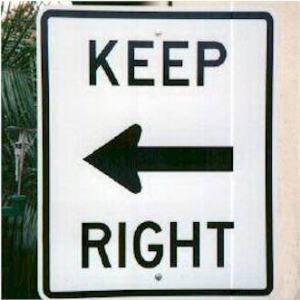 This past Saturday morning we had a breakfast at my church for a bunch of volunteer worship leaders. After we shared about ourselves, I shared on how important it is as a worship leader to be easy for people to follow. I did this by modeling and talking about 10 ways to make it hard for people to follow you. I’ve listed them below.
1. Be timid
Timidity begets timidity. Confidence begets confidence. If you’re timid, unsure of yourself, and insecure, the people in the room are going to feel sorry for you, want to help you, think you were put up front too soon, and will pull back. As my old professor Steve Brown says, do some self-talk before you get up front and say to yourself, “I have been commissioned by the High King of Heaven…” and lead with boldness.
2. Play too much
If you overplay, you come across like you’re angry. If people in the room sense that you’re angry or intense, their defense mechanism is going to be to want to protect themselves and they won’t let themselves trust you. Don’t play too much. And back to the first point, don’t play too little. Find the right balance.
3. Sing the wrong melody
I once sat in a church full of people while the worship leader sang the wrong melody (on purpose) for every line of the chorus of “How Great is Our God”. This was ironic since the chorus says “…sing with me…”. They couldn’t sing with him because he wasn’t making it easy. We want to make it easy for people to sing along with us. Sing the melody, sing the right melody, and sing it consistently throughout the song. If you veer into harmony, you must (1) make sure someone else has taken clear leadership of the song from you, and (2) use a different “voice” (i.e. breathier, softer, back from the mic). (I wrote a post on this a while ago here.)
4. Sing/play impressively
Leading worship requires most of us to set aside most of what we are really capable of doing, for the sake of serving the congregation and serving the song. If every singer and instrumentalist on stage was demonstrating the full scope of their respective skill-sets, it would be a disaster. Your job is to insert yourself into people’s consciousness as seldom as possible during a time of singing. So stay simple.
5. Sing the wrong keys
C to shining C is a good rule of thumb. Guys are mostly comfortable from a low C to middle C. They can dip lower and pop up higher, but do best in that octave range. The same principle applies for women, but up an octave. If you want people to sing with you, you’ll need to think through keys carefully, often taking songs down from where they were recorded, into more singable keys. (I wrote a post on this a while ago here.)
6. Mumble
“What did he/she say?” is one sure way to distract people. Speak slowly and articulate well when you’re speaking. And don’t try to say 4 sentences in the space of 2 measures.
7. Inconsistent tempo
The average person in the room can’t identify specific things/instruments/notes that are “off” during a time of worship. But they can identify that something is off. Tempo is one of those somethings that, if not consistent, and if unpredictable, can make people feel like something is wrong. Set the right tempo for a song either by using a metronome or by singing a quick section of the song in your head before you start to establish the tempo of the song. Once you’ve established it, stick with it.
8. All over the map themes
Songs should connect with each other. Don’t try to pick a song list in 5 minutes. Give yourself time, chew over it, pray over it, consider the scripture passages and sermon theme, and come back to it a few times during the week if you have to. You want your songs to go somewhere – not just all say the same thing, and not all be randomly placed.
9. The worship leader voice
Seriously. Just use your normal voice. Don’t contort your vowels, get growly, get breathy, raise or lower your pitch, or talk differently than you’d talk if you were greeting someone at your door. You might not realize you do this, so ask people who know you. Or record yourself leading and listen back. You might be surprised. People can spot fake-ness from a mile away. (I wrote a post on this a while ago here.)
10. No clear leadership
In the absence of leadership, people don’t feel safe. With too much leadership, people want to shut down. It’s a tricky balance, but it’s really a simple biblical principle. We want to say to people, in the words of David, “O magnify the Lord with me, and let us exalt His name together!”. That’s what our role is: to call people and to help people magnify and exalt the name of the Lord together.
 Worthily Magnify