
When the Congregation Claps On the Wrong Beat

This past Sunday we closed our service with Tim Hughes’ song “Happy Day” celebrating the “empty cross, the empty grave” and “life eternal” that Jesus won for us.

I started the song off by playing four measures on my own, and then the rest of the band joined me. The problem? They were one beat behind.

Because my intro was just straight eighth-notes and I jumped into it after saying something to the congregation, my drummer (who is super gifted) couldn’t quite tell which beat was the downbeat. Hence the band coming in one beat behind.

I quickly realized that this meant the congregation was clapping on the wrong beat.

What should I do? Go the entire song with the congregation clapping on the wrong beat? Try to fight them and hope they figure it out? Or just stop the song and start over?

I chose the last option. I just motioned to the band to stop, told the congregation we were going to start over and why, and then we tried it again and got it right.

Here’s how it sounded:

I think this is the first time I’ve ever had to stop a song and re-start it. I don’t imagine it will happen that often. But sometimes, like this past Sunday morning, it’s the best option.

And I think it was the right call this time. It showed the congregation we don’t take ourselves too seriously, it helped the band get back on track, and allowed us to sing the rest of the song without a huge distraction. This kind of thing helps keep us humble. It’s also fun to look back on it (or listen back as the case may be) and laugh. And learn. But mostly laugh.

Handling Awkward Moments – A Medical Emergency

This past Sunday at my church, I was sitting in the congregation and listening to the sermon, when I noticed an individual stand up and walk towards the back of the room. I thought it was an odd time for this person to leave since the sermon was almost over, and I also thought it wasn’t very discreet since they were sitting directly in front of the preacher!

About 15 seconds later, a huge gasp arose from the back of the room as this person proceeded to faint, fall onto the laps of a couple people, and end up lying on the floor.

Thankfully, we have several doctors and nurses who attend our church, two of whom were sitting within arm’s reach of where the individual fainted. We’ve also prepared for this kind of incident by installing emergency 911 buttons at our sound desk, and training our ushers how to respond. This person was taken to a hospital within minutes and released that afternoon, but it was still a huge disruption to the service.

It’s impossible to know when a service might be interrupted by a medical emergency. But it’s good to think through how you should respond. Bill Haley, one of our associate pastors who was preaching, handled it like a pro. Here’s what he did:

Don’t pretend it’s not happening!
Bill recognized he has lost the attention of the room, and that someone needed help. To continue with his sermon would have been futile and foolish. He could pick up his sermon later, but he had to address the emergency first.

Ask if there are any doctors in the room
Bill was in mid-sentence when the person fainted. After hearing the loud gasp and seeing that someone had fainted, he immediately said: “are there any doctor’s in the room?” Seconds later, an ER doctor and a handful of nursed were at the person’s side. Bill had the advantage of a microphone, and he used it well.

Pray
Once this individual had medical attention and 911 had been called, Bill said: “let’s pray”. He led the congregation in praying for the person until they were being carried out of the room.

Slowly get back to where you were
After this person was taken out to the lobby, he reassured people that he would update us on their status at the end of the service, encouraged us to keep praying for her, reminded us that God was in control, and slowly transitioned back into his sermon.

Recognize that the dynamic in the room has changed
I had planned to follow Bill’s sermon with Enfield’s arrangement of “Crown Him with Many Crowns”. Knowing that people were still shaken up and distracted, we changed the arrangement on the fly to be a bit more laid back and less aggressive. To follow a medical emergency with a rock version of a hymn could have been perceived as insensitive and jarring.

One thing that Bill did that ended up adding to some of the confusion was to ask intercessory prayer team members to go lay hands on the person who had fainted. This resulted in too many people being around, and required the doctor and nurses to tell people to go back to their seats. Next time, I’d ask people to extend a hand towards the person from their seat, but to leave room for the professionals to do their job.

I may never have to deal with this particular scenario again, and you may never face this kind of “awkward moment” in one of your services. But when you’re dealing with a group of people standing up and singing for long periods of time, a variety of ages, 52 Sundays a year, and just plain old odds, it’s most likely going to happen someday.

How to Handle the Tambourine Lady

I met her when I was 15 years old and living in Panama City, Florida. My dad was pastoring a small Episcopal church, and my family had been there for about a year and a half.

I had been leading at our youth ministry’s weekly services, a couple of songs for the Sunday morning service, and songs at other events ocassionally.

This particular event was one of a series of summertime mid-week services held in the chapel, with an extended time of singing at the beginning, followed by a teaching. I had just started Paul Baloche’s new (at that time) song “Open the Eyes of My Heart, Lord”, when she came in the back door with her tambourine swinging.

I was really young and had not been leading worship for very long. I had no idea what to do. I couldn’t believe this was happening – and from the looks on the faces of the people in the congregation – they couldn’t either.

The tambourine is one of those instruments that either has to be played really well, or hidden deep inside a closet where no one would ever think to look. You know what I mean.
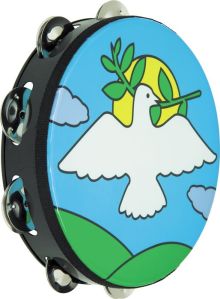
In this instance, it was not being played well. Honestly, it was being played horrendously poorly. That’s probably too kind of a definition. It wasn’t being played at all. It was being used as a weapon of mass distraction. That’s more like it. A bit cheesy but accurate.

No one had taught me what to do in this situation. None of the conferences I had attended had offered seminars on “what to do with the tambourine lady”. The worship leading books had all conveniently left this chapter out. And YouTube didn’t even exist yet, so I couldn’t log on and watch Paul Baloche’s instructional video on the topic.

So I would like to offer some tips on what do when you’re leading worship and all of the sudden a woman walks into the back of the room with her own personal tambourine. I call them the “AAA’s”.

Assess
Do a quick damage assessment of the congregation. What percentage seems to be distracted and disturbed? Has everyone noticed? Do they not even care? Are they about to stage a tambourine revolt and kick her out of the room? The extent of the damage will affect your next move.

Adjust
If the tambourine “playing” seems to have distracted every single person in the room, you might want to think about skipping your fast songs and singing some slow songs. Really slow songs. Odds are (you hope – and pray) that the slow tempo will mean no more tambourine. Or you may just need to keep going on as you had planned.

In all seriousness, when a disruption like this happens, just relax, pray a quick prayer for the Holy Spirit’s guidance, and then make the decision that you feel is best. You may very well need to adjust your leading somehow.
Approach (and ask)
Seek the tambourine lady out after the service at all costs. If you can’t find her, call her. If you can’t call her, email her. If you can’t email her, drive to her house. If she doesn’t have a house, put an ad in the local paper. Somehow you have to talk with this person – with your pastor, ideally.

What you want to do is approach her, thank her for her desire to worship God with the tambourine, and ask her if she would like to come to an audition.

If she says no, then you can ask if she would refrain from playing during a service since the other musicians who are up front all rehearse together.

If she says yes, I would be surprised, but you’d need to set up a time to meet with her and audition her, and then be honest with her. (See my post on how to be honest with unskilled musicians who audition for worship teams.)

You may never meet the tambourine lady, but I have heard that she has a habit of showing up at most churches at one point or another.

If you do have the privilege of meeting her, please tell her I said hi.

Handling Awkward Moments – When a Song Bombs

Sometimes you teach a new song and it really clicks.

Sometimes you teach a new song and it just takes a while for it to catch on.

But other times you teach a new song and it bombs.

It sounded great on the CD and you liked it a lot when you sang it at a conference you attended, but in the context of your congregation it just doesn’t work at all. If the song were a TV show it would be canceled. If it were a politician it would be voted out of office. If it were a Washington Redskins quarterback… well never mind.

It can be awkward when you introduce a new song and it bombs. I had a guy come up to me one day after we taught a new song that fell incredibly flat and he said: “I thought to myself during that song you taught ‘I could learn this song if I really wanted to’ but then I decided I didn’t really want to”.

When a song “bombs” it might be because it was the wrong song for your particular congregation, it was the wrong time to introduce it, your worship team wasn’t quite able to pull it off, the congregation couldn’t hear the melody so they decided to not even try, or it wasn’t a very good song in the first place.

Whatever the reason may be for a song “bombing” – it’s awkward when you’re the one who’s imposing it upon the congregation.  What do you do?

If it’s the wrong song – let it go
Maybe the musical style is too far outside your congregation’s comfort zone. Maybe the melody is too complicated. Maybe the content doesn’t resonate. Yes, we want our congregations to grow and be comfortable with a wide variety of songs – but by forcing songs on them for which they’re not ready, we’ll make that growth happen more slowly.

If it’s the wrong time – put it on the bench
Once in a while I’ll introduce a new song and feel that it’s just not the right time. It’s a good song, but for some reason I just need to wait on it a bit longer. These songs get put “on the bench” – not thrown off the roster.

If your worship team can’t pull it off – don’t try
It might be a great song, and your congregation might be ready for it, but if your musicians can’t lead it confidently, it’s probably wise for you to wait until they can. Be honest with yourself and realistic about what kind of songs your worship team is able to lead well. Err on the side of deference to your volunteer musicians’ abilities – not what you hear on the CD.

If it bombed the first time – but you still think it could work – give it a second try
Don’t be afraid to be persistent with a song you really feel could work with your congregation, even if it did bomb the first time. It’s probably a good idea to get a few other opinions before you try it again, but oftentimes a song (especially one that’s a bit different than the norm) will take a while to gain traction with a congregation.

Tee it up it better
When I taught Tim Hughes’ “Happy Day”, I took a minute before we sang it to tee it up. I explained that we were going to learn a song that helped us celebrate how Jesus defeated death and rose from the grave, how that was indeed something to be “happy” about, how that kind of happiness isn’t a shallow, Hallmark-card “happy”, and that at the end of one the verses we would take a moment to lift up a shout of celebration together, and take it as an opportunity to rejoice in the fact that Jesus is alive. Then we learned the song and people weren’t completely caught off-guard. If I had just plowed right into it, it might not have gone over as well.

Don’t stress out about it
I can be tempted to spend some time licking my wounds after a song I introduce bombs. There’s no reason to do that. It’s an unrealistic expectation that every song of every service on every Sunday will be met with whole hearted enthusiasm by the congregation, and a sign of a sinful and prideful desire to come across as perfectly polished.

Two things remain true regardless of what songs I choose, and how enthusiastically they’re received. First, my only boast is in the cross, and second, God is great and greatly to be praised.