The Problem with Gospel Amnesia

1Forgetting your identity in Christ will mess you up in lots of ways. Especially when you’re in ministry.

Paul Tripp describes a “gospel amnesiac” as someone who forgets their identity in Christ. And based on this definition, we’re all gospel amnesiacs. Every single one of us.

And this messes us up because, as Paul Tripp said at the Doxology and Theology conference this past November, when we forget what’s already been secured for us vertically (i.e. in Christ), we search for it horizontally (i.e. from the people around us).

We forget that we’re fully loved in Christ, and so we try to make everyone in our congregation like us (and it crushes us when they don’t).

We forget that we’re forgiven in Christ, and so we rehearse our mistakes in our minds and allow our failures to become chains around our ministry ankles.

We forget that in Christ, God speaks words of love over us, and so we’re haunted by angry, critical words hurled at us by hurting people.

We forget that we’re free in Christ, and so we become enslaved to performing a certain way, pleasing a certain power bloc, or perpetuating a certain system.

We forget that in Christ, we are adopted by God as sons and daughters, and so we’re constantly needy of affirmation and compliments in order to fill the father void.

Gospel amnesiacs are always looking around them to receive what’s already been given to them in Christ. Under the pressures of ministry, our insecurity becomes crippling. By forgetting our identity in Christ, we become walking beggars, looking for crumbs of horizontal approval, instead of remembering that we already have everything we need.

Look up to Jesus. Keep your eyes on him and walk straight ahead following his path through the valleys and peaks of ministry.

Look around you to Godly, grace-filled people. They will remind you of the gospel when (not if) you forget it.

Look past the distractions of temporary approval, fame, likability, status, or any other criteria you’ve set up to determine your identity.

Your identity is secure in Christ!

The Embrace of Musical Convergence (And Its Implications for Traditional Church Choirs)

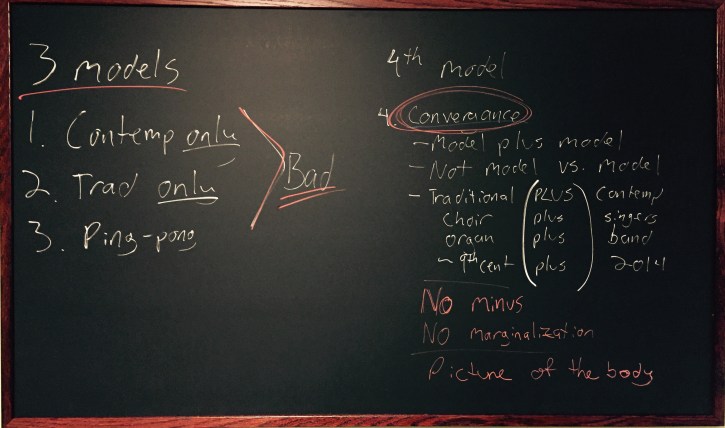
Convergence

There are three common music models in western/protestant/liturgical churches these days:

1. The traditional model. The music is almost exclusively classical, and any contemporary elements are on the fringes.

2. The contemporary model. The music is almost exclusively modern, and any traditional elements are on the fringes.

3. The ping-pong model. There’s a traditional side and a contemporary side. Each side gets its turn, at its own service, or with its own songs, and there isn’t a whole lot of unity or cooperation.

Is it possible for a church with a history of a traditional music program (choir, organ, hymnals, handbells, etc.) to embrace modern forms of music (bands, vocalists, projected lyrics, “worship teams”, etc.) without the traditional music dying as a result?

Yes, it is possible. And that’s what my church, our congregation, our choir, our instrumentalists, and I are pursuing these days.

We’re pursuing a fourth model, which is called “convergence”. Maybe you call it “blended”. It allows for vibrant traditional music, and vibrant contemporary music, and it puts them together in one combined expression. Choir plus singers. Organ plus band. Traditional plus contemporary. 6th century plus 21st century. Liturgy plus spontaneity. We can play ping-pong when it’s called for, but we play together most of the time.

This “convergence” model accomplishes several things:
1. It’s faithful to our past
2. It builds a bridge to the future, and to those from outside our traditions
3. It’s a picture of the body (independence and interdepence)
4. It’s alive and messy and risky and new and exciting
5. It’s about addition, not about subtraction

Most importantly,

6. It demonstrates our unity in Christ

What does this model mean for a traditional church choir?

This model embraces the choir and calls them further up and further in. Is it different? Yes. Is it the traditional model? No. Is it calling more or less out of the choir than before? More!

In this model of musical “convergence”, being a member of the choir is not just about singing the anthem. It’s about singing and leading all of the songs in a service from beginning to end. From the call to worship to the final hymn. Every note of every song being an opportunity for the choir to fulfill a worship leading role, a congregational-singing-cultivating role, a visible role, an audible role, and a pastoral role. From challenging repertoire, to simple liturgical responses, to contemporary songs that will only (and should only) be in our repertoire for shorter seasons, the choir is being called to be an integral worship leading presence on all of it.

Here’s the kicker about “convergence”:

The addition of new things does not mean the subtraction of older things.

The experimentation with new forms does not mean the elimination of older forms. The birth of new songs does not mean the death of old songs. New singers and musicians on the platform don’t mean the replacement of other singers and musicians. We must force ourselves to think in terms of addition and multiplication, not subtraction and division.

The motto of “convergence” is “More! Older! Newer! All of it!” It’s leaning into what God’s doing, it’s being willing to be messy and make mistakes, and it’s trusting that the foundations are strong enough to handle adding some new structures. This isn’t demolition, it’s expansion. There aren’t any wrecking balls in sight, only more bricks.

And the Cornerstone isn’t going anywhere.

Classical musicians need not run in fear at the sight of an electric guitar. A drummer need not be banished to the youth room, hidden behind plexiglass, and surrounded by foam. Traditional choral repertoire need not be thrown into the trash can. There has to be a way for musical convergence to work. It can work when we love one another, when we keep the congregation singing along, when we exalt Christ above all things and above all preferences, and when we’re willing to take risks in an atmosphere permeated with God’s grace.

Here’s to keeping on trying to make musical convergence work!

Pointing At The Same Thing From Different Angles

1In his book Christ Centered Worship, Bryan Chappel suggests eight components to a “gospel structure” for corporate worship, drawing from the narrative of Isaiah 6:

  1. Adoration (recognition of God’s greatness and grace)
  2. Confession (acknowledgement of our sin and need for grace)
  3. Assurance (affirmation of God’s provision of grace)
  4. Thanksgiving (expression of praise and thanks for God’s grace)
  5. Petition and Intercession (expression of dependence on God’s grace)
  6. Instruction (acquiring the knowledge to grow in grace)
  7. Communion/Fellowship (celebrating the grace of union with Christ and his people)
  8. Charge and Blessing (living for and in the light of God’s grace)

Worship leaders need to keep this structure in their minds when they’re planning services. To think through the placement of songs and different elements in such a way that coherently and cohesively tells the story of the gospel, it’s helpful to frame it against the narrative from Isaiah 6, like Bryan Chappel’s “eight components” so helpfully do.

Within this gospel structure there is a large amount of freedom. That’s the beauty of it. For worship leaders, it allows for all sorts of songs, kinds of songs, topics of songs, and “moods” of songs. It’s not so narrow that it’s limiting, and it’s not so broad that it’s maddening. Amazingly, yet not surprisingly, the gospel works.

And so it’s unfortunate when worship leaders, seeking to faithfully lead worship within this wonderful gospel structure, get stuck in an every-four-minutes spin-cycle, which re-sets with every song, and by the end of the progression of songs, hasn’t actually progressed anywhere at all.

If I had to summarize this spin-cycle, it would be:
1. Confession (I am a worm)
2. Assurance (God saved me through Christ)
3. Thanksgiving (I’m grateful!)

And then that song ends, and the next one begins, and we sing the same three points again. It’s like we’re afraid of betraying the core of the gospel if we dare to have a progression from point A to any point between B and Z, and take the risk of having our congregation articulate responses to the gospel, within an Isaiah 6 gospel structure, that might go beyond the bulletproof safety zone that requires fairly little ingenuity from week to week.

It seems like some worship leaders get the idea that every song needs to say the same thing, in the same way, using the same formula, following the same trajectory, and focusing on the same pillars of the gospel. The pillars are there for a reason: to provide a structure. So let the gospel structure free you and inform you, but not constrain you. Focusing on the same pillars in the same way from song to song is what I’m describing as the spin-cycle which can end up robbing our people of the opportunity to explore the unsearchable greatness of God.

If we sing the same three (or so) structural points, starting over with every song, we portray the gospel as myopic, the glories of God as describable, the implications of Christ’s finished work as easily summarizable, and our response as containable. Instead, we should feel free to use as wide a musical/lyrical/thematic vocabulary as possible, clearly within a gospel structure, but expansively and robustly broad, helping our people exalt a God whose glories couldn’t be fittingly exalted even if we had a thousand tongues.

It’s a huge and tragic problem when churches have no structure to their theology of worship, jump from theme to theme, follow no recognizable progression, and occasionally happen to land on the gospel when a song conveniently mentions it.

But it’s also a problem when churches/worship teams get stuck in a worship spin-cycle, failing to show any other angle of the indescribably beautiful gospel besides the one they’ve come to believe they grasp. Healthy gospel structures, like the one derived from the account in Isaiah 6, free us to exalt a God of grace, who redeemed us through his Son, and has sent his Spirit. Unhealthy gospel structures, and yes, I’m saying there can be such things, constrain us and limit us to see the bullet points instead of the masterpiece.

A tour guide at the Grand Canyon is always pointing to the Grand Canyon. And to help his group see more of the beauty of the Grand Canyon, he takes them on a journey from overlook to overlook. They don’t just stand in one place and look at it from the same angle. The scope of the Grand Canyon can’t be captured from one spot.

Similarly, a worship leader is always pointing to Jesus. And to help his congregation see more of the beauty of Jesus, he takes them on a journey from song to song. They don’t just stand in one place and sing from the same angle. The glory of God, revealed in the face of Jesus Christ, can’t be captured from one spot.

You can point to the same thing from different angles. That’s what a gospel structure ensures!

So let’s avoid the false security of the every-four-minute spin cycle, saying the same thing, and saying it in the same way. Turn the seat-belt sign off and move around the cabin!

Worship Leader Resolutions: 2015

1So here we are. A new year. Worship leaders all over the world are ironing their skinny jeans, flannel shirts, and scarves (it gets cold up there under those hot lights), ready for all the new opportunities to sing songs incredibly high. In the spirit of new year’s resolutions, I offer worship leaders these suggestions to make 2015 even more epic (remember that Oceans drummer?!) than 2014.

1. Rename your worship team
“Praise team” is so early-1990s. “Worship team” is so 2000s. We need to throw those dorky phrases in the trash where they belong (along with transparency slides and foam mic covers) and embrace more modern names. Consider “The Brilliant Harmony Society Collective” or “Everyone’s Favorite Grandson” or “God’s Anointed Servants” (“GAS” for short). Bingo! Revival is already breaking out.

2. Retune the golden oldies
Why hasn’t “Shine Jesus Shine” been retuned yet? Has anyone heard the Mumford and Sons-esque version of Don Moen’s “God is Good (All the Time) yet?”. How about a techno/electronica version of “Lord I Lift Your Name on High”? There is a HUGE market out there that’s been untapped, people. You can thank me later. On your way to the bank, of course.

3. Develop your personal brand
Who needs administrative assistants, or music associates, or any of those antiquated ministry support roles? You need a personal brand developer. Band name? Check. Twitter / Facebook / Instagram / Tumblr / Flickr / Noisetrade / SoundCloud / BandCamp / BingoClub / BowlingLeague presence? Check. Hipster logo? Check. Now how about your own personal FroYo flavor? Personal coffee bean supplier? Food taster? Skinny Jeans tailor? You have some work to do.

4. More effectively capitalize on the seldom-used “retweet” feature
Most worship leaders still don’t know about the hidden “retweet” feature on Twitter (even after I mentioned this oversight last year). We need to step it up in 2015 and use this feature more often (i.e. daily). Someone likes your Don Moen retune? Retweet it  Someone accidentally said your name when they sneezed? Retweet it. If you don’t retweet any mention of you, then we might forget that you exist, and then we might forget that we need you to keep existing. Here’s the mantra: “We tweet the retweet because we treat our wee tweeters to retweets.” Say it. While singing “Oceans”.

5. Embrace the lip-sync
Building a worship team “Brilliant Harmony Society Collective” is such hard work. Whether they’re volunteers, professionals, or somewhere in-between, it just takes too much time to work with actual people. Thanks to worship resources like Ableton Live we can already bring in string sections, timpani hits, techno-pads, and electric guitars with the click of a button. Let’s just go full throttle in 2015 and bring in the canned vocals too. I’m looking forward to standing at the mic this Sunday, singing my lips out to the latest worship hit, and hearing the congregation say “man, you sounded an awful lot like Chris Tomlin”. I’ll lower my prescription-less glasses so I can look them in the eyes and say “that’s because it was Chris Tomlin”. Then I’ll get into my limo and go home.

6. Incorporate more one-liners
After the 399th time of hearing you say “Good morning! Let’s stand together”, your congregation might die of sheer boredom. You need to pull a Taylor Swift and “Shake it” up with some worship one-liners to really get the blood flowing. Examples: “Ittttttttttt’s worship time!” Or “Here I am! I’m back! You’re glad to see me, and I’m glad to see you!” Or “Testing, testing, one, two, three / Who wants to praise the Lord with me?!?” I could think of some more but then you’d thank me too much and I’d have no choice but to retweet you.

7. Use reverse octave jumps
We’ve pretty much exhausted the octave jump supply of all of its awesomeness. Last year I suggested the “octave MONSTER jump” but that’s run its course as well. Now it’s time to kick that octave jump train into reverse and ride it for another solid decade. Here’s what you do. Step one: start the song in a singable range. Everyone is happy. Step two: build the second chorus. Everyone knows something is coming. Step three: drop down an octave into the sub-bass range, in which only the big/old dudes in your church can sing. Who cares if it’s awkward? It’s epic, man. If people can’t keep singing along it’s their problem.

8. Dance like never before
I really think that if our worship leadership is going to go to the next level, then we need to start dancing. Not just tapping our feet, but full-on dancing. And not spontaneous dancing, but pre-planned, choreographed, synchronized, banner-tastic, flag-a-riffic, throw-me-my-linen-ephod dancing. You want the Spirit to lead you where your trust is without borders? Then walk upon the water of dance, my friend.

9. Throw in some more “hey!”s
No power of hell, no scheme of man, can ever pluck me from his hand. Till he returns or calls me home, here in the power of Christ I’ll stand. HEY!” Cue the four-on-the-floor kick drum beat, mando/banjo solo, foot-stomping, and beards, and you’ve got yourself a hit.

10. Never smile
If you smile when you’re up front, people will think you’re having fun. If they think you’re having fun, they might think you’re normal. If they think you’re normal, they might not buy into your personal brand. If they don’t buy into your personal brand, you might not get your FroYo royalties! If this happens, have no fear. The royalties from your U2-inspired retune of “Days of Elijah” will make up for it. But try not to smile. It will throw off your scarf.

Happy new year!

Looking Back On 2014

1In mid-2009 I started this blog in the hopes of offering practical help to worship leaders – by a worship leader – for whoever would find it helpful. I started off aiming to write out of a place of transparency and vulnerability — dealing with my own day-to-day experiences/mistakes in ministry — and sharing any tips/advice/thoughts that God prompted me to share. I’ve been incredibly encouraged and humbled by how God seems to have used this little piece of internet real estate to encourage worship leaders.

It’s been over five years since I began, and blogging here continues to be an incredibly rewarding exercise for me, mainly because of the great conversations and friendships that have been struck up. 2014 was no exception. To all of you who read, share, and/or comment on this blog, please know how grateful I am for you! Thank you for helping my desire for this blog come to fulfillment.

Interestingly, the top five posts on this blog in 2014 were:

1. Are We Headed For a Crash? Reflections on the Current State of Evangelical Worship. In this post I shared some of my concerns and warnings for those of us in the evangelical worship movement. To say that this post struck a nerve is an understatement.

2. Top Ten Ways to Annoy Your Sound Engineer. Even though I wrote this post in 2011, it took on a life of its own this year and seemed to make a lot of people chuckle. Mission accomplished.

3. Oh Magnify My Face with Me. A post in which I attempt to articulate my concerns about the common practice in mega churches and Christian conferences of magnifying the worship leader’s face during the singing. To quote myself: it’s awfully hard for you to decrease when your face is the size of Honda Civic.

4. Ten More Ways to Annoy Your Sound Engineer. I like poking fun at sound engineers. It’s because I love them so much and think their role is so crucial. Thank you, sound engineers!

5. Sing a New Song (But Not Too Many… And Not Too Many of Yours). I had three major points in this post. First, we should sing new songs! Second, we shouldn’t sing so many new songs that people stop singing along. Third, we shouldn’t ask our congregations to sing so many of our original compositions that they can’t sing along.

The four countries that most commonly visit this blog are: the U.S., Canada, the U.K., and Australia. I have yet to receive any invitations to speak at a conference in Hawaii (or the Bahamas), which is one of my top-five lifelong ministry goals. There’s still time…

1I was honored this year to receive Worship Leader Magazine’s Editor’s Choice Award for one of the top worship blogs. This was a very kind gesture by Chuck Fromm (the editor of Worship Leader Magazine) and I was honored to have this blog named amongst so many other good ones. Sadly, this award did not get me out of doing dishes every night at home (I tried but Catherine said she wasn’t that impressed), and the police officer in Falls Church who gave me a speeding ticket a few months ago didn’t seem to be impressed when I flashed my “TOP WORSHIP BLOG” badge in his face.

This was quite a momentous year for my family and me, as I left The Falls Church Anglican in July and came on board as Director of Worship and Arts at Truro Anglican Church in August. Our oldest daughter started kindergarten, our middle child started preschool, and our youngest (now one-year old) continued the Brown-baby tradition of not sleeping through the night even once. Because of all of these exciting things, I didn’t post as frequently or substantively as I would have liked, and I hope that I can get back into a more normal blogging rhythm in 2015.

So again, thanks to all of you who read, share, comment on, and subscribe to this blog. I’m thankful for you! I hope that this blog can continue to be a place of practical encouragement for worship leaders, a place to have meaningful conversations about practice and theology, and maybe even a place to laugh once in a while — especially at ourselves.

Happy new year!