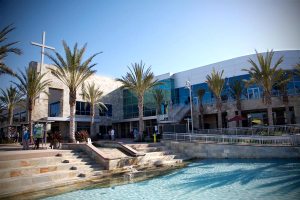
 This past Saturday I spent the afternoon/evening at Mariners Church in Irvine, California, watching how they “do things”. They’re about a ten-minute drive from my in-law’s house in Newport Beach, where Catherine and I are on “vacation” with Megan and her adoring grandparents.
Mariners Church is quite different from my church in many ways. It’s non-denominational and non-liturgical, while mine is Anglican and liturgical. Its average weekend attendance is over six times ours. All of the musicians are paid, while ours are volunteers. They have a state-of-the-art “worship center”, while we have a civil war-era Historic Church for our traditional services and a 900 seat “main Sanctuary” for our more informal services. They have a sprawling campus, complete with bar-b-q grills, a lake, bookstore, café, and tons of parking. They have a five-person camera crew at each service and project images of the worship leader, band, and speaker during the entire service. There are many more differences.
But while my church does differ from Mariners Church in some of our approaches to ministry, our facility, theological emphases, size, and cultural setting, we still share a love for Jesus, an evangelical and orthodox understanding of scripture, and a mission to preach the Gospel. And while my worship team looks and operates differently in many ways from Mariners’, there is always something to learn. I learned a lot on Saturday by sitting in on their sound check, rehearsal, production meeting, and evening service. They made me feel at home, gave me an in-ear monitor pack to listen in, and let me look “behind the scenes”. It was a blast. Here are a few things I learned:
Monitors, monitors, monitors
Mariners Church has a separate sound board to run separate in-ear monitor mixes for each band member, and an engineer whose only job is to run their mixes. Not every church can afford this (!), but most churches and worship teams would be well-served to devote more money and energy to making sure they have good monitor equipment and competent people running it. I have a renewed dream of having in-ear monitors for the entire worship team at my church, and having a separate person taking care of these mixes to free our sound engineer to worry about the main mix exclusively. This will take money, time, and patience.
“Rehearsal” shouldn’t be a bad word
Here’s Mariners’ typical rehearsal/service schedule:
Wednesday
– Evening rehearsal (musicians and monitor engineer) to get a feel for how they want to play the songs. This rehearsal is recorded and posted online for the band after rehearsal is finished.
Saturday
– 1:30pm: Band members arrive, tune, and plug in. Sound team is ready and equipment is in place.
– 1:45: Band plays together (ad lib) for five or ten minutes while monitor mixes are set. Note that they are playing continuously during this time, speaking to the monitor mix engineer through individual mics that are fed only into the headphone mix.
– 2:00: Rehearsal begins. Band plays through each song, stopping occasionally to correct chords, tempo, repeats, etc. Lyric operator runs lyrics concurrently to see if there are any errors and to get a feel for how to project them best. Camera and lighting operators are also in place.
– 2:45: Band takes 15 minute break. Worship leader takes part in a production meeting at this time which is attended by the directors of the different components of the service (video, lighting, audio, etc.) the “producer”, and others involved in the execution of the service. They talk through the service, what is happening and why, and what needs to happen before the service begins.
– 3:00: Everyone involved in any aspect of the service gathers to pray together.
– 3:15: First full rehearsal of the entire service (minus sermon and announcements).
– 3:40: 5 minute break.
– 3:45: Second full rehearsal of the entire service (minus sermon and announcements).
– 4:20: Break.
– 4:30: Scrolling announcements begin on the screens.
– 4:45: Church events slideshow projected on the screens.
– 4:57: Band plays musical prelude.
– 5:00: Service begins.
– 6:15: Service ends.
– 6:25: All the players from the earlier production meeting gather again to debrief. What worked? What didn’t?
Sunday
– 8:00am: Full rehearsal of the entire service (minus sermon and announcements).
– 8:30: Break.
– 8:30: Scrolling announcements begin on the screens.
– 8:45: Church events slideshow projected on the screens.
– 8:57: Band plays musical prelude.
– 9:00: Service begins.
– 10:15: Service ends.
– 10:30: Scrolling announcements begin on the screens.
– 10:45: Church events slideshow projected on the screens.
– 10:57: Band plays musical prelude.
– 11:00: Service begins.
– 12:15pm: Service ends.
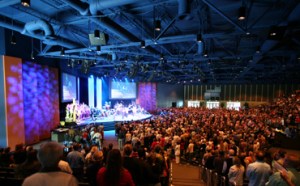 Most worship teams/tech teams can’t (and shouldn’t) take on a rehearsal schedule exactly like this. Mariners Church does it because they have 9,000 people attending on a weekend, paid musicians, and have gone for a more highly-produced service. Don’t think I’m saying that every church should do three full run-throughs before its first service! If you’re not careful you can over-rehearse and burn out your volunteers.
But there are also problems with under-rehearsing, and I suspect most worship teams/tech teams (my church’s included) might be guilty of it quite often, if not every weekend. If your rehearsals are efficient and effective, most people won’t mind giving up their time to be there. You’ll be better equipped, your worship team/tech team will be better prepared, and your congregation will be led with better skill. Mariners Church rehearses often and well. That combination is key.
Keep arrangements fresh
I’m guilty of using the same chord charts for years and years. Once I have a chart for a song, I’ll use that one every time we sing it. One thing that Mariners does really well is keep their arrangements fresh. They’ll change a chord progression, try a different feel, slow it down, speed it up, use a different electric guitar or synth sound, drum pattern, etc. They’re always looking for ways to keep their songs from feeling stale, and that’s something most worship teams (again, mine included) could improve on.
Don’t take input personally. Musicians should seek to serve the song
At one point during rehearsal, Tim Timmons (the worship leader – a great guy) asked the drummer to change the feel on the chorus of one of the songs. The drummer said “OK.” It was that easy. Throughout their rehearsal, ideas and suggestions were offered freely and no one was defensive or took it personally. That’s how a healthy body works.
Have the lyrics operator at rehearsal
I am now convinced that this is crucial. The role of the lyric operator is so critically important to the skillful leading of a service, that to expect it just to “work” with no rehearsal, and with the person showing up ten minutes before the service starts is dangerously negligent. During the first run-through at Mariners, Tim realized the video for “God of Wonders” that projected the lyrics was about one beat behind, meaning the lyrics were “following, not leading”. They adjusted things so that once the service started, the lyrics were put up about 2 seconds before they were supposed to be sung. I’ll be talking with our technical director and discussing how we can get our lyric operators to attend rehearsals as soon as possible.
Walk, talk, and pray through the service with your team
Tim took time to walk through the service with the musicians and volunteers to explain why he had chosen certain songs for specific points, what would be happening at particular moments, what he was going to say in between a song, etc. Then they prayed over the service, including many of the specific moments Tim had said to look out for. This not only helped the team feel connected and on the same page, but it also helped Tim think through and articulate what he was going to say, why he was going to say it, and what his goal was. Great idea.
I’ll share some more things I learned tomorrow.
 Joseph Stigora’s setting of Psalm 96 gets a bad rap. Sure, he started it off in the key of F# at the Worship God conference in 2008 only to have the band join in the key of G, prompting this hilarious and often-viewed YouTube video, but you’d never know anything else about how the song goes or how the verses sound unless you were at the conference.
  Fill in the blanks:
 Yesterday I shared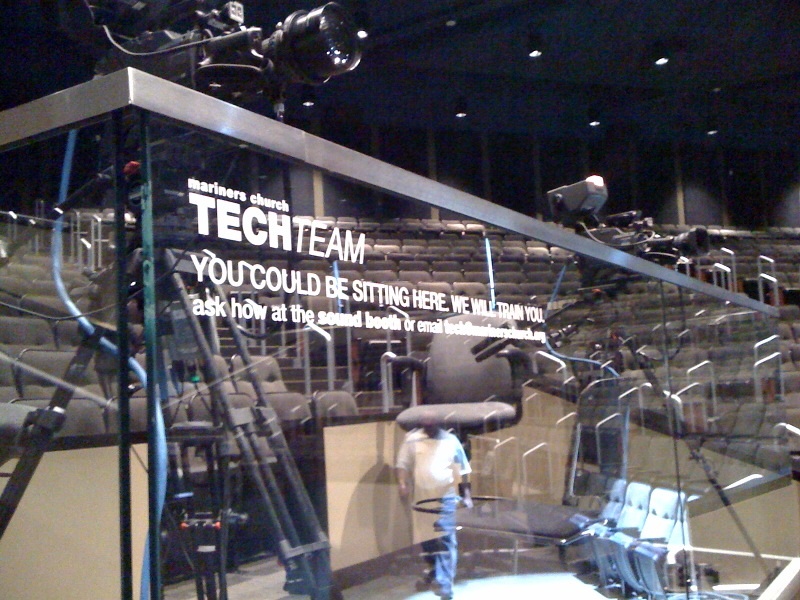
 This past Sunday I thought it would be a good idea to begin the service a bit differently, by singing Joseph Stigora’s version of
  Worthily Magnify