What I Learned From Recording a Live CD

Last week my church recorded a live worship CD. It was the most exhausting/rewarding/fun musical experience of my life. I’m really excited about the CD and would be thrilled if you pre-ordered it, but wanted to share some things I learned after several days of rehearsals and recordings.

The value of laughter
Three of the musicians (Carl Albrecht on drums, Luke Moseley on piano, and Russell Crain on electric) were guests. We had never met each other, led worship together, or rehearsed. So there wasn’t a ton of chemistry that first morning at an 8:30am breakfast. It didn’t take long, though. After our Student Ministry Director got us laughing at Chuck Norris facts, the rest is history. We had great times of laughter, and that really helped the team grow together.

The value of good food and drink
We had volunteers delivering huge breakfasts with Starbucks coffee, afternoon snacks, cookies and milk, and plenty of water. We had good lunches and dinners around town. There was always something close-by to eat or drink. This kept us going. (I wrote a post on this topic a while ago here.)

The need for breaks
We did a good job most of the time taking 15 or 20 minute breaks every hour and a half or so. When things would start to drag we’d take a break and get a rest. On the Friday, however, we didn’t leave ourselves enough time after the 2nd full run-through to take a long break before the evening recording. So we all felt a bit frazzled and worn out that night. Lesson learned. We should have planned better for a long break.

Don’t make your congregation anxious
Before our first recording on Friday night, I went through little sections of each song that I thought might be new to the congregation, or I thought they might sing wrong. On one hand, it was good because it broke the ice and make people laugh. But on the other hand, I received feedback that it made the congregation feel anxious and afraid to mess up. So on Saturday night I scrapped the whole idea and just encouraged people to sing out. We were all much more relaxed.

A metronome really helps
Obviously, since we were making a recording, we had to play to a metronome in our ears. Carl controlled this and was an invaluable help. I learned that the difference between the right feel and the wrong feel can often be just one or two beats per minute. It took the pressure off our shoulders and helped keep us all more together. This isn’t realistic for every team or every song or every Sunday, but we’ve actually started to use a click in our ears on Sundays and so far we’re actually (mostly) enjoying it.

People in your congregation want to volunteer
Two weeks ago I sent an email to our worship team/choir/others with 15-20 different needs I had (airport pick-ups/drop-offs, meals, rides, etc). Within 24 hours, all the slots were filled, and many were double-booked. I should take time more often to ask people for help.

Our congregation loves to worship
For years, people have been asking me when we were going to have an evening of extended worship. After seeing the response this past weekend, I don’t know what took me so long.

Rigorous rehearsal doesn’t have to mean perfection
We rehearsed the recording’s 14 songs more than I’ve ever rehearsed any songs. But we never tried to get them perfect. Our goal was to get comfortable and confident enough with them that we could lead them with excellence. But we still held loosely to them and left space for God’s leading. The goal of rehearsal should never be perfection, even for a live CD.

Things to Pray for Before a Service

If you’re anything like me, and if your worship team is anything like mine, sometimes when you gather to pray (and I hope you do) before a service, you can either blank on what to pray or you can tend to pray the same sort of thing. What kinds of things are we supposed to pray for before a service? Here are some ideas:

That your worship team would be unified in the Spirit
All of us have different gifts, but we all belong to the same body (1 Corinthians 12:12-13). Your worship team needs the Spirit’s help to act as one body, not a bunch of individual members.

That Jesus would be made central
John the Baptist said in John 3:30 that “(Jesus) must increase, but I must decrease”. The Psalmist wrote in Psalm 115:1, “Not to us… but to your name give glory…”. These are our prayers, and we need the Holy Spirit to help us decrease and to help Jesus to increase (John 16:14).

That God’s word would be preached faithfully
The “sword of the Spirit” mentioned in Ephesians 6:17 isn’t a synthesizer pad or a cool transition. The sword of the Spirit is the word of God. We should be praying that God’s word is preached boldly and faithfully, and that what we do supports it.

That people would sing from their hearts
In Matthew 15:8 Jesus lamented the people who honored him with their lips but whose hearts were far from him. One of our jobs is to help prevent lip-service to Jesus. We need the Holy Spirit for this, since he is the only one who can search our hearts (Romans 8:27).

That you would lead with Spirit-inspired excellence
If I wanted to, I could play an excellent guitar solo. But it wouldn’t do any good. Excellence on its own is useless. Excellence for the purpose of God’s glory and the congregation’s edification is commanded (Psalm 33:3). We need God’s help to discern the difference between being impressive for the sake of impressing, or excellent for the sake of serving.

That unbelievers would be convicted by the Holy Spirit
Here’s an understatement: there are certain things God can do that you can’t do. You might be a great worship leader but you can’t convict unbelievers of sin. In 1 Corinthians 14:24-25, Paul says that one advantage of prophecy is that an unbeliever can be “convicted… and declare that God is really among you”. This is why you should pray that God helps you lead prophetically, in the power of the Holy Spirit, so that even unbelievers will see God’s glory.

That you would be led by the Holy Spirit
Don’t just plow through your song list and rush through it without taking time to let God lead you to repeat, underline, emphasize, or even skip certain things. If the Holy Spirit lives in you, then (this is amazing) you can know the very thoughts of God (1 Corinthians 2:11). What you’re thinking is important. But what God is thinking is more important. Pray that the Holy Spirit speaks clearly to you what’s on God’s heart as you lead.

That the time of singing would bear fruit
It’s not enough to give people a pleasant singing experience on Sunday mornings. We should be changed every time we encounter God individually or corporately. One of the main ways our time of singing can bear fruit is for the words we sing to sink deep down in our hearts and stay there during the week, reminding us of the truths we’ve sung (Colossians 3:16).

That your sound engineer will have wisdom and energy
Seriously, pray for your sound engineer(s) anyone else on the AV team at your church. Too often worship teams treat their audiovisual colleagues like second-class citizens. Pray for them, honor them, thank them, and be understanding when something goes wrong. They need God’s help to stay attentive, to be able to engage in worship, and to maintain servants hearts while in the background.

That you would lead, sing, and play beyond your natural abilities
There are many instances in scripture when the Holy Spirit enables someone to operate beyond their normal ability (Moses in Exodus 31:3, David in 2 Samuel 12:32, Ezekiel (all throughout the book), Micah in chapter 3:8, Zechariah in Luke 1:67, Stephen in Acts 6:10, and Peter in Acts 11:12). These are normal people to whom God gives supernatural strength for the demonstration of his power and the proclamation of his good news. Worship leaders would be wise to ask for that same supernatural strength, every single Sunday.

The Holy Spirit: The Very Breath of God in Our Very Midst

The Holy Spirit first appears in the second verse of the first chapter of the first book of the Bible, Genesis 1:2. The earth is formless and dark, and “the Spirit of God was hovering over the waters”. The word for “Spirit” is “Ruach”, meaning “breath of God”. The very breath of God is present at creation.

After that, we see the Holy Spirit again when he comes upon particular people at particular times. Here’s a quick walk through the places in the Old Testament where the Holy Spirit is mentioned.

Exodus
The Spirit fills Moses with skill, intelligence, knowledge, and all craftsmanship (31:3, 35:3).

Numbers
The Spirit rests on Moses’ elders and they prophesy (11:25). Moses wishes the Spirit would be in “all the Lord’s people” (11:29).

The Spirit “comes upon” Balaam (24:2). Joshua is a man “in whom is the Spirit” (27:18).

Judges
The Spirit is “upon”, “clothes”, or “rushes upon” Othniel (3:10), Gideon (6:34), Jepthah (11:29), and Samson (14:19, 15:14).

1 Samuel
The Spirit “rushes” upon Saul (10:10, 11:6) and David (16:13). He “departs” Saul (16:14), and comes upon Saul and his messengers (19:20, 19:23) and they prophesy.

2 Samuel
David says the Spirit “speaks by me, his word is on my tongue” (23:2).

1 Kings
Elijah says the “Spirit of the Lord” will “carry” Ahab (18:12).

2 Chronicles
The Spirit “came upon” Azariah (15:1) and Jahaziel (20:14), and “clothes” Zechariah (24:20).

Nehemiah
The Spirit warns God’s people “through… prophets” (9:30).

Job
Job says “the Spirit of God has made (him)” and “the breath of the Almighty gives (him) life” (33:4).

Psalms
David prays that God will not take his Holy Spirit from him (51:11)

We are told that when God “send(s) forth (his) Spirit” people “are created and (he) renew(s) the face of the ground” 104:30.

There is nowhere David can flee from God’s Spirit/presence (139:7).

The Psalmist prays for the “Spirit to lead (him) on level ground” (143:10).

Isaiah
Isaiah prophesies that the Spirit will “rest upon” Jesus, a Spirit “of wisdom and understanding, the Spirit of counsel and might, the Spirit of knowledge and the fear of the Lord” (11:2).

The Lord calls his children “stubborn” who “make an alliance, but not of my Spirit, that they may add sin to sin” (30:1).

The prophet longs for the day “the Spirit is poured upon us from high” (32:15).

Isaiah asks “who has measured the Spirit of the Lord, or what man shows him his counsel” (40:13).

We are told of “the chosen one” and that God will “put (his) Spirit upon him” (42:1).

God says he “will pour water on the thirsty ground, and streams on the dry ground” and that “(he) will pour his Spirit upon your offspring, and (his) blessing on your descendants” (44:3).

God makes a covenant that “(his) Spirit… and (his) word… shall not depart out of your mouth or out of the mouth of your offspring” (59:21).

Isaiah, speaking of himself, other prophets, and ultimately pointing to the Head of prophets, Jesus, says “The Spirit of the Lord is upon me…” (61:1)

Isaiah laments how God’s people “rebelled and grieved (God’s) Holy Spirit” (63:10).

Ezekiel
The Spirit “lifts” him up (3:12, 3:14, 8:3, 11:1, 11:24, 43:5).

The Spirit “enters” him (2:2, 3:24).

The Spirit falls upon him (11:5).

The Spirit places him in a valley full of bones (37:1).

God says that he will not hide his face anymore, when he pours out his Spirit “upon the house of Israel” (39:29)

Joel
God declares that he will “pour out (his) Spirit on all flesh; your sons and your daughters shall prophesy, your old men shall dream dreams, and your young men shall see visions. Even on the male and female servants in those days (he) will pour out (his) Spirit” (2:28-29).

Micah
The prophet says that he is “filled with power, with the Spirit of the Lord…” (3:8).

Haggai
God says that “(his) Spirit remains in your midst. Fear not” (2:5). “In a little while”, God says, “I will shake the heavens and the earth, and the sea and the dry land…” (2:6).

Zechariah
“The Lord of hosts” says that the obstacles to rebuilding of the temple will be overcome “not by might, nor by power, but by (his) Spirit” (4:6).

When we arrive at the New Testament, and when Jesus’ work is complete, the prophesies of Joel and Isaiah are fulfilled when the Holy Spirit is poured out in Acts 4:31. The very breath of God in our very midst.

We live in this reality and under this outpouring. We are the ones, the sons and daughters, about whom Joel prophesied. The Holy Spirit is no longer reserved for particular people at particular times, but has been poured out on all who put their trust in Jesus Christ.

But we don’t always experience the Holy Spirit in our lives or in our gatherings with the degree of power that God intends. And that’s a shame.

For our sake
We can so often be like cars along the side of the road that have run out of gas. That’s not what our manufacturer designed us for. We need power (Acts 1:8). Sure, we can coast to a certain degree, but we’re burned out, and we’re empty. When this describes us in our lives and/or in our ministry, the Holy Spirit whispers, “there’s more!”

For the church’s sake
We need the Holy Spirit if we want to proclaim the good news of the Gospel in our churches, through our preaching, and with our music. The Holy Spirit brings unity where the church so often experiences division (1 Corinthians 12:12-31). The Holy Spirit brings a demonstration of God’s power where churches so often rely on the eloquence of words of wisdom (2 Corinthians 2:4). And the Holy Spirit points people to Jesus when worship leaders try to do it on their own (John 16:14).

For our gatherings’ sake
People come to church on Sunday morning, whether they realize it or not, longing for genuine joy, longing to encounter something great, longing to encounter something close, and longing to see God at work. The Holy Spirit helps people encounter the glory (2 Corinthians 3:18) and genuine love of God (Romans 5:5).

For Jesus’ sake
If we really want to be people and worship leaders who bring glory to Jesus and help people see him clearly, then how do we expect to do this without the help and the power of the one whose job it is to glorify Jesus? (John 16:14). The Holy Spirit glorifies Jesus! We often think we can glorify Jesus on our own and we are dangerously mistaken.

I am increasingly convinced that for a large number of worship leaders, the Holy Spirit plays no central role in their leading. They might pay homage to him on the periphery, or confess a belief in him doctrinally, but he is held at arm’s length practically. The sad result is services and singing that lack a demonstration of the very breath of God in our very midst and this needs to change for the sake of the glory of Jesus!

More later.

Handiwork and Jesus

The barbarians are at the gate.

And they play the electric guitar.

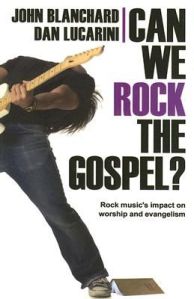
This is the main point of the first chapter of Can We Rock the Gospel, by Dan Lucarini and John Blanchard, and it gets even better from there.

“…rock music is worldly, evil, and something to be avoided.”

“Rock music is a stumbling block and a scandal to many Christians today and it is dividing the church.”

“…What is undeniable about rock is its hypnotic power.”

“…using [rock] in God’s service is spiritually perilous.”

“There is music that reflects God’s glory and there is music that does not.”

“…Christian rockers are… imitating a music style that was created and inspired by men who… have rejected the God of the Bible.”

“The central paradigm of rock ‘n’ roll is a kind of voodoo… that’s far removed from the sober values of western culture.”

“…Put out the fire. Demonstrate once and for all your allegiance to Christ and your opposition to Satan by clearing these musicians’ material out of your life and out of your home.”

“If you are serious about being a disciple of Christ you should not lay yourself open to possible demonic influence through these records.”

“The throbbing beat of rock-and-roll provides a vital sexual release for its adolescent audience.”

“Anything that might help to create that kind of syndrome (proclivity towards drug addiction because of rock music) should be avoided like the plague.”

“Kids at a heavy metal concert don’t sit in their seats; they stand on them and move – it’s the spirit of rebellion.”

“Rock music and tattoos have also seemed to go hand in hand… some Christian teenagers are rushing to get a tattoo… in direct violation of the fifth commandment.”

“Under rock music, the secretion of hormones is more pronounced… which causes an abnormal imbalance in the body’s system… and impairs judgment.”

“The low frequency vibrations of the bass guitar, along with driving beat of the drum, affect the cerebrospinal fluid, which in turn affects the pituitary gland, which in turn directs the secretions of hormones in the body.”

“…The essence of the actual musical form tends to reproduce itself in human conduct.”

“Rock music… opens the door to psychological manipulation.”

And there are still five more chapters to go!

“’Whoever therefore wants to be a friend of the world makes himself an enemy of God’ (James 4:1). No Christian in his right mind would want to play around with this warning!”

“Can a rock ‘n’ roll song explain what is meant by God, sin, judgment, the death of Christ, repentance, faith, or justification? If not, how can it convey the gospel?”

“Can we truly touch peoples’ hearts by tickling their ears?”

“The drum trap set arrived on the platform about two months ago. The respect, reverence, and humility have vanished from our sanctuary.”

“Rock music in all forms is controversial, closely associated with ungodly behavior, and at times downright dangerous. Why then would Christian musicians choose it to accompany the praise and worship of God… to proclaim the gospel of his grace… risk causing false conversions and creating soft disciples… (and) choose to offend millions of other Christians”

“…in our times we are dealing with a troublesome style called rock…”

“Nowhere in the Bible does God command us to ‘redeem’ music, nor does Scripture give any examples of God’s people redeeming the evil music of a secular or pagan culture.”

“Music about God should be like God…”

“Would you expect to find this kind of music in heaven?”

“It is our conviction that rock music… is… contrary to the teaching of Scripture.”

“Turning your back on rock music would set you free from the need to wrench your church music away from its grubby associations from things such as rebelliousness, occultism, sexuality, and the drug culture.”

“By abandoning rock music… you would be free to experience an infinitely healthier dimension of Christian life and witness.”

“Time saved in advertising, planning, organizing, supporting, and attending gospel concerts, religious road shows and the like could be put to better use in activities that have clear New Testament backing.”

I could go on with more quotes but the basic gist of the argument is this: rock music is satanic in origin. The music itself is dangerous. It cannot be redeemed for God’s glory. It must not be used in church. It is unbiblical. Those who enjoy or employ this style of music do so at their own and at their congregation’s spiritual and literal peril.

Their stories are sad: people who fell into deep sin and for whom a hallmark of that period was the presence of rock music, pastors who forced a new style on a congregation, insensitive worship leaders, hurt congregation members, and the sad temptation for some Christian musicians to seek their own glory or wealth through performance.

Their warning is dire: rock music is destroying the church, endangering the proclamation of the Gospel, and has power over anyone exposed to its beat. The beat itself is evil. It was designed to induce rebellion. It is a tool of Satan and it must be resisted.

But their arguments are fatally and fundamentally flawed. It all boils down to how you view handiwork and how you view Jesus.

1. Handiwork
Music is God’s handiwork. And guess what? We have been given dominion over handiwork.

Harold Best says it excellently in his book Music Through the Eyes of Faith:

“As glorious as the creation is, it was merely created and not begotten. A strawberry, a galaxy, a dolphin, and a sea lion are not in the image of God. They are handiwork, pure and simple, thus of an entirely different order.

The next point is crucial. Having made the creation and having created us in his image, God has given us particular assignment that could not have been given to any other created beings. In telling Adam and Eve to rule over the fish of the sea and the birds of the air and over every living creature that moves on the ground (Genesis 1:28), God was setting down a basic principle. Man and woman, created in the image of God… are neither the same as the rest of creation nor subject to it. While materially they can be outweighed by a mountain or overpowered by the force of the ocean, and while they are incapable of changing the speed of light, they cannot be morally, spiritually, or behaviorally overcome by anything in the creation around them.”

– The Creator Is Not the Creation and the Music Maker Is Not the Music, pg. 16

News flash, my Christian brother or sister: you have dominion over handiwork. Therefore, no beat, no chord progression, no rock band, no orchestra, no modulation, no snare drum pattern, no organ prelude, no electric guitar rhythm, and no brass trio has any power over you.

It would be absurd for me to look at a toaster and say to the person next to me: you better be careful standing next to that toaster. If it starts clicking to a certain rhythm, it will make you want to do drugs and have sex and rebel against God. It would be absurd because it would be granting a power to the toaster that it does not have. It would be making an idol out of the toaster to say that it has power over your actions.

We all know the power of music. The gift and the danger of it is that it moves us. All styles. All genres. All instruments. An unaccompanied chant can move us. A rock band can move us. Music moves us, and that’s how God (not the Rolling Stones) designed it. This is why anyone, whether it’s a choir conductor, a worship leader, an organist or a trombonist, must be careful. So God has given us the Holy Spirit (Ephesians 1:17), to help us steward his gifts (like music) with wisdom.

But it’s one thing to say music has power to manipulate our emotions and it’s an entirely different thing to say that music has power to manipulate our behavior, expose us to demonic influence, or keep us from proclaiming the Gospel. To quote Steve Brown, that’s a lie straight from the pit of hell and it smells like smoke.

The Christian has dominion over handiwork. Therefore, music does not have dominion over us. Even more therefore, the Christian can use any and all sorts of music to the glory of God. Nothing is outside the bounds. This is real freedom. And unless this makes you slightly uncomfortable, you probably don’t get it yet.

More from Harold Best:

“Let’s concentrate on something that almost never comes to mind: the music that Jesus heard and made throughout his life – the music of the wedding feast, the dance, the street, and the synagogue. As it turns out, Jesus was not a composer but a carpenter. Thus he heard and used the music made by other, fallen creatures – the very ones he came to redeem. The ramifications of this single fact are enormous. They assist in answering the questions as to whether music used by Christians can only be written by Christians and whether music written by non-Christians is somehow non-Christian. But for now, it is important to understand that even though we don’t know whether every piece of music Jesus used was written by people of faith, we can be sure that it was written by imperfect people, bound by the conditions of a fallen world and hampered by sinfulness and limitation. So even though we do not know what musical perfection is, we do know that the perfect one could sing imperfect music created by fallen and imperfect people, while doing so completely to the glory of his heavenly Father.”

– The Fall, Creativity, and Music Making, pgs. 18 and 19

Oh, how wonderfully freeing and exhilarating a thought: Jesus, the “perfect one”, the sinless, spotless, perfect Lamb of God, sang songs written by sinful people, in his generation, and he did so to his Father’s glory and pleasure.

God has given us music. It’s his handiwork. And he’s given us dominion over handiwork. If songs and melodies written by sinful men were still good enough for Jesus to sing, then we must not fear that we are in any danger because of them.

To say that a particular beat or genre or instrument can never be used to glorify God is to say that there are areas where God’s rule does not extend. And it is also to say that Jesus doesn’t offer full justification and redemption. And that leads to my final and most important point.

2. Jesus

“For by a single offering [Jesus] has perfected for all time those who are being sanctified.” Hebrews 10:14

One offering, once and for all (1 Peter 3:18), Jesus Christ crucified, makes me faultless before the throne (Jude 1:24), gives me confidence to approach the Father with confidence (Hebrews 10:19), not by my own merit (Ephesians 2:8), or because of my own efforts, but because I’ve been redeemed by Jesus (Romans 3:24).

Jesus covers all my sin. All of it.

And he covers all of my music too.

There is no indication in scripture that once you become a Christian and are “in Christ”, that is, reconciled to God (2 Corinthians 5:18), God’s pleasure with you or your offering is based any longer upon your own or your offering’s goodness. The purest we can make ourselves is still filthy before a holy God. The most innocent we can make our offerings is still not enough to prevent them from defiling his most holy place on their own.

Our selves and our offerings are covered by the blood of Jesus when we put our trust in him.

No music on its own is acceptable to God. Suppose you discovered a man on earth who had sinned the least. And this man had never heard any music before to corrupt his ears, never read any tawdry gossip to corrupt his mind, and never been tempted by an image. Suppose this man composed a beautiful symphony, performed by nearly-as-equally sinless as him. We can call this the most-pure musical offering that man can offer.

Now suppose you discover a worship leader who has committed his fair share of sins. He’s listened to all kinds of music, some good, some not so good, and some really good. He only knows a few chords and he really enjoys using those few chords to write simple worship songs and playing them with a band. There’s a drummer and bass player too. The genre could be classified as “rock”. They lead the singing at a church that meets in an old warehouse in Chicago. It gets a bit loud sometimes. We can call this the below-average not-terribly-refined, loosely rock ‘n’ roll offering.

Which of these gets closer to being acceptable to God on their own? The one composed by really good people? Or the other one that’s composed by a guy who listens to Coldplay and leads worship on the side as a volunteer? Which one pleases God more?

Answer: neither. God’s acceptance of an offering has absolutely nothing to do with that offering’s or the offerer’s goodness.

Our being accepted – and our music being acceptable – is 100% based on Jesus’ perfect sacrifice. We come to the Father through Jesus. Period. No other criteria. No other basis. No other questions asked.

We can’t make music perfect enough to please a perfect God.

In God’s eyes there is no “more acceptable” or “less acceptable”. Its all or nothing.

The good news of the gospel has far-reaching implications. Farther reaching than we might like to believe. So far that our music making is implicated.

Those who maintain that rock music cannot and should not be used in church are making a grievous mistake: they forget that Jesus is the only thing that makes our music and us acceptable to God.

God is great and greatly to be praised, and his greatness is unsearchable (Psalm 145:3). Thrown into one giant pot, every worship team, choir, pipe organ, guitar, choir anthem, contemporary song, bass guitar pattern, trumpet descant, four chord progression, Handel’s Messiah, chant, sung Psalm, and drum set add up to about 1/900,000,000th of the glory God is due. His glory is unfathomable.

And so God says to us: here is music. Use it, and use it well. You have dominion over it. Use it to my glory. And here is my Son, he will redeem you and make a way for you to offer it in my very presence. Let everything that has breath praise the Lord! (Psalm 150:6)

More Easter Eggs of Wisdom

Yesterday I shared some observations and tips for leading worship on Easter. I have a few more.

Watch out for the ladies who wear hats. If a woman comes to church wearing a hat, she means business. She’s in no mood to joke around. The bigger the hat, the more feathers and lace it contains, and the more valuable it appears, the more seriously you should take her.

Watch out for the dudes who wear pink pants. Listen, I know it’s Easter, but no man should ever be seen in public, especially in church, wearing pink pants. Alert your ushers to this man as quickly as possible and have him ejected.

If you ever need a good laugh, watch this video. “Christ the Lord is Risen Today” with “That’s Amore”. The best song combination in the history of time. 

People who correct you when you say “happy Easter” with “no… happy Resurrection Day!” should also be ejected. Yes, Easter has been commercialized and associated with bunnies and chocolate and eggs and spring time, but it doesn’t mean that if I choose to still call it “Easter” that I’m not a Christian. I am. And I really like chocolate. But not pink pants.

When/if you say “Alleluia! Christ is Risen! The Lord is risen indeed! Alleluia!” (or something similar) you might want to say it with some enthusiasm. Seriously, it’s Easter. This is amazing! Jesus Christ is alive! Then why do you sound like you’re reading me a bedtime story? Raise your voice a little bit. It’s OK.

Timpani make every song sound awesome. I don’t care what song you’re playing. Add a timpani roll and now it’s officially awesome.

Brass makes every song sound even more awesome. More so than timpani, throw a good brass quartet onto a song and now you’re talking. Jesus is not only alive but he’s coming back right here, right now, right on this chorus! (By the way, if the trumpet player aims correctly, he can take care of a few of those fancy Easter hats.)

Easter Sunday afternoon naps are statistically proven to be more satisfying than any other nap any other day out of the year. It’s true.

The Sunday after Easter is a good Sunday for the youth band to lead the music. You need a break. They hardly ever to get to play in the main services. Take a vacation and let them lead for you. Just make sure none of the guys wear pink pants.