Worship Leading Tricks – Pt. 1

The best way to grow in effective worship leading is to get as much experience as you can. You can’t rush it. Small groups, large groups, nursing homes, vacation bible schools, funerals, weddings, retreats, and Sunday mornings. Over the course of weeks and months and years, you’ll find yourself growing. And, hopefully, you’ll always be growing in your skill. If you ever think you’ve “arrived”, you’re mistaken. You’re probably in danger of a really embarrassing couple of services until you come to your senses.

But while growing in worship leading takes time, there are certain “tricks” that long-seasoned and very-beginning worship leaders alike can employ, regardless of how long or how briefly they’ve been doing it. This isn’t an exhaustive list, and these are listed in no order of importance.

The placebo mic
Let’s say you’ve just arrived in your job. You’ve inherited some singers whose voices are more suited for singing in the car – with no passengers – than singing in public. Asking them to step down from the team will start World War III. Talk to your sound engineer (if he’s trust worthy). Tell him you want that singer’s voice mixed solo. So lo you can’t hear it. Problem solved.

“Thank you so much”
Here are some things you might hear after a service: “That was just wonderful.” “That was my least favorite service in the history of time.” “I wish you would do more Bill Gaither songs.” “You remind me of a young Neil Diamond.” “I think you should do this song I heard on the radio.” “I couldn’t hear that singer standing next to you.” Your response? “Thank you so much.” Add on a brief conversation closer like “That’s very helpful” or “I’ll talk to my sound engineer” before closing with, you guessed it, “thank you so much”. Then repeat as needed until the person leaves.

Master your “I meant to do that” face
So you forget to do the last verse. You start off in the wrong key. Your string breaks and you have to switch guitars. You start to play your instrument but the pastor hasn’t finished talking. You sing the wrong words. You start a 4/4 song off in 3/4. Whatever your mistake is – unless it’s glaring – keep trucking. Act like you’ve got everything under control and you meant to do that, and 95% of the people won’t notice.

Less is more
I did a post on this a few months ago – but I’ll summarize it here. It’s better to leave people wanting more than to leave people begging you to stop. I’d rather end a set one song early than go one song too long. I have a hard time listening to my own advice on this one, but I try.

Don’t do too much new stuff
One new song: people will give it their best shot. Two new songs: people will try to muster enough energy to learn it, but won’t enjoy it. Three new songs: you’re pretty much on your own. Err on the side of choosing songs that the bulk of people will know. It will build capital and trust that you can then lean on and draw from when you teach something new.

You don’t have to say much
Don’t stress over what to say at the beginning, how to transition between songs, what to pray at the end, or what to say in between lines. There are really only two things you have to say: First, “let’s stand together and sing”, and second, “you can be seated”. If you’re comfortable saying more, and what you’re saying is helpful, then go ahead. But if you’re just not comfortable saying much, then don’t. Get them to stand, get them to sing, then get them to sit down.

Oops

A few Saturdays ago we began our Saturday service with the Stuart Townend/Keith Getty song “Creation Sings the Father’s Song”. If you don’t know this one you can read a post I did about it a while ago or just watch the YouTube clip here.

After an opening prayer and bit of liturgy we did a Stuart Townend/Aaron Keyes song based off of Psalm 62 called “My Soul Finds Rest”. It’s a great song. You can see it here.

Both songs are strong, congregational, truth-filled songs.

They also sound a lot alike.

So after the second verse of “My Soul Finds Rest” I was so caught up in the moment that I launched into the chorus of “Creation Sings”.

Oops.

Here’s how it sounded in all of its splendor.

OK, so a few lessons learned:

1. Don’t do two songs back-to-back, even if there is a pause between them, that sound exactly the same. And are in the same key. And have the same time signature. And both have three verses and a chorus. And both choruses have similar lyrics.

2. If you happen to mess up royally like this, there’s no way to hide it. Just keep trucking, laugh, and correct yourself.

3. Definitely don’t post the recording of this royal mess up on the internet.

But I just couldn’t resist letting you hear this moment of loveliness.

We changed one of the songs the next morning. That’s lesson #4: rehearsals and run-throughs (our Saturday service is always a good “run-through” for us) are always a good idea.

Don’t Believe Your Own Hype

You have a fan club, whether you realize it or not.

Maybe it’s small. A few old ladies who think you’re just adorable and ask when you’re going to make a CD.

Or maybe it’s larger. Gushing Facebook posts, lots of Twitter followers, people recognize you at the grocery store, and your church bookstore carries your very own CD.

Most worship leaders are somewhere in between. You don’t have a CD to sell or Twitter followers of any substantial number, but you do have a significant number of people at your church who see you up front regularly, have an affinity for you, and think you’re much more terrific and wonderful than you actually are.

In any case, it can be tempting to start to believe the hype that naturally surrounds anyone who stands on a stage in a position of leadership and possesses musical gifts. Before you know it you’re demanding only Evian bottled water, yellow M&Ms, and the auditorium a constant 72.4 degrees (that’s in Fahrenheit for my European friends).

Don’t believe your own hype. It’s a slippery slope to arrogance and pride and there is nothing that will hinder your effectiveness in ministry more. God isn’t exaggerating when he warns us that he “opposes the proud” (James 4:6).

Here are three practical ways you can keep the “hype” around you in check.

Be approachable
Avoid the temptation to cloister yourself away in a back room before and after the service. Rock stars do this. Worship leaders shouldn’t. Be available and approachable before and after the service. This is an easy and tangible way to demonstrate to your congregation that you love them, and to deflate the inflation of your ego.

Be humble
For anyone seeking to pursue humility, C.J. Mahaney’s book Humility: True Greatness is an absolute must-read. You can read it in one evening, but if you’re smart, you’ll take some time to read through it and allow the Holy Spirit to convict you and help you see where you need to grow.

It’s easy to say “be humble” but it’s hard to do. “Pursue humility” is a much better way to phrase it. Every morning, every day, and every night, resist the fleshly pull toward pride. Laugh at yourself. Encourage and honor those around you. Remember your sinfulness. Rejoice in Jesus’ work of redeeming you and covering you with his blood. That’s the only thing worth boasting in.

We start to believe the hype when we believe there’s something about ourselves that’s worth boasting in. Unless that “thing” is the cross of Christ, we’re off base.

Be cross-centered
Paul writes in Ephesians 2:1-3,

“…you were dead in the trespasses and sins in which you once walked, following the course of this world, following the prince of the power of the air, the spirit that is now at work in the sons of disobedience – among whom we all once lived in the passions of our flesh, carrying out the desires the body and the mind, and were by nature children of wrath, like the rest of mankind.”

You. We all. Our. By nature.

Verse 4:

But God, being rich in mercy, because of the great love with which he loved us, even when we were dead in our trespasses, made us alive together with Christ – by grace you have been saved – and raised us up with him and seated us with him in the heavenly places in Christ Jesus.”

But God. Two of the greatest words in all of scripture.

The hype tells us we’re wonderful and adorable and a really big deal. The cross tells us we were children of wrath but are now objects of God’s mercy.

As a worship leader, to be effective you have to be deflective. People will sinfully want to praise you. You’ll sinfully want to receive it and believe it. Don’t. Deflect the praise of man and direct your own need to make much of something great onto the One who is rich in mercy and worthy of every bit of hype we can muster.

Always Learning

Every single time worship leaders lead worship, there are certain things they could have done better.
This applies to beginner worship leaders and “seasoned” worship leaders. Whether it’s your first time or four-hundredth, there is always at least one thing you can look back on and say “I could have done that differently“.

Beginner worship leaders can run the risk of getting discouraged by all the things they could have done better, and thinking maybe they’re not cut out for it.

More seasoned worship leaders can run the risk of thinking they’ve made every mistake there is to make, and that they’ve mastered the art.

Worship leaders who are just starting out should take comfort in the fact that the process of maturing never stops – and those who have been doing it a little longer should keep that in mind too. No one ever “arrives”.

Tonight I led the music for our monthly men’s ministry gathering. In no particular order of importance, here are some things I could have done differently:

  • The first two songs we sang, “Blessed Be Your Name” and “Come Thou Fount”, felt a bit over-done. I think I’m doing those songs too often, especially at these monthly meetings.
  • The last song we sang, “Here I Am to Worship”, felt really over-done. I should put that song on hold for a while.
  • I got to church too late to do a sound check. Since it was just me leading on guitar, I figured it would work fine this way. My guitar ended up being too loud and my voice too quiet. I should always do a sound check with the sound engineer, if possible.
  • Some of the words on the slides went too far down. Since the ceiling is low, some men had a hard time reading the bottom line or two. We should make sure we adjust the slides when we’re projecting lyrics in that room.
  • I kept my eyes closed for much of the time. I did that this past Sunday night too. I’m getting back into that bad habit.
  • I went too long. I need to be sure I’m wrapping up when I’ve been asked to wrap up.

A lot of these things are relatively minor, and might not have stood out to anyone else in the room. My goal certainly isn’t to make a big deal out of these little issues or beat up on myself. But rather, I’ve found it helpful for my own growth, and a practical way to pursue humility, to be in the habit of asking “what could I have done differently or better“.

Even if there’s only one thing I can point to, and there always is at least one thing, then hopefully God will use that to keep me moving forward on the road of maturity.

There is Always Something to Learn – Pt. 2

Yesterday I shared some things I learned after spending a Saturday at Mariners Church in Irvine, California. It’s a church that is different from my church in many ways, but it is possible (and a good idea) to learn new things even from a church that is completely different from yours, and even when there might be things you’d rather not emulate. There has got to be something you can see or hear that will help you think about how stay fresh.

Here are a few more things I learned:

Don’t rehearse right up to the minute the service is about to start
Mariners builds in enough time to their rehearsal schedule to allow the band to be finished a good 30-40 minutes before the service start time. This gives the band a break and means the congregation doesn’t walk into the middle of a sound check. 

Invest in good equipment
Too many churches own lousy equipment, have poorly designed sound systems, use the wrong microphones, replace a piece of equipment only when it breaks, and replace that broken equipment with new lousy equipment. Whether your church meets in a living room, a cafeteria, a traditionally designed church building, or a 3,000 seat auditorium, make sure you buy the best equipment you can possibly afford.

Train and deploy volunteers in technical areas
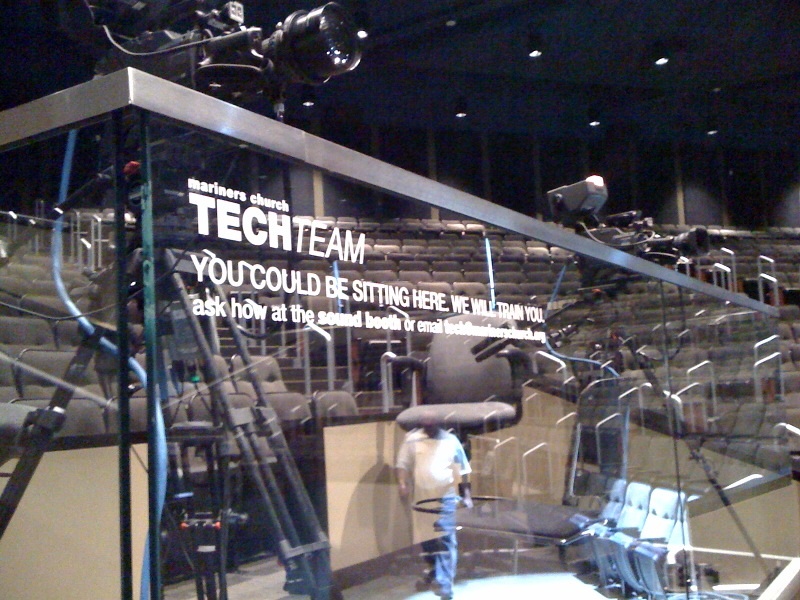
While Mariners has a very large staff, larger than many churches in fact, they depend on a large number of volunteers to help in technical areas. I loved this creative way of recruiting volunteers to run cameras: it says “you could be sitting here. We will train you. Ask how at the sound desk or…” Great idea. Who wouldn’t want to wear a cool headset and run a camera? Recruiting isn’t as hard as we make it seem sometimes.

Have fun
All of the rehearsals, production meetings, and run-throughs that I watched were, most importantly, efficiently run and fruitful. But they were also full of laughter and good-natured ribbing. No one took themselves too seriously. This seemed to make the long rehearsal schedule seem less tedious, break tension, and help foster humility. When Tim Timmons introduced me at rehearsal and said we “met online”, he received a fitting amount of roasting and mocking.

Getting a good electric guitar sound is possible
One of the highlights of my time at Mariners was meeting Russell Crain, their electric guitarist. I’ve always really appreciated Russell’s skill, creativity, visible engagement in worship, and musical taste. I also love the sound he gets out of his guitar. His overdrive is full and smooth, his reverbs/delays/echos are subtle and just-right, and his lead work cuts through the mix without being piercing. Russell is a humble guy and was kind enough to show me how he gets his sound. I’d like to do a post later on detailing his equipment and set up, but for now I’ll just say that he uses a Line-6 M13 stompbox modeler, volume pedal, and then one another pedal I can’t remember. This is fed into a Marshall amp that is backstage in a sound-absorption enclosure. They mic this amp in some creative ways that I’ll share later. The lesson I learned was that it is possible to get a good electric guitar if you have a skillful and humble player, the right pedals, the right amp, and the right mics.

Here is a video I took of Mariners beginning their 3:15pm Saturday run-through.

So as you can see, like I said before, this is a different kind of church than the one in which I serve. But there is always something to learn – if you take the time to look.