“Those who look to him are radiant, and their faces shall never be ashamed.” (Psalm 34:5)
A few weeks ago I was watching a worship service online that had Kathryn Scott as the guest worship leader. I’ve always enjoyed her songs (she’s best known for her song “Hungry (Falling On My Knees)”) but had never seen her lead worship before.
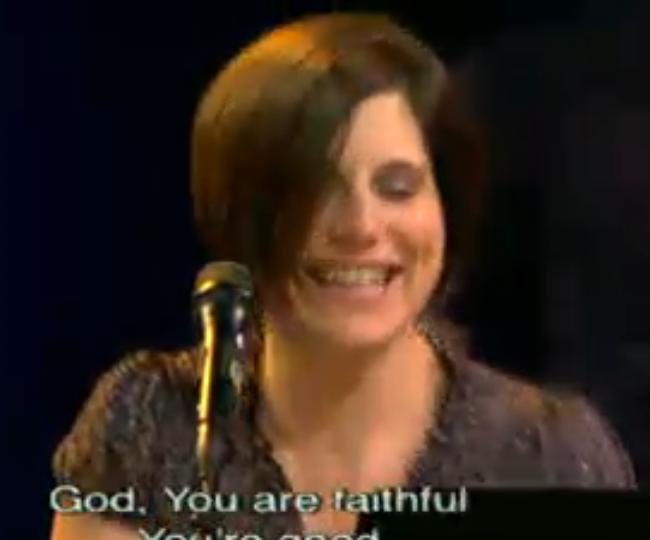
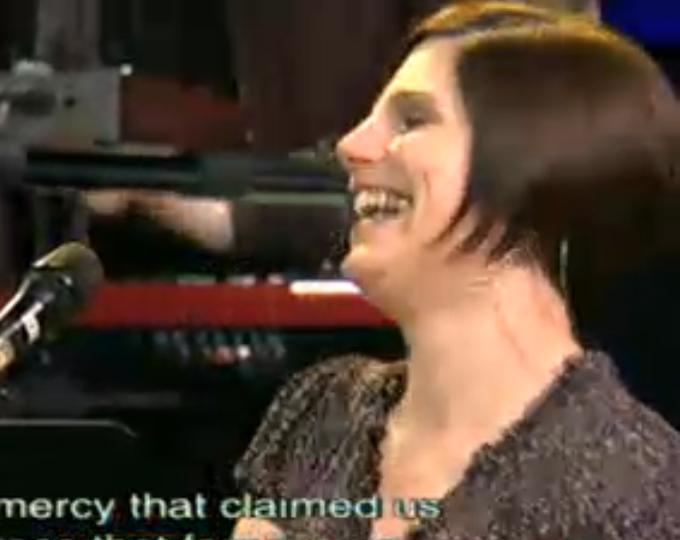
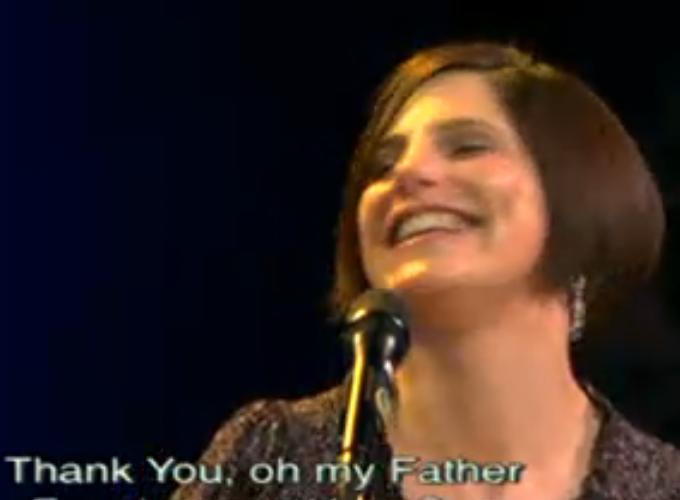
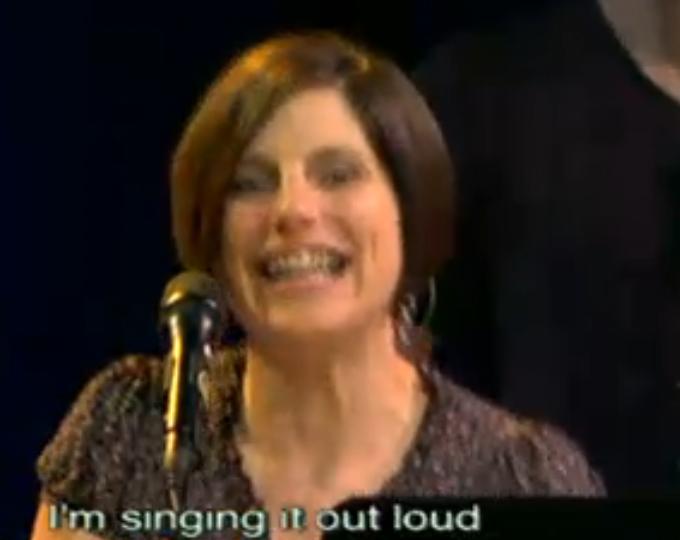
I was struck by the joy, enthusiasm, and smiling that permeated her leadership. Here are a few snapshots:
I’ve been told that I oftentimes look really intense, sometimes a bit angry, when I lead worship. I could learn a lot from Kathryn’s genuinely joyful example. What a difference it makes and what a message it sends!
Don’t be fake when you’re up front – plastering on a smile or putting on an act. Worship God genuinely and whole-heartedly, and model to your congregation God-centered worship.
But remember that what we’re celebrating and proclaiming each week is that God has rescued sinners through Jesus Christ – this is the Gospel, this is “good news” – and it’s worth smiling about!
This past Sunday at my church, I was sitting in the congregation and listening to the sermon, when I noticed an individual stand up and walk towards the back of the room. I thought it was an odd time for this person to leave since the sermon was almost over, and I also thought it wasn’t very discreet since they were sitting directly in front of the preacher!
About 15 seconds later, a huge gasp arose from the back of the room as this person proceeded to faint, fall onto the laps of a couple people, and end up lying on the floor.
Thankfully, we have several doctors and nurses who attend our church, two of whom were sitting within arm’s reach of where the individual fainted. We’ve also prepared for this kind of incident by installing emergency 911 buttons at our sound desk, and training our ushers how to respond. This person was taken to a hospital within minutes and released that afternoon, but it was still a huge disruption to the service.
It’s impossible to know when a service might be interrupted by a medical emergency. But it’s good to think through how you should respond. Bill Haley, one of our associate pastors who was preaching, handled it like a pro. Here’s what he did:
Don’t pretend it’s not happening! Bill recognized he has lost the attention of the room, and that someone needed help. To continue with his sermon would have been futile and foolish. He could pick up his sermon later, but he had to address the emergency first.
Ask if there are any doctors in the room Bill was in mid-sentence when the person fainted. After hearing the loud gasp and seeing that someone had fainted, he immediately said: “are there any doctor’s in the room?” Seconds later, an ER doctor and a handful of nursed were at the person’s side. Bill had the advantage of a microphone, and he used it well.
Pray Once this individual had medical attention and 911 had been called, Bill said: “let’s pray”. He led the congregation in praying for the person until they were being carried out of the room.
Slowly get back to where you were After this person was taken out to the lobby, he reassured people that he would update us on their status at the end of the service, encouraged us to keep praying for her, reminded us that God was in control, and slowly transitioned back into his sermon.
Recognize that the dynamic in the room has changed I had planned to follow Bill’s sermon with Enfield’s arrangement of “Crown Him with Many Crowns”. Knowing that people were still shaken up and distracted, we changed the arrangement on the fly to be a bit more laid back and less aggressive. To follow a medical emergency with a rock version of a hymn could have been perceived as insensitive and jarring.
One thing that Bill did that ended up adding to some of the confusion was to ask intercessory prayer team members to go lay hands on the person who had fainted. This resulted in too many people being around, and required the doctor and nurses to tell people to go back to their seats. Next time, I’d ask people to extend a hand towards the person from their seat, but to leave room for the professionals to do their job.
I may never have to deal with this particular scenario again, and you may never face this kind of “awkward moment” in one of your services. But when you’re dealing with a group of people standing up and singing for long periods of time, a variety of ages, 52 Sundays a year, and just plain old odds, it’s most likely going to happen someday.
These last couple of weeks have been really weird for people living in the Washington D.C. area.
First, we got hit with 30 inches of snow on Friday, February 5th. Everything shut down that day and the weekend immediately after. Most churches in the area canceled their Sunday services (we had one service with about 175 people), and then on Monday, all local schools, county governments, and the Federal government stayed closed.
After beginning to dig out on Tuesday, we got hit with another blizzard on Wednesday that resulted in schools being closed the entire week, local and federal government closing for two more days, awful road conditions, horrible traffic, bored kids, exhausted parents, and everyone’s schedules being thrown completely off track.
So this past Sunday morning as we began singing “Praise the Lord” by Doug Plank and Bob Kauflin, I was aware that many people were coming in from an exhausting and crazy week and a half, and all of us were feeling like it had been a long time since we had felt like things were back to normal.
It seemed like I needed to help people wake up and “shake off” all the weirdness that had come from two back-to-back snow storms. If I just plowed through the songs without addressing in some way the fact that our lives had all been significantly disrupted over the last ten days, I’d be ignoring a giant elephant in the room.
The first thing we did was start the opening song off in a way designed to help people join in. Instead of hitting them with a wall of sound, we took the first verse and chorus with just a few instruments and voices and then gradually ramped up.
Secondly, I tried to model an enthusiasm and eagerness in my singingand expressiveness. If I had come across as blizzard-beaten or feeling weird, that would have spread into the room.
Thirdly, I took a minute in the middle of the song to welcome people, explain why we were starting off in an upbeat way, invite them to clap with us, and encourage them to “shake off” the snow, the cold, the horrible traffic, and the historically bad commute from the previous Friday morning. It wasn’t the most eloquent thing I’ve ever said, but it seemed to help people relax.
You can listen to how it sounded here:
A few caveats:
– I don’t do this kind of thing every Sunday. If I did, it would get old. Quickly.
– I try to be gentle and confident. I don’t want to boss people around, but I also don’t want to come across as timid.
– I don’t want to be a comedian, but I want to have a tone of good humor in my voice
– My goal isn’t to whip people up into a frenzy, but to break the ice, and help people feel comfortable.
– No one likes waking up with cold water on their face.
If you’re leading worship and you get the feeling that people are a bit sleepy, I’m not suggesting that interrupting the song and telling people to “shake” it off is how you should always handle it. Besides, what does it mean to “shake” something off?
Usually, the best thing to do is just be patient, keep faithfully pointing people to the glory of God, and learn what you can from that experience to show you if there’s something different you can do. It’s not always all that complicated.
But every once in a while, if you do it sparingly and lovingly, just a simple and friendly encouragement can help.
I’m always a bit confused when, having just been talking to a worship leader with a normal voice and normal word pronunciation, he proceeds to lead worship and sing with a completely different voice and with strange pronunciation. What just happened? Is that the same person I was just talking to? Is he trying to be cool? Does he have a speech impediment that you can only hear when he sings or prays?
Where we might say “open the eyes of my heart, Lord”, he says: “ohhhpin de ahs of my hearrrt, Lird” (with lots of vibrato for special effect).
Or instead of “better is one day in Your courts” it becomes “bedda is a one deh in yir kirts”.
In some cases when he prays he might alternate between a ultra-breathy and halting whisper or a Shakespearean/Charlton Heston-esque bravado.
I’m not talking about when people with different accents pronounce words differently than my American english (i.e. Kristyn Getty pronouncing “power” as “par” in her Irish accent). I’m talking about when someone takes on a completely different and unnatural voice when a microphone is placed in front of their face.
Some worship leaders don’t realize they’ve developed a “worship leader voice”. It’s just a bad habit they’ve picked up over time and no one has had the boldness to break it to them. Maybe you’re this kind of worship leader. Or maybe you need to break the news to someone who is!
Other worship leaders do it on purpose – thinking that it’s how a lead singer is supposed to sound, it makes them come across as more emotional, or that different pronunciation rules apply when you sing versus when you talk. If you’re this kind of worship leader, may I plead with you to consider leading worship with your normal voice?
When you take on a different identity when you lead worship (which is what I would argue is going on when you change how you talk or pronounce words when you’ve got a microphone in front of you), you are making yourself a much larger presence in the room than you need to be. Some people might not notice what you’re doing – but a lot of people will. And to those people, they will spend half (at least) of the service trying to figure out what’s bothering them, realizing it’s you, and then trying to get past it.
You’re also sending the signal, whether you intend to or not, that you’re up front to perform. Why else would you be pretending that you talk or sing a certain way when in reality you don’t? It gives the impression that there is an aspect of your singing or praying which is artificial or contrived.
Worship leaders should be seeking to be as minimal a “presence” in the room as possible. Not distracting people with a sudden linguistic transformation is one way to do that.
Just be yourself when you lead worship. Don’t take on a different persona or change how you talk or pronounce words with mangled vowels or drawn-out “r’s”. Be the same person and use the same voice when you’re on stage and off. And watch the vibrato.
This past Sunday I thought it would be a good idea to begin the service a bit differently, by singing Joseph Stigora’s version of Psalm 96. I first heard this version at the 2008 Worship God conference (the time when they started it off in two keys) and really liked it. The chorus (“sing to the Lord a new song, sing to the Lord all the earth, sing to the Lord, bless his name, tell of his salvation from day to day”) is congregational, with the verses sung by the worship leader. It’s unusual for us to start off a service with an unfamiliar song, especially a song where the congregation doesn’t sing on the verses, but it seemed appropriate this past Sunday and I was looking forward to it.
Looking back, however, I realize that I forgot one important detail: since a good number of people come in late, or come in once they hear the music start, about half of the congregation wouldn’t hear my instructions to only sing the chorus and to listen to the verses.
So what ended up happening was that anyone who came in after I gave those instructions (a few hundred people) was really confused.
How come no one is singing the verses? Is Jamie expecting us to know these verses? These verses are not very easy. Have we ever sung this song before? What am I supposed to do on the verses – just stand here or something? The words are on the screen – but no one around me is singing them. This is weird.
It didn’t quite work out the way I thought it would work out. A good portion of the congregation seemed genuinely confused and not sure of what to do – which is a strange way to start off a service. I got a very kind email on Monday morning from a friend in the congregation (who walked in after I told the congregation to only sing the chorus) and let me know how hard the verses were to sing – and how no one around him was even trying!
So… lesson learned: it’s confusing for people when they walk into an already-begun service and are out of the loop that they’re not supposed to sing the verses to a song. Maybe it would be a better idea to wait until further into the service.
I’ll keep trying new, different, and fresh things. Some will work, some will not. It’s good for the congregation and it’s good for me. There’s nothing to be afraid of!

 This past Sunday at my church, I was sitting in the congregation and listening to the sermon, when I noticed an individual stand up and walk towards the back of the room. I thought it was an odd time for this person to leave since the sermon was almost over, and I also thought it wasn’t very discreet since they were sitting directly in front of the preacher!
  These last couple of weeks have been really weird for people living in the Washington D.C. area.
 I’m always a bit confused when, having just been talking to a worship leader with a normal voice and normal word pronunciation, he proceeds to lead worship and sing with a completely different voice and with strange pronunciation. What just happened? Is that the same person I was just talking to? Is he trying to be cool? Does he have a speech impediment that you can only hear when he sings or prays?
  This past Sunday I thought it would be a good idea to begin the service a bit differently, by singing Joseph Stigora’s version of
  Worthily Magnify