More Easter Eggs of Wisdom

Yesterday I shared some observations and tips for leading worship on Easter. I have a few more.

Watch out for the ladies who wear hats. If a woman comes to church wearing a hat, she means business. She’s in no mood to joke around. The bigger the hat, the more feathers and lace it contains, and the more valuable it appears, the more seriously you should take her.

Watch out for the dudes who wear pink pants. Listen, I know it’s Easter, but no man should ever be seen in public, especially in church, wearing pink pants. Alert your ushers to this man as quickly as possible and have him ejected.

If you ever need a good laugh, watch this video. “Christ the Lord is Risen Today” with “That’s Amore”. The best song combination in the history of time. 

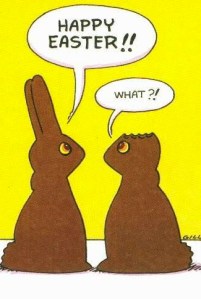
People who correct you when you say “happy Easter” with “no… happy Resurrection Day!” should also be ejected. Yes, Easter has been commercialized and associated with bunnies and chocolate and eggs and spring time, but it doesn’t mean that if I choose to still call it “Easter” that I’m not a Christian. I am. And I really like chocolate. But not pink pants.

When/if you say “Alleluia! Christ is Risen! The Lord is risen indeed! Alleluia!” (or something similar) you might want to say it with some enthusiasm. Seriously, it’s Easter. This is amazing! Jesus Christ is alive! Then why do you sound like you’re reading me a bedtime story? Raise your voice a little bit. It’s OK.

Timpani make every song sound awesome. I don’t care what song you’re playing. Add a timpani roll and now it’s officially awesome.

Brass makes every song sound even more awesome. More so than timpani, throw a good brass quartet onto a song and now you’re talking. Jesus is not only alive but he’s coming back right here, right now, right on this chorus! (By the way, if the trumpet player aims correctly, he can take care of a few of those fancy Easter hats.)

Easter Sunday afternoon naps are statistically proven to be more satisfying than any other nap any other day out of the year. It’s true.

The Sunday after Easter is a good Sunday for the youth band to lead the music. You need a break. They hardly ever to get to play in the main services. Take a vacation and let them lead for you. Just make sure none of the guys wear pink pants.
Little Easter Eggs of Wisdom

In case you haven’t noticed, Easter is just around the corner. This is one busy week for worship leaders and church musicians with a lot of extra rehearsals, added stress, and raised expectations. Last year I wrote a post on keeping it all in perspective, so this year I thought I’d offer just a few random lessons I’ve learned over the years of leading worship on Easter. These are in no particular order of importance.

“Christ the Lord is Risen Today” is too high in D major. Most hymnals have this classic hymn in the key of D. That’s fine for the first two lines, but then towards the end you start hitting some high F#s. Too high, especially at a 7:00am sunrise service. Go with C major. It keeps the high note to an E, and the lower notes are still singable.

Make sure your overflow room is staffed and pretty. I’ll never forget walking past our overflow room one year and seeing a room full of nicely dressed people, sitting in a dark room, staring at a grainy video image, listening to a low quality audio feed, looking like they were at a funeral. Easter shouldn’t feel like a funeral (obviously). If you’re anticipating having an overflow room, make sure it’s bright and has flowers, has a great video and audio feed, and put some live singers in there to sing along with the music and encourage the people to do the same.

Don’t forget the food. I wrote a post a few months ago on how important it is to feed your team (literally). Easter Sunday is usually a long morning for the pastors, musicians, and volunteers. Make sure to get some coffee, juices, water, and food for people to snack on all morning long. It will keep morale up and keep people’s energy going strong.

Stick with familiar songs. On Christmas and Easter, people want to sing familiar songs. This can be tough because there are many more familiar Christmas carols than there are Easter hymns. Do throw in some newer songs, but I would caution you against trying anything brand new. Your congregation won’t mind singing familiar songs, and your visitors will appreciate your thoughtfulness.

Stay away from the cheese. It’s hard to find good art/graphics to use on your screen or in your bulletin. The internet abounds with images of bunnies, eggs, and cute sunrises. Unless it’s good quality and adds something – don’t use it.

Dress up. Guys, wear a tie. Ladies, wear something nice (and modest!). Unless you serve in a setting where wearing a tie or nice clothes would make you stand out, go ahead and dress up on Easter. It’s always better to be overdressed than underdressed, and this way you don’t run the risk of coming across as flippant.

Treat this like your super bowl. This is most likely going to be the best-attended Sunday for your church this year. Make sure your campus looks nice, your signs are clear and in place, your chairs are well placed, and you’re ready for visitors.

Remember where the power comes from. The gospel will change people’s lives, not your music. Make sure the good news of Jesus Christ – our risen Savior who conquered sin and death on the cross – is proclaimed with clarity and passion. Make it plain, make it clear, make it central, and make it the focus. 

A Room Full of Stories

I came across this powerful video made by, of all places, Chick-Fil-A. It’s a powerful reminder that every person who walks through the door of your church has a story. Many are experiencing great trials and heartbreak. Others are experiencing joy. No two people are the same.

When you look out over your congregation this weekend, ask God to give you a love for them. They all need to hear the good news of a Messiah who rode into Jerusalem on a donkey and then was lifted on a cross five days later for our sins. He lives again and he is our hope.

Spreading the Honor Around

As a worship leader, you are one of the most visible people at your church. The administrative assistant to children’s ministry might have been there longer, get paid less, and do more work, but because you get up on platform each week, you get more recognition, you get more thanks, and you get more credit than you deserve.

Your church might not have a very large staff at all. Most churches don’t. I happen to serve at church with 40+ full-time staff, and 15 or 20 more who are part-time, but this isn’t the norm. Regardless of how large the staff is at your church, the principle is the same: you get more attention than the other people who care about and work for the church just as much as you do.

You have to be really careful as a worship leader not to buy into the notion that your work is more important than the secretary’s, or the nursery worker’s, or the outreach coordinator’s, or the youth pastor’s. And if you’re smart, you’ll make a point of honoring those people in less visible positions than yours.

Paul wrote in 1 Corinthians 12 that we are one body with many members. That body stays healthy as long as the different parts don’t start thinking they’re more or less important than other parts of the body. In verse 25 we’re told that all the members of the body should “have the same care for one another. If one member suffers, all suffer together; if one member is honored, all rejoice together“.

You are just one part of the body. You have a unique role – but you’re not any more important than any one else. You’re not the big kahuna. You’re one of the fish.

You probably know this (although we can always use a reminder). The point is that your fellow staff members, volunteers, or behind-the-scenes coworkers might not feel like you act like it. There’s a good chance you don’t. Think about it.

Because you are one of the most visible people at your church, you need to go out of your way to show honor to the people who are not as visible. Write a note, say thank you to the person who empties your trash can, tell the nursery worker what an amazing job they do and how grateful you are for them, and don’t expect any compliments in return.

Sure, we get a good dose of criticism because we’re up front. But we also get more than our fair share of compliments. Pass some of that around to your fellow body-members, and they’ll all operate just a bit more healthily because of it.

Small Words That Make a Big Difference

Sometimes all you have to do as a worship leader to make it easier for people to follow you is know when to say some simple words. People will follow a person they can trust, a person who makes them feel at ease, a person who is looking out for them, and a person that is trying to make it easy for them to follow along.

Here are some examples of small words you can say that will make a big difference:

“If you’re able…”
When I’m leading music for a healing service, or a service where I’m aware there are people who can’t stand up and need to remain seated, I’ll say “if you’re able to stand, why don’t we stand together to sing”. You might use this phrase when you’re aware of a person or larger proportion of people who can’t participate with the majority of people. It helps them feel cared for, and it won’t bother the people to whom it doesn’t apply.

“If you’re comfortable…”
Obviously you don’t want to use this one all the time. But used intentionally and sparingly, it can help people if you say things like “if you’re comfortable, perhaps you want to open your hands in a posture of surrender to the Lord” or “if you’re comfortable, let’s clap our hands together as we sing”. You might use this phrase more often when you’re leading a reserved group of people in expressions of worship that might push the envelope a bit.

“We’re going to learn a new song…”
When I was first starting to lead worship, I used to introduce new songs by saying “I want to teach you a new song”. My youth pastor told me this was a bit annoying. It put the congregation in a position of being my students as opposed to my fellow-worshippers. Try phrasing things in a way that puts you all in the same boat.

“Let’s continue in worship…”
I’ve lost count of how many times I’ve heard a worship leader get up after the sermon and say “let’s worship” or “now we’re going to worship”. News flash: the whole service should be seen as an act of corporate worship. The singing is one form – it’s not the only form. Your congregation will be served and your pastor will be honored if you phrase things in such a way that paint the whole service as being worship.

“Let’s sing that first verse again…”
Your congregation/lyrics operator/worship team can’t read your mind. If you know you’re going to go back to the first verse or back to the bridge, tell them that’s what you’re going to do, and give them the first three or four words.

“This song might be new to you…”
If you taught a song three weeks ago and haven’t done it since, you should treat it like it’s 90% new. Consider saying “we’re going to sing a song we learned a few weeks ago. It might be new to you, so we’ll sing the first verse a couple of times, and you can join in as you’re able”. The goal isn’t to baby people or say so much that you get in the way, but just to acknowledge that you know the song is new but that you’d really like them to sing.

“You can be seated”
If you’re the one who wraps up the time of singing and people are supposed to sit, you might as well tell them. If this isn’t an issue for your congregation and they just know when to stand and when to sit, that’s great. But sometimes people do appreciate being told what to do. Few things are more awkward in a service than half the people sitting, half the people standing, then those people sitting, then everyone being asked to stand again, etc.

A good host is mindful of how his guests are doing at all times. A good usher is there when you need him but invisible when you don’t. A good tour guide shows you the amazing sights and keeps you from wandering off, but otherwise gets out of the way. Sometimes being a good worship leader just means doing little things well, and those little things flow from keeping the people that you’re leading in mind.