Knowing How to Respond to Sunday Morning Complaints

1I don’t understand what people are thinking when they approach me on a Sunday morning with that fire-in-the-eyes look that says “let me give you a piece of my mind”. Can’t they understand that I’m busy? Don’t they see that I’m juggling a bunch of different mental and actual demands? Apparently not. And people in ministry all over the world and throughout the history of time have had to deal with the people who want to get into a conflict at the worst possible time of the entire week. It’s crazy.

This happens to me about three times a year now. I’m fortunate. Other worship leaders and/or pastors get it every week! But in one of the more memorable episodes, after a morning when I used the “That’s My King!” video as a call to worship, I was approached by an individual who had been very offended by it. He expressed himself to me for several minutes and every instinct in my body was to give it right back to him. I wanted to return the favor and give him a piece of my mind.

But I didn’t. I listened, gave lots of head nods and “hmmms”, thanked the man for sharing his concerns with me, assured him that I meant no offense, apologized for any offense that was caused, and he left slightly pacified. Of course, the rest of the afternoon I spent rehearsing in my mind what I could have said or what I should have said to set the man straight.

I wrote a former seminary professor of mine, Steve Brown, the next day and I apologized to him. If you’ve ever listened to Steve or read any of his stuff, you’ll know that he encourages pastors/people in ministry to be real, to not be afraid to offend people, and to not take people’s “stuff” when they they throw it at you.

I said to Steve: I’m sorry. I let you down. I had a guy come up to me after church yesterday who laid into me and I just stood there and took it. I didn’t fight back. I should have. Next time I will.

He wrote back. Here’s some of what he said:

I just stopped and prayed for the guy who came up to you with his drivel…

…that he gets the hives.

We showed that video at our church and the people were cheering by the end.  Anybody who doesn’t “get” the power of that is spiritually dead.

And you didn’t let me down.  In fact, you did the right thing.  Jesus said that we were to be as innocent as a dove and wise as a serpent.  You did the innocent thing.  The wisdom comes in knowing whose butt to kick and when to put it off for a better time.  The last thing you needed was to “speak truth” to a guy like that. 

But there will be other times.  Keep your gun loaded.

Steve was right.

9 times out of 10, when people approach you on a Sunday morning with complaints, the wise response is to kindly listen and then thank the person. You don’t need to deal with handling conflict when your attention is on leading the congregation and leading your team.

The only time I think it’s wise to rebut people is: (1) if it’s before the service. Tell them it needs to wait. Don’t let them throw you off your game. And (2) if they’re attacking you personally. They can criticize your song choices, volume, arrangements, etc. But if they come at you personally, you’re within your rights to say to them that you’d appreciate it if you had this conversation some other time and perhaps with your pastor present. That should take care of that.

We have enough on our plates on Sunday mornings without having to add doing battle with offended congregants. In that moment, unless it’s before a service or they’re attacking you personally, just let the Holy Spirit be Christ in you. And just like Jesus took scorn and insults and responded (most of the time) with love and wisdom, so let our response be also.

The Useless Sound of an Indistinct Bugle

1My almost 2-year-old, Emma, is starting to talk. It’s super cute and fun, and we are loving it. The only problem is that no one else can understand what in the world she’s actually saying.
For example: “goke” can mean “milk” or “broken”. Or “shah” means “straw”. Or “gang gang” means “candy cane”.

She’s talking alright. But it’s indistinct. What she’s saying isn’t clear enough for most people to understand.

In his first letter to the Corinthians, Paul spends some time giving them instructions on corporate worship. Apparently some of them are getting together and having a wonderful time using the gifts of the Spirit, but no one else who walks into the room has any idea what’s going on.

He says to them, in one of his more wonderfully pointed moments:

…if the bugle gives an indistinct sound, who will get ready for battle? So with yourselves, if with your tongue you utter speech that is not intelligible, how will anyone know what is said? For you will be speaking into the air. (1 Corinthians 14:8-9)

The specific thing he’s talking about is the use of the gift of tongues, but the principle applies much more broadly. The principle is this: when you get together as Christians, make sure what’s going on is as clear as possible.

Imagine the uselessness of an indistinct bugle. You hear it off in the distance and you think it’s calling you to battle. But the person next to you disagrees completely. He says it’s announcing the arrival of royalty. Someone behind you speaks up and says you both have it wrong. It’s the sound of a musician playing a ballad for his lover.

Total confusion.

So imagine the uselessness of indistinct message in our songs. You hear it and you think it’s talking about Jesus’ second coming. Your friend hears it and says it’s about the trials we face. You get an email from someone thanking you for that very same song that she says is talking about her loved one who’s in heaven.

Huh?

It’s comforting that God knows our hearts completely, regardless of whether we use the right words. We don’t have to articulate ourselves to him perfectly for him to get the picture.

But if the Apostle Paul were to walk into your service this Sunday and sing the songs you pick, would he say you were “uttering speech that was not intelligible” or that you were “speaking into the air”? That wouldn’t be a good thing.

As worship leaders we should aim for clarity and distinction in our proclamation of the good news of the Gospel so that everyone who comes in, and who has ears to hear, can hear. And understand what in the world you’re actually saying.

Praise My Soul the King of Heaven

1Having grown up in the Episcopal/Anglican church, one of the hymns I grew up learning to sing and love was “Praise My Soul the King of Heaven”. The first time you hear it the melody is a bit tricky. But it’s good. And the lyrics are full of powerful descriptions of the kingship and worth-ship of Jesus. But I never had much success putting the hymn in a more contemporary format.

One night in 2009 I was watching the consecration of Bob Duncan as the first Archbishop of the Anglican Church in North America and during the incredibly long procession of clergy and bishops, the orchestra and choir led the congregation in a powerful arrangement of the hymn. It turns out that John Wasson, a worship leader/musician in Texas had written the arrangement just for that occasion.

You can watch the really long procession and hear John’s full arrangement on this rough YouTube video:

It wasn’t long until I was trying to rip off John’s arrangement to use this hymn at my church. I experimented (with varying levels of success), but the result was that I had found a way to bring this amazing hymn into a contemporary context. The other small change I made was to close the song by going back and singing the last line of first verse after singing the final verse. It ends better that way.

When my congregation received word that we’d have to vacate our property of over-275 years, and I started exploring the prospect of recording a live CD in our Sanctuary before we lost it, I knew we’d have to put this hymn on it and try to capture a bit of the arrangement John had written in 2009. But… it couldn’t be as incredibly long.

So I sat at my kitchen island one night, about 6 days before we’d start recording the CD, watching the video of the song from Bishop Duncan’s installation, hearing Carl Albrecht‘s drumming in my head (since I’ve been listening to his drumming since I was a kid and he had kindly agreed to play drums for this project), Russell Crain’s electric guitar genius (since I had come to admire his playing when my Father-in-law began pastoring a church that neighbors his), and Simon Dixon’s organ prowess (since he and I have the privilege of working together).

I wrote a rough arrangement of it and recorded this really (really) rough demo. Oh, I was recovering from the flu, I just remembered:

Like I said, it’s rough. So when we began rehearsals for the CD, Carl suggested we cut the intro by half. Great idea. Then Russell began experimenting with different things he could do on the intro. On the first night we recorded, here’s what the intro sounded like:

Russell thought he could do his part better, so on the second night, he changed some things.

The result of all of this thinking/arranging/demo-ing/rehearsing/tinkering is on my church’s live CD. Here’s the final full-song result in its mixed and mastered form.

If you’d like to download it for free: click here.

Here’s the chord chart we used for the recording. If you want a more simple chord chart (without the crazy chords on verse 4 that we put in to work with the choir descant, click here).

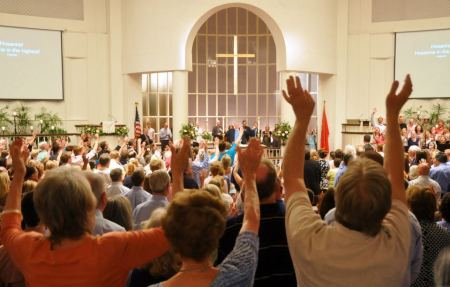
Here’s my church singing the more simplified version of this hymn in our last service ever in our building. The picture at the top of this post is from that night too.

Figuring Out Who You Are

1When I was first starting to really get into worship leading during middle school, I was spending a lot of time listening to a Pentecostal worship leader out of Florida. You wouldn’t know who he is, since the only reason I could listen to him was because my Mom had subscribed to that church’s sermon ministry and when they sent the tapes they included the whole service.

So I’d listen to those tapes and sit there transfixed. The worship leader (and team) was really good. This stuff wasn’t edited or produced or anything. This was live, straight-from-the-sound-board, as-it-happened worship. In classic Pentecostal style, they could take a 3 or 4 minute song and make it go (and go) for 15 minutes. And the more they repeated a song the more people seemed to get into it.

You can criticize that style all you want, but for me at that point in my life, attending and leading worship in an old, dead Episcopal church, listening to those tapes was like water to my thirsty soul.

Naturally, when you listen to a particular worship leader and/or style of music for a while, you start to copy it. And so I, a middle school boy leading worship at a little Episcopal church, began to replicate the Pentecostal worship leader I was hearing on the tapes.

The guy on the tapes could hit a high G and make it sound like he wasn’t even trying. When I tried to hit a D it sounded like I was mimicking a farm animal. The guy on the tapes would add all these phrases and runs and cool embellishments and it made the congregation respond with more vigor. When I tried to do something cool it just sounded like I was… well… trying to do something cool.

I was over-doing it. Big time. Instead of being who I was, a fourteen year old guy who had an average voice, was pretty good on the guitar, and loved to worship, I was trying to be the guy I was listening to on my Walkman after school every day.

I began to become aware of this problem when I started recording our times of worship and listening back to them. As much I wanted to convince myself that I sounded awesome, I couldn’t. I was embarrassed. I felt bad for the people who had to endure my attempts to hit high notes, do cool embellishments, and be somebody I wasn’t. Thank God that the youth group I was leading worship for was gracious and encouraging and never critical.

So for several years, into high school and college, I began an adventure of attempting to lead worship as myself. I would swing from trying to be Bob Kauflin to trying to be Stuart Townend to trying to be Tim Hughes to trying to be like Matt Redman.

But eventually the time came when I had led worship for long enough, gleaned different positive things from different worship leaders I had seen or heard, made enough mistakes, and had enough freedom to stretch my own wings, that I began to get comfortable in my own skin. I was figuring out who I was as a worship leader, and who I wasn’t.

This process is ongoing. I still catch myself trying to be someone I’m not. But, by God’s grace, I feel less and less pressure to be someone I’m not.

How about you? When you lead worship are you trying to be someone else? Have you picked up things from other worship leaders that just aren’t who you are? Are you over-doing? Maybe you just need to relax and not try as hard to be who you think you need to be when you’re leading worship.

Incorporate all the good things from other worship leaders that you see or listen to. Learn as much and as often as you can. Always be eager to make adjustments to how you lead. But at the end of the day, be yourself.

A New Year To Do Old Things

1So it’s 2013. A new year, a fresh start, and a new number you have to get used to writing on your checks. That’s the hardest part for me.

We hear a lot in these first few weeks of a new year about doing new things, or making new resolutions. There’s a pressure on us, in our personal lives and in our professional lives, to do things a little bit differently.

Worship leaders aren’t immune to this pressure. We can begin feel the need to be more innovative, creative, and different than we were last year. Just this morning as I was watching the archived first session of the Passion 2013 conference I noticed feeling the pressure: teach these new songs, incorporate these new sounds, and do it this coming Sunday.

Growing and changing are not only good things, but they’re necessary things. Living things grow and change. Psalm 1 describes the man who delights in God as being like “a tree planted by streams of water…” Since when have you seen a living tree not change from year to year?

But the focus on the new can come at the expense of the focus on the old. Yes, it’s good to let God grow us up and change us as worship leaders as we draw from him. But don’t forget the old things that you’re called to. Year after year after year.

Love Jesus. Study his word and worship Him when no one’s looking.

Love your family. Don’t fall victim to the worldly pressure to overwork and miss out on your commitments in the home.

Love the Church. With all of its issues and problems and politics, it’s the body of Christ and you’re a part.

Love your worship team. Don’t treat your worship team like they’re just a bunch of names on a monthly schedule. Build community and foster friendship among your team.

Love your congregation. Don’t become a celebrity who only appears on a stage every Sunday. You might be a great singer, but if you don’t have love, you’re just a resounding gong (1 Corinthians 13:1).

Love to see your worship team leading your congregation in singing to Jesus. All of the above combine in a worship leader’s heart that finds no greater joy on Sunday morning than being caught up in praise to Jesus with a worship team and a congregation all singing the same song.

So, this new year with new pressures to do things in a new way, may we not forsake the old, foundational things that really matter: loving Jesus, loving our families, loving our churches, and loving to sing the unchanging song of heaven for all eternity: worthy is the Lamb.