
Are You Not Ready to Worship?

1I always cringe when I hear worship leaders begin a service by asking the question “are you ready to worship?” The hope is that the congregation will respond with an enthusiastic “yes!” and everything will go swimmingly. But the reality is that the answer to that question might actually be a resounding “no!”, but no one really feels comfortable admitting it.

Most people don’t come ready to worship God on Sunday mornings. It’s true. They couldn’t find anything to wear, and before they could get out the front door, their dog puked all over the new carpet. Then their toddler decided to pour her chocolate milk all down her dress when they pulled out of the driveway. On the way to church, they got in a fight with their spouse over who forgot to start the dishwasher last night. When they get to church, they really don’t feel like talking to anyone, but they get stuck in a conversation with an extrovert who really wants to talk about her home renovation nightmare. They drop off their screaming chocolate-milk-covered toddler in nursery, and feel like the worst parents in the world. They make their way into the sanctuary, where the music has already begun and the first thing they hear is the worship leader asking “are you ready to worship?” This, of course, makes them feel guilty, because they really just feel like terrible parents who forgot to start their own dishwasher, and who have dog-puke-covered carpet waiting for them at home. But they’ll sing along and try to muster something up so people don’t judge them.

A better question would be “are you not ready to worship?” Are you feeling distracted, discouraged, spiritually dry, emotionally spent, or condemned? Did you just have a fight on the way to church? Are you feeling lonely as you sit there all by yourself? Are you annoyed by something right at this moment? Did you forget to eat breakfast? Did you yell at your kids literally six minutes ago?

Most people are somewhere on the spectrum of “not ready” when that first song starts up. My extreme example certainly won’t apply to everyone, and there are of course some people who are ready, well-slept, prayed-up, and right there with you from the first downbeat. But even the most spiritually disciplined Christians will find themselves assaulted by the pressures, concerns, bad traffic, and far away parking spots of the world between the time they leave their house and the time they sit down in their pew.

So worship leaders can’t approach their congregations with the expectation that they’re “ready to worship”. And they certainly shouldn’t ask them that out loud!

Worship leaders should approach their congregations with the expectation that they’re probably not ready to worship. (But they shouldn’t say that out loud either.)

A worship leader who’s aware that his/her congregation is most likely filled with people who aren’t exactly fired up and ready for the kind of epic worship we see in those online worship videos will present a congregation with the gloriously good news of a great and faithful God, a gracious Redeemer, and a generously outpoured Holy Spirit, instead of a guilt-inducing pressure to hype something up that isn’t there to begin with.

Because it’s God who initiates worship. Not us. “For God, who said, ‘Let light shine out of darkness,’ has shone in our hearts to give the light of the knowledge of the glory of God in the face of Jesus Christ.” (2 Corinthians 4:6). God speaks, God shines, God reveals, and then we respond. Not the  other way around. God’s revelation of his glory is not dependent upon our worship of him. God’s revelation comes first. Our response comes second.

So don’t start a Sunday service with the response. Don’t expect distracted people to be ready to go on the first beat of the first song. Start by letting God shine in his people’s hearts. Again. And again next Sunday. And again the Sunday after that.

That’s what the people in the pews – as distracted, disjointed, and disgusted by dog puke – need from their worship leaders. Don’t expect them to be ready. Expect them to be needy. Let God shine, and then let them respond – not to a question from their worship leader – but to the glory of their Savior.

The Speech

micWhen I was first starting out as a worship leader, I was an eager 12-year-old who knew how to play some chords on a guitar, thought I had a good voice, and was ready for my youth pastor to let me on stage so I could do what I was made to do.
Not so fast, he said. We need to have a conversation.

First, I sat with my youth pastor in his office while he gave me “the speech“. I knew it was coming, since it was something of a rite-of-passage for the different musicians growing up in the church. I can still remember balancing my Peavey Patriot electric guitar on my scrawny lap while my youth pastor communicated the following expectations:

  1. Don’t show off
  2. Don’t promote yourself
  3. Above all else, try to stay humble

He was clearly and carefully telling me that if I ever wanted to stand on the stage, and if I wanted to be invited back the next week to stand on the stage, I needed to understand the basic and unchanging rules of the game: this was never to be about me.

And in the years to come, my youth pastor would hold me to those rules. When he caught a whiff of me showing off, or becoming impressed with myself, he would call me on it. And to this day, whenever I lead worship, somewhere in the back of my mind, “the speech” is on repeat, and I’m slightly nervous that if I veer into show-off mode, my youth pastor is going to call me on it.

Over the last 20 years, as the prevailing model of worship leading has slowly but noticeably morphed from something very average looking/sounding, to something almost flawlessly airbrushed and polished, it has been harder and harder for worship leaders to stay true to what used to be the generally accepted rules of the game, as were concisely presented to me by my youth pastor in “the speech”. The principles of restraining our egos, refusing to promote ourselves, and resisting the pull of pride.

Now, in many circles, there’s a pressure on worship leaders (especially young ones) to exude more of a stage presence/persona, to build and maintain a social media following, to find ways to share their look, their recordings, and their accomplishments, and somehow do it in a way that isn’t blatantly self-promoting, but is more subtle. I know that I’ve not been immune to feeling this pressure myself.

It’s a pressure that all worship leaders need to regularly resist. The Holy Spirit himself will give us “the speech” on a daily basis, if we let him, with all of the gentleness and love that we should expect. We need to let him call us out on stuff from time to time, just like my youth pastor used to. Not in a way that condemns, but in a way that points us (and thereby our congregations) ever consistently to Jesus.

Growing and Leading Vibrant Choirs: Announcing A Day-Long Intensive This Coming March

1This week I’ve been sharing some thoughts on whether it’s possible (and I think it is) and how it’s possible (in spite of the trends) for choirs to experience vibrant ministry and growth – and to partner with contemporary bands, not just be separated out into their own distinct worlds, as happens so often.

This has been a departure for this blog, which (since it started way back in July 2009) hasn’t dealt with the topic of choirs very often, simply because it wasn’t my background, it wasn’t my problem, and it wasn’t on my radar.

But now it’s something I’m thinking about on a daily basis, and something I’m excited about at my local church.

If this is something that gets you excited, and if you’d like to dig deeper, I wanted to let you know of a day-long intensive I’m going to be hosting in Atlanta coming up this March for about 20 worship leaders/choir directors, that still has room for about 10 more people.

We’ll arrive in Atlanta the afternoon/evening of Tuesday, March 21st, and get to know one another a bit at dinner that night, share what’s happening in our own churches, and enjoy fellowship.

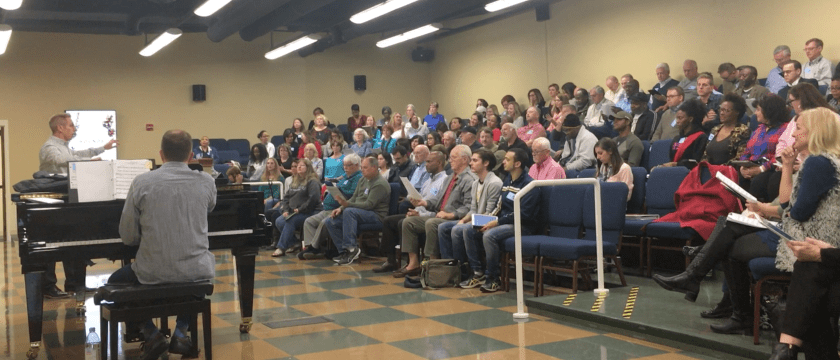
On Wednesday, March 22nd we’re going to spend all day at Mt. Paran Church of God in Atlanta, learning from their people, throwing some big questions out, and really drilling down into what can make this actually work. I want this to be really practical stuff. Then that night we’ll observe their choir rehearsal. Then late that night we’ll have a final Q&A with their leadership. It will be a long, full, content-rich, meaningful time. We’ll look at the problems, the possibilities, the practicalities, and the pastoral essentials.

We’ll all fly/drive home on Thursday March 23rd.

So far, a group of about 10 people I’ve invited from Anglican and Presbyterian churches around the country are going to be there. But I wanted to leave room for more, in case anyone else is interested.

If you’re interested, you can apply for one of the openings by clicking on the “contact me” tab above. Send me a quick note and simply let me know why this interests you. I will follow up by the beginning of next week to let you know if you’ve been “accepted” (for lack of a better word) and how to register.

If you’re not interested, then thanks for reading this far, and I’d appreciate your prayers for this small gathering in late March.

A Vibrant Future (Together) for Choirs and Worship Bands – Pt. 2

1Yesterday I shared a short summary of some big questions I’ve been wrestling with over the last two and a half years – and many others have been wrestling with for much longer – when it comes to considering a vibrant future for choirs, and how it’s possible for those choirs to partner  in vibrant ministry with worship bands. This runs counter to the trends in the white protestant church, and is not something I ever thought I’d be called to be involved in, as someone who’s not classically trained, and for much of my life was the “contemporary music” guy at churches.

In late November, I traveled to Mount Paran Church of God in Atlanta, along with my colleague/friend/choir director Andrew Cote (actually Dr. Cote, but we don’t want that to get to his head). Andrew and I are working hard, praying a lot, and having a lot of fun putting our heads together with the great people at our church, about how we can continue to cultivate a worship ministry that is indeed a real community of worshippers and worship leaders, and is big enough for a choir, band, instrumentalists, classically trained musicians, self-taught musicians, young, old, and everyone in between. Mount Paran has been working at cultivating that kind of ministry for quite a long time now, and so it was incredibly encouraging to go there and see what’s possible.

I saw a choir that was a true microcosm of their community. Different races, ages, backgrounds, musical experiences, and level of giftedness, blended together into a vibrant worship leading engine of their church. Add a small (mostly volunteer) “orchestra” of strings, brass, and woodwinds. And then your typical “band” of drums, guitars, keys, loops, and vocalists. It’s a big church with a big budget and a big staff, but what struck me the most was something that money can’t buy, and even the most polished production can’t fake: an overwhelming atmosphere of partnership, of worship, of unity, and a humble pursuit of excellence. And their people SING. And the sweet presence of the Holy Spirit is powerfully tangible. It was something to celebrate.

I found myself amazed at how they organize things, how they memorize their music, how they color-code the lyric projection for the choir so they can follow their cues, how they do their planning, how they do auditions, how they’ve been faithful at planting and pruning this kind of ministry over decades, and much more. It was humbling to sit there and realize how much I have to learn. I realized that I was indeed a student, who didn’t know quite as much as I thought I knew. And it felt good.

And God was teaching me all these things – and moving me to tears – at (gasp!) a church that’s part of a different denomination, who does things in a totally different way from me, and yet who loves Jesus, cherishes His word, and longs to see Him exalted and central in their Sunday morning gatherings.

As is usual when anyone comes home from a conference or retreat, there is the inevitable slump when you come down from the mountain top experience. I certainly experienced that. But for my own sanity, I jotted down some observations, and so did Andrew. We had a long coffee to talk about what we thought God was saying to us. And this was a bit of what we wrote down together.

Caveat: I’m baring my soul here – unfiltered and mostly unedited – so you can get a sense of the real-world, down-to-earth stuff that I’m involved with these days. It’s exciting! And exhausting. The list below might not make much sense or be relevant to you, but this blog has always been intended to help worship leaders lead better, so I share these honest thoughts in the hopes that it helps someone, somewhere, in some way.

Reflections since Mount Paran visit

  1. It was like a trip to the future. I want that kind of community, commitment, vibrancy, diversity, youthfulness, vigor, worshipfulness, agility, and maturity in our worship ministry.
  2. I came back inspired, but personally (and honestly… because I’m a sinner…) deflated. I want that NOW. I want the result without having to do all the work 🙂
  3. I needed to be reminded that nothing grows without first being planted, tended, watered, pruned, and constantly maintained/nurtured.
  4. Mount Paran isn’t perfect (!), but it has the kind of “fruit” I’d like to strive for. They’ve worked long and hard for that fruit. It didn’t look like that even 15 years ago.
  5. If we plant, tend, water, prune, and maintain/nurture the worship ministry here, then by God’s grace we will continue to see growth, albeit something unique to Truro, but something organically healthy and life-giving
  6. We’re not starting from scratch.
  7. Our choir loves to sing, is committed, wants to sing lots of different genres, and our church has a rich history of vibrant worship. Hard to find another place quite like it in the Protestant/Anglican/Liturgical world.
  8. So there’s a lot of good there.
  9. Let’s continue pruning.
  10. What can we do now?
  11. In general: A continued focus on consistency, prayer, and loving our people.

So we’re aiming to double the choir to 80 voices. Big recruitment efforts.

Make rehearsals great again. I like the weekly newsletter idea.

Work on anthems at least four weeks out to assist in memorization

January – June: 6 solid months of continued consistency

Install section leaders/choir ministry team

Install confidence monitors on stage to assist with getting off the page

Mixing in all the previous anthems from Fall ‘16

Choosing solid anthems (all 10s!)

Aim to memorize 1 or 2 pieces

Focus on the congregational stuff. Especially choruses in parts, and learning new songs a few weeks out

Possibly a Friday night/Saturday workshop

Jamie and Andrew visit Mt. Paran again, and possibly bring a few key leaders along for a mini-retreat

Summer 2017: Another huge recruitment effort.

Have a great choir retreat

Maybe bring Mark Blankenship (from Mt Paran) in for a weekend?

Continue to prune, be consistent, pray, and push hard.

Tomorrow I’ll share some details on a small day-long intensive I’m going to be hosting at Mount Paran in March on the subject of cultivating vibrant choirs, and partnering with worship bands, and how you can explore being a part of it, if anything I’m saying over these last two posts resonates with you.

A Vibrant Future (Together) for Choirs and Worship Bands – Pt. 1

As a worship leader in Anglican churches for over 20 years now, I’ve witnessed first hand the all-too-common polarization of worship ministries, with worship teams on one side and choirs on the other. And I’ve witnessed the slow and steady dwindling of choirs, as evidenced in this study by Duke University last year (Pay particular attention to pages 9 – 10.)

Over the last two and a half years, since I began as the Director of Worship and Arts at Truro Anglican Church, I have been forced to grapple with this problem, on a small scale in my local church. As a non-classically trained musician who doesn’t direct choirs, tasked with directing a music program with a long history of a vibrant choir at the center, but whose choir was experiencing the trend occurring throughout protestantism, I was suddenly face-to-face with the questions: Can our choir go against the trend? Can our choir and worship bands work together? Can our choir grow? Can our choir attract new people? Can the culture in our rehearsals change? Will there even be a choir at my church in 15 years?

I’m more and more convinced that the answers to those questions can be a resounding “yes!”

But how?

The answer to that question is not so easy. But within the body of Christ, and within the protestant Church itself, there are churches with vibrant, multi-ethnic, cross-generational, musically-flexible choirs, which are a worship leading force in their services, and attract members from a wide range of musical backgrounds, many of whom may have never read music even once in their lives.

And many – if not all – of the churches that actually have growing and vibrant choirs, are outside of the fairly narrow stream of white/reformed and/or evangelical denominations.

One such church is Mount Paran Church of God in Atlanta. Having watched their services online for years, I can say that they are living proof of the kind of wonderful and flourishing ministry that’s not just possible with a choir, but also possible with respect to partnership between generations. Their choir is a thriving cross-section of their congregation and community, and there is a beautiful community between the choir and band which is increasingly hard to find. Their worship director, Mark Blankenship, has served that church for 30+ years, and the fruit of his ministry is something that can (and should!) encourage all of us who are wondering if choirs have a future, and if they do, whether they can co-exist and co-operate with a worship “band”, or whether we’re stuck with separate services.

Here’s their choir/band/orchestra doing one of my new favorite songs, “How Excellent” (this is a special song – not intended to be sung by the congregation!):

My colleague/partner-in-crime/choir director Andrew Cote and I made a trip down to Atlanta a couple of months ago to visit Mount Paran, to observe one of their choir rehearsals, and to meet with their worship leadership. Tomorrow I’ll share some of my take-aways.