
Thinking Surgically When Leading Liturgically: Recognizing the Danger

Some people love liturgy. They can’t get enough of the stuff. The more prayers, creeds, incense, call-and-response stuff, vestments, and pageantry the better.

I am not one of those people. I like a lot of it, but I also don’t like a lot of it. I’ve lived with it all my life so it’s lost its novelty with me. I see a lot of the good, but I also see a lot of the bad. 

Some things I like (in no particular order of importance).

  • The church year. I love how it tells the story of Jesus.
  • The liturgy for the burial of the dead (i.e. a funeral). I love how it starts off with the proclamation from the back of the room: “I am the resurrection and I am Life says the Lord…”
  • The Maundy Thursday service ending with the reading in darkness of Jesus’ arrest and betrayal while all of the adornments in the church are stripped away.
  • The Easter Vigil service where the service begins in darkness with songs and readings and prayers telling the story of redemption all the way from Genesis, culminating in the great Easter acclamation and a celebration of Jesus’ resurrection.
  • The Easter acclamation: “Alleluia! Christ is risen!” to which we reply “The Lord is risen indeed. Alleluia!”
  • The prayer for purity.
  • The prayer of humble access.
  • The Gospel truth that is soaked through so much of the liturgy and prayers, to help protect the church from doctrinal error.

Some things I don’t like.

  • The robotic, monotonous, heartless repetition that it can instill in so many congregations. Amazing truths can be spoken and sung with so much familiarity that they don’t affect the heart.
  • “We can’t do ____ because the prayer book says we have to do ____.”
  • The elevation of tradition to a place of inerrancy that only Scripture should hold.
  • The pomposity that can accompany it.
  • The impression it gives that prayers should always (a) be fancifully worded and (b) professionally offered.

But if I had a choice to lead worship either at a totally non-liturgical church or a liturgical church for the rest of my life, I have to say I’d pick the latter. In spite of all the things about the liturgy that frustrate me, I think I would find myself longing for its structure after a while.

I’m in a bit of a dilemma with liturgy. I like it when it works. I don’t like it all the time. But in my church, it’s used nearly all the time, whether I happen to think it works or not!

Maybe you’re like me and you’re a liturgy-lite person. Maybe you’re the person I described who can’t get enough or it. Or maybe you can’t stand liturgy at all and just have to tolerate it.

Whatever your personal feelings for liturgy, there is a temptation that lurks: it becomes empty words, empty acts, empty rituals, empty movements, and empty prayers.

You might love liturgy or you might hate it. Or, like me, you might be confused about what you think about it. Regardless, if you’re not careful, and if your church’s leadership isn’t careful, it loses its power.

Good drivers know the dangers of driving. Good doctors know the danger of bad medicine. Good builders know the danger of their tools. Same principle applies for worship leaders. Good worship leaders know the danger of familiarity, i.e. liturgy.

So the first step towards “thinking surgically when leading liturgically” is to recognize its danger. Only then can you see its potential.

It’s not all wonderful (for those of you can’t get enough) and it’s not all terrible (for those of you who can’t stand it).

Liturgy is like a box of chocolates. Some bits of it are filled with tasty filling. Some bits are terrible. Too much of it will leave you in a coma.

The danger is that it all becomes empty. And that’s where you come in. More later.
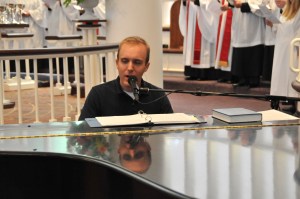
Thinking Surgically When Leading Liturgically

Every church has its own liturgy.

Some forms of liturgy are obvious: a book of common prayer, a prescribed order of service, processionals, the creeds, collects (corporate prayers in unison), the church year (i.e. Advent, Christmas, Epiphany, Lent, Easter, Pentecost, Ordinary time), etc.

Some forms of liturgy are less obvious: the worship leader always starts the service by inviting people to stand, the sermon is at the end, the announcements are before the sermon, we sing upbeat songs then sing slower songs, etc.

So here’s fact number one: There is no such thing as a non-liturgical church. Some are more so than others, but every church has its own customs, its own traditions, and its own normal pattern for corporate worship.

But there is a big difference between what a non-denominational service looks like when compared to a Presbyterian service. It doesn’t take a rocket scientist to figure out that some services are fairly loose and informal, while other services are more structured and formal.

And in those churches that employ a more liturgical form of corporate worship are worship leaders who are struggling with how to work within those constraints. It’s a struggle. There isn’t as much wiggle room and freedom in a highly liturgical church as there is in a “non-liturgical” church (although even those churches do have liturgy).

Here’s fact number two: it’s more difficult to lead worship in the context of a formal liturgy.

That’s a bold statement, I know. But I believe it’s true. Every church presents its own challenges, and every worship leader faces different circumstances. But speaking specifically to the exercise of leading people in corporate worship in song: it’s harder to do within the confines of formal liturgy.

I was born and raised in the Episcopal Church. Every Sunday of my life, from birth through my sophomore year of college, the service format was a by-the-book (Book of Common Prayer, that is) Holy Communion service. I know the book. I know the liturgy. And I’ve learned to love the liturgy, and see its structure not as being a constraint on my worship leading, but as providing scaffolding on which I can stand.

These next several posts are geared entirely toward people who lead worship in a church that utilizes a more formal liturgy. If you’re in a more informal church, you might not find a lot that applies to you. But if you serve in a church where the pastors are called priests, the lobby is called a narthex, your board of elders is called a Vestry, your green room is called a sacristy, your stage is called the chancel, your opening song is called a processional, you have hard-covered books of common prayer/common worship in the pews (not seats), and you know what a Sanctus is, then I hope you find some of what I have to say helpful.

So while I do believe that it’s more difficult to lead worship in the context of a formal liturgy, I want to encourage those of you who do, and help you thrive within the confines (and know when they can be broken out of).

I’ve titled this series: “thinking surgically when leading liturgically”. It’s a clever name and it rhymes, but I hope it makes a point. And that’s fact number three: you can work with the liturgy to make a service come alive.

It takes careful and prayerful planning. It takes getting familiar with the liturgy. It takes some boldness. And it takes knowing when to tinker and when not to tinker. But it can work. Liturgy doesn’t have to be a force of lethargy and robotic deadness in your services.

Your congregation can experience vibrant, Christ-centered worship in a liturgical setting. It’s more difficult, but it’s possible. Trust me. Tomorrow we’ll start looking at how.

How Often Should I Introduce New Songs?

How often worship leaders should introduce new songs is an incredibly important question.


Someone recently wrote and asked me this question and here’s how I answered:

Week one: Teach Song A

Week two: Do Song A again somewhere in the service. If it’s a slow song, do it during communion or at the end of a set. If it’s an upbeat song, do it first thing, and ease into it.

Week three: Teach Song B.

Week four: Do Song A again. Do Song B again somewhere in the service where it fits.

Week five: Don’t teach anything new. Give people a break.

Week six: Teach Song C.

Week seven: Do Song A or Song B again. Repeat Song C again somewhere in the service.

Week eight: Do one of the three new songs you’ve taught. Don’t teach anything else.

So in the course of roughly two months, you’ve taught 3 new songs, and repeated each one at least twice. This gives you enough experience with the song to know whether it’s a keeper, whether it should be put on the bench, or whether it should be canned.

Out of those three new songs you’ve done in two months, two might stick around in your repertoire. More realistically, out of three new songs, only one will really become a regular song. There are exceptions, of course.

As I look back over a year, usually I’ve added 6-8 solid new songs to the repertoire. Another 4-6 are in the repertoire but still needing some time to simmer. Another 4 – 6 songs are put back on the shelf.

Adding too many new songs overwhelms a congregation. Not introducing any can deaden them. Find the right balance for your congregation of building their confidence by singing familiar songs, and spending some of that capital you’ve earned on stretching them with new songs.

Are You Amazed Anymore?

A few nights ago our 15 month old daughter, Megan, started walking on her own. She had taken one or two independent steps before, but finally, one evening after dinner, she decided she was quite comfortable walking around our entire living room.

We were amazed. We applauded her, swooped her up and hugged her, took pictures and video, Skyped with her grandparents in California so they could see it, and delayed her bed time by quite a bit just so we could keep watching her walk.

Several days have passed and she’s still walking – but I’m not amazed anymore.

What would have been unheard of just a week ago – Megan walking around the living room – is now normal to me. I check email and read the news while she toddles around without any applause or swooping or filming or Skyping.

It’s easy for us to lose our amazement, isn’t it?

When I first came to my church 6 1/2 years ago, they were still relatively new to the use of contemporary music in congregational worship. I was young and immature, but eager and excited, and was quickly overwhelmed by how far the congregation had to go (and, whether I realized it or not, how far I had to go too).

Over the course of time, God, by his grace, has moved us ahead. Is there still room for growth? Oh yes. Have we made any progress? You would be amazed.

But I’m not amazed anymore. And I should be.

What would have been unheard of just 6 1/2 years ago is now normal to me. I would have never been able to introduce an upbeat celebratory song. The band couldn’t have played it and the congregation would have been shocked. I certainly wouldn’t have heard any clapping or seen any physical expressiveness. Our repertoire was shallow. Our equipment was terrible. Our rehearsals were ineffective.  These are just a few examples off the top of my head. I could probably think of hundreds more.

God has faithfully helped us grow. He has answered prayer after prayer and allowed us to express our worship to him and encounter him in a level of freedom that we weren’t experiencing just a short time ago. He has done it. And I should be amazed.

The people of God have a long and sad history of forgetting his “wondrous works” (Psalm 105:5) and selfishly demanding more without remembering what he’s already done. We’re all guilty of this. But oh how much more satisfied and joyful we’d be if we opened our eyes to the miracles he’s done right in front of us.

What “wondrous works” has God done in your midst, in your congregation, in your own life and ministry, and in your worship team? More than you remember and probably more than you realize. What “unheard of” things are now normal?

There will always be room to grow. But there will always be a reason to be amazed.

I want to be a father – and a worship leader – who never ceases to be amazed by baby steps. How about you?

Don’t Believe Your Own Hype

You have a fan club, whether you realize it or not.

Maybe it’s small. A few old ladies who think you’re just adorable and ask when you’re going to make a CD.

Or maybe it’s larger. Gushing Facebook posts, lots of Twitter followers, people recognize you at the grocery store, and your church bookstore carries your very own CD.

Most worship leaders are somewhere in between. You don’t have a CD to sell or Twitter followers of any substantial number, but you do have a significant number of people at your church who see you up front regularly, have an affinity for you, and think you’re much more terrific and wonderful than you actually are.

In any case, it can be tempting to start to believe the hype that naturally surrounds anyone who stands on a stage in a position of leadership and possesses musical gifts. Before you know it you’re demanding only Evian bottled water, yellow M&Ms, and the auditorium a constant 72.4 degrees (that’s in Fahrenheit for my European friends).

Don’t believe your own hype. It’s a slippery slope to arrogance and pride and there is nothing that will hinder your effectiveness in ministry more. God isn’t exaggerating when he warns us that he “opposes the proud” (James 4:6).

Here are three practical ways you can keep the “hype” around you in check.

Be approachable
Avoid the temptation to cloister yourself away in a back room before and after the service. Rock stars do this. Worship leaders shouldn’t. Be available and approachable before and after the service. This is an easy and tangible way to demonstrate to your congregation that you love them, and to deflate the inflation of your ego.

Be humble
For anyone seeking to pursue humility, C.J. Mahaney’s book Humility: True Greatness is an absolute must-read. You can read it in one evening, but if you’re smart, you’ll take some time to read through it and allow the Holy Spirit to convict you and help you see where you need to grow.

It’s easy to say “be humble” but it’s hard to do. “Pursue humility” is a much better way to phrase it. Every morning, every day, and every night, resist the fleshly pull toward pride. Laugh at yourself. Encourage and honor those around you. Remember your sinfulness. Rejoice in Jesus’ work of redeeming you and covering you with his blood. That’s the only thing worth boasting in.

We start to believe the hype when we believe there’s something about ourselves that’s worth boasting in. Unless that “thing” is the cross of Christ, we’re off base.

Be cross-centered
Paul writes in Ephesians 2:1-3,

“…you were dead in the trespasses and sins in which you once walked, following the course of this world, following the prince of the power of the air, the spirit that is now at work in the sons of disobedience – among whom we all once lived in the passions of our flesh, carrying out the desires the body and the mind, and were by nature children of wrath, like the rest of mankind.”

You. We all. Our. By nature.

Verse 4:

But God, being rich in mercy, because of the great love with which he loved us, even when we were dead in our trespasses, made us alive together with Christ – by grace you have been saved – and raised us up with him and seated us with him in the heavenly places in Christ Jesus.”

But God. Two of the greatest words in all of scripture.

The hype tells us we’re wonderful and adorable and a really big deal. The cross tells us we were children of wrath but are now objects of God’s mercy.

As a worship leader, to be effective you have to be deflective. People will sinfully want to praise you. You’ll sinfully want to receive it and believe it. Don’t. Deflect the praise of man and direct your own need to make much of something great onto the One who is rich in mercy and worthy of every bit of hype we can muster.