Ministry is like a roller coaster. And for me, one of the lowest lows I’ve ever experienced on this roller coaster was a season when I was in the caught in the middle of a “worship war” and didn’t know how to get out. Some fairly vocal people were making noise that the kinds of music I was introducing (i.e. contemporary worship music) at a particular service were worldly, evil, Satanic in origin, and unable to be used for God’s glory. I knew in my heart that they were misguided in their thinking and theology, but I didn’t have the vocabulary with which to respond to them.
That opportunity came when I saw Harold sitting in a pew all by himself. I introduced myself and asked if he had a few minutes. He was incredibly kind (and even knew who I was which I think is ridiculous) and I was able to tell him, face-to-face, how his book changed my life. Later that night, and even the following day, I was able to spend more time with Harold and hear his wisdom, counsel, and excellent critiques.
Chapter 1: God’s Creation, Human Creativity, and Music Making
“God is directly and continually engaged with his handiwork. Natural laws continue to work because Christ is now saying so; the galaxies continue to speed away from each other because Christ is now saying so; we continue to live, move, and have our being because Christ is now saying so.”
God’s Names and Creatorhood, and Human Creativity, pg. 13
“Had God not made the creation, God would still be the Creator, self-caused, entirely complete. In a way that eludes us, the triune God can be eternally at work within himself, disclosing the fullness of himself to himself and infinitely rich within those disclosures. What does this mean to our creativity and music making? Above all, it means that we should not make music in order to prove that we are or to authenticate ourselves. God created in us the capability for understanding that we are authenticated in him, not in what we do.”
God’s Names and Creatorhood, and Human Creativity, pg. 14
“As glorious as the creation is, it was merely created and not begotten. A strawberry, a galaxy, a dolphin, and a sea lion are not in the image of God. They are handiwork, pure and simple, thus of an entirely different order.
The next point is crucial. Having made the creation and having created us in his image, God has given us particular assignment that could not have been given to any other created beings. In telling Adam and Eve to rule over the fish of the sea and the birds of the air and over every living creature that moves on the ground (Genesis 1:28), God was setting down a basic principle. Man and woman, created in the image of God… are neither the same as the rest of creation nor subject to it. While materially they can be outweighed by a mountain or overpowered by the force of the ocean, and while they are incapable of changing the speed of light, they cannot be morally, spiritually, or behaviorally overcome by anything in the creation around them.”
The Creator Is Not the Creation and the Music Maker Is Not the Music, pg. 16
“Let’s concentrate on something that almost never comes to mind: the music that Jesus heard and made throughout his life – the music of the wedding feast, the dance, the street, and the synagogue. As it turns out, Jesus was not a composer but a carpenter. Thus he heard and used the music made by other, fallen creatures – the very ones he came to redeem. The ramifications of this single fact are enormous. They assist in answering the questions as to whether music used by Christians can only be written by Christians and whether music written by non-Christians is somehow non-Christian. But for now, it is important to understand that even though we don’t know whether every piece of music Jesus used was written by people of faith, we can be sure that it was written by imperfect people, bound by the conditions of a fallen world and hampered by sinfulness and limitation. So even though we do not know what musical perfection is, we do know that the perfect one could sing imperfect music created by fallen and imperfect people, while doing so completely to the glory of his heavenly Father.”
The Fall, Creativity, and Music Making, pgs. 18 and 19
“The creation, at first glance, appears to be full of anomalies. Because there are lobsters and hummingbirds, deserts and rain forests, turtles and people, we might be tempted to believe that a mixture of creative opinions has been at work, as assortment of deities, if you will, who have either compromised with each other or concluded their business in outright disagreement. How could the same Someone think up a hippopotamus and then turn around and imagine an orchid? Is God inconsistent? Does God have any taste? Or is he a Creator whose sense of rightness and beauty are so complete that we will have a more comprehensive way of integrating all of the supposed anomalies and contradictions in human creativity? Is there a way for us to see if or how the music or Eric Clapton or Beethoven can fin a place among the musics of Japanese kabuki, the Balinese gamelan, the songs of Stephen Foster, an anonymous dreamer of songs in Africa, J.S. Bach, and Blind Lemon Jefferson? We need to find ways to validate artistic pluralism without becoming so sloppy as to allow anything.”
God’s Creation, Stylistic Pluralism, and Music Making, pg. 24
“…We may have no more aesthetic right to say that a sunset is more beautiful than an artichoke than we do to say that classical music is more beautiful than jazz or Gothic preferable to Bauhaus. Perhaps we need to compare Gothic with Gothic, jazz with jazz, folk with folk, and so on, before we get involved in trying to decide among them.”
God’s Creation, Stylistic Pluralism, and Music Making , pg. 25
“If the same God can think up a cucumber and a falcon, the same potter can make a vase and a free-form object, the same poet can make a simple couplet or an extended drama, and the same composer a Scripture song or a symphony.”
God’s Creation, Stylistic Pluralism, and Music Making, pg. 26
“A galaxy and a blade of grass may differ, but only in the expanse of quality. This should give us no excuse for overlooking the wonder in a blade of grass. The galaxy and the grass are put together in the same way: elemental particles are chained together, in the one case to make something small and, in the other, to make something exceedingly vast. It is the elemental parts, the “simple particles,” that, yet to be explained, remain the greater mystery. We can make the same mistake with simplicity and complexity that we do with worth and function when we see one as better than the other. What is simplicity in human creativity? Complexity? If complexity means more and simplicity less, then the final movement of Beethoven’s Ninth Symphony is complex and Braham’s “Lullaby” is simple. If complex means complicated and simplicity clear, then Karl Barth’s writing is complex and C.S. Lewis simple. And if the cathedral of Notre Dame is complex, the great pyramids of Egypt are simple. Which of these is better? More profound? … Which is more profound, the brevity of the Golden Rule, or the cumulative rhetoric of the book of Romans?”
God’s Creation, Simplicity, Complexity, and Music Making, pages 30 and 31
“When Jesus Christ became flesh, he became a part of the creation in exactly the same way that every human being has. That is, even though he was fully God, he came fully human… In a way, God was simplified. And as with so many simplicities, this deepens the mystery. While this emptying means everything to our redemption, it applies to our artistic and musical creativity with nearly equal force. An analogy may help. Let’s say that before Christ became human, he could be likened to a symphony, in all its complexity and power – magnificence carried out over a grand expanse. But when he became human, he became a folk tune, simple and shortened… His becoming a folk tone was not a compromise, a dilution, a put-down, or a thinning out… Becoming a folk tune was a uniqueness in itself, with its own wholeness, integrity, and usefulness. Putting it this way prevents us from saying that a folk tune is a thinned-out or reduced symphony. Rather, it is an emptied symphony, completely possessed of its own wholeness, integrity, and uniqueness… Each musician must come to experience the dignity, rightness, and eventual joy of putting things aside, of emptying oneself and taking the form of a servant. Such musicians must be able to move back and forth, gracefully, servingly, and willingly, from the symphony to the folk tune, back and forth without complaint, compromise, or snobbery, without the conceit that doing an oratorio is somehow more worthy or more deserving than doing a hymn tune. All servant musicians must be able to be in creative transit, serving this community and challenging that one, all the while showing grace, power, elegance, and imagination.”
The Incarnation, Human Creativity, and Music Making, pages 32 and 33
“Which is the greater mystery, that Christ is God or that he could empty himself while remaining God? Likewise, which is greatest mystery, that we are artistically creative or that we can remain just as fully creative while emptying ourselves?”
The Incarnation, Human Creativity, and Music Making, pg. 34
I’m grateful for Harold Best, and I’m grateful for the Doxology and Theology conference making it possible for his voice to be heard by a new generation of worship leaders.
 I am not a classically trained musician. I play primarily by ear, I prefer to read chord charts, I’ve never had voice lessons, I don’t conduct choirs, and I can’t play the organ. I’ve been playing guitar since the age of 7 (I took several years of lessons, some with pretty advanced music theory), and piano since the age of 18. On piano I’m mostly all self-taught, and don’t pretend to be able to play classical piano or accompany choirs or sight-read sheet music.
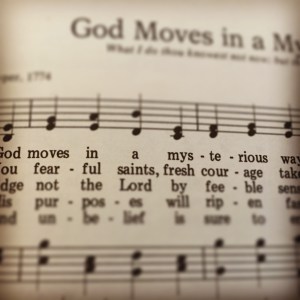 Several years ago I was in the middle of one of those seasons when I was having a hard time believing that God was actually hearing (and caring about) my prayers. I had been crying out to him to answer me in the way that I wanted, in the timeframe I had chosen, with the thing that I thought was best. All I could pick up in return was radio silence. Nothing was happening. Nothing was changing. I was discouraged.
 This picture is of me with Harold at about midnight in the kitchen in Bob and Julie Kauflin’s home. Having the privilege of spending time with those two men, both of them heroes of mine, is one that I will always remember and cherish. I was almost unable to attend the conference, but thanks to a friend’s generous gift of Delta SkyMiles, I was able to go at the last minute. God provided, if for no other reason, than so I could have the chance to say “thank you” to Harold Best.
 I’m afraid I might have started something…
 I’m always on the lookout for good, congregational, theologically rich worship songs. It can be a challenge sometimes to fill this spot in my church’s repertoire. Last year I set out to write one, and got some ideas when I was reminded of the “Te Deum”, an ancient Christian prayer/hymn.
 Worthily Magnify