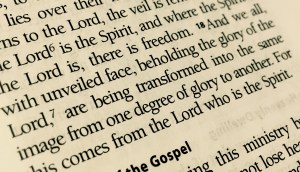
 Earlier this year, my church began projecting the text of our scripture readings on Sundays. In our Anglican service, we have at least two readings from Scripture at each service. There are Bibles in the pews, and most people can now access a Bible on their own phone/tablet, so why project the Scripture text too?
We have at least four reasons:
1. Our international/English-as-a-second-language community has asked for it. Those who don’t speak English as their first language still really want to follow along and be engaged in our services, in English. The readings are difficult for them, because by the time they find/turn to the scripture that’s being read, it’s over! Seeing the scriptures read while they’re being projected is an immense help to those for whom the English language is still new.
2. We want people to hear, read, mark, learn, and inwardly digest the scriptures as much as possible. The Bible is the “Sword of the Spirit” (Ephesians 6:17). The more we can get people hearing and reading the Word of God, the better. There is power in actually reading the scriptures together. Hearing them is absolutely essential. We think reading them is essential too. Besides, getting the scriptures to be readable by lay people (in their homes, much less in church services) was a pretty big part of the reformation, and we think that it’s still important today.
3. We project almost everything else in our services, except for some of the liturgy the pastor prays before communion (since it’s printed in our Liturgy Books in the pews). By not projecting the Scriptures, we might inadvertently send the signal that they’re not as important as the song lyrics, creeds, prayers, responses, etc., when, in fact, they’re more important than all of those things combined.
4. We consistently attract non-believers, or new believers. We hear reports every week of people coming to church who have never been to church before, or haven’t been in decades. Through the Alpha course, and through relationships, we are regularly seeing a smattering of people in our services every Sunday who are non-Christians and/or non-churched. They don’t know what the big numbers mean (i.e. a chapter), what the little superscript numbers mean (i.e. the verses), or when Jesus is talking, or when he’s telling a parable, or whether “the Word of the Lord” is in the Bible, or just an extra thing we add. They are complete newbies to the Bible. How wonderful! Projecting Scripture makes it accessible, more follow-along-able, and less intimidating.
We want to encourage our congregation to read along on Sundays, either in the Bibles in the pews, or on their phones/tablets, or on the screens. Or all of the above!
In the words of Thomas Cranmer:
“Blessed Lord, who caused all holy Scriptures to be written for our learning: Grant us so to hear them, read, mark, learn, and inwardly digest them, that we may embrace and ever hold fast the blessed hope of everlasting life, which you have given us in our Savior Jesus Christ; who lives and reigns with you and the Holy Spirit, one God, for ever and ever. Amen.”
 A worship leader can never go wrong having his congregation proclaim the gospel in song. In our weekly quest to find something that “works”, we quite simply don’t have to look any further than to Jesus, to what he accomplished for us, and to what he has secured for us. Regardless of your church’s setting, demographics, traditions, worship style, successes, failures, attendance numbers, and whatever buzzword is floating around at the moment, singing songs grounded in the gospel of Jesus Christ always – always – “works”.
 There are so many different kinds of churches, with different expressions of worship, using different musical styles, in different parts of the world, with different histories, different emphases, and different callings. The worship leaders at these churches have different callings and have to discern how to serve their congregations most effectively, taking into account all of the uniqueness about their setting.
 Good news for worship leaders all over the world: there’s no reason for you to do much talking. Seriously. You really don’t need to talk that much.
 My almost 2-year-old, Emma, is starting to talk. It’s super cute and fun, and we are loving it. The only problem is that no one else can understand what in the world she’s actually saying.
 Worthily Magnify