Rehearsing Anywhere

Over the 8 years I’ve been serving at my church, I’ve learned by trial and error, but mostly by necessity, that it’s possible for a worship team to rehearse (a) anywhere, and (b) with very little time, and still be prepared.

Of course there’s the ideal: a dedicated time, a regular time, in a dedicated space, preferably with all your equipment, even more preferably with the same equipment you’ll use for the service, in the same room where the service will be, with the equipment cooperating and being run by experienced people.

If you can have that ideal, then God bless you.

But if you can’t have that ideal, then welcome to my world.

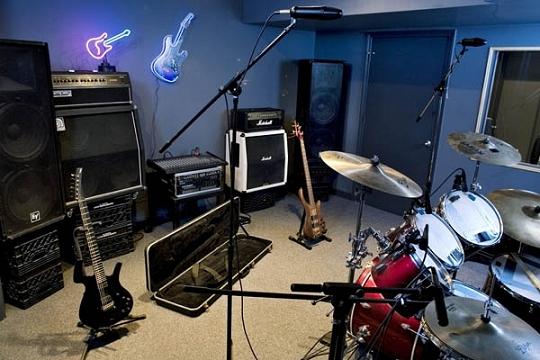
Especially now, since my church has lost our building, and we’re worshipping off-site at schools on Sunday for the foreseeable future. We usually can’t get into these spaces until Sunday morning, and can’t rehearse much in that space because our first service has different musicians (more traditional), so we look for a band room or choir room or something with a piano and some chairs.

This past Sunday we were at a Catholic High School which had promised us the use of their band room, but alas it was locked. We had to improvise. So we found their chapel. No piano, no instruments, no anything, but we had to make it work, and so we did.

I think a lot of worship leaders/teams think that in order to have a good rehearsal they have to run through every song twice, do the entire length of that song, have a protracted time of discussion and/or chaos in between songs, and go past everyone’s bedtime so everyone leaves tired.

I’ve learned a few things over the years thanks to not having “the ideal” that I think have helped me and the worship teams at my church learn to have short rehearsals without all the equipment or conveniences.

Step one: Talk your team through the songs. Take charge. Communicate clearly from top to bottom how you want the song to go. Tell your instrumentalists and singers what you’d like for them to do. Don’t boss them around, but do give them direction. You don’t have all day. Before you play a note of the song, talk through it. Say “here’s what we’re going to do…” and lay it out. Go through the whole song list like this. Talk through all the songs in sequence.

Step two: Play through the songs. Don’t have all your instruments? That’s OK. Your drummer can play drums with his hand on a chair. Your guitarists can bring their guitars in unplugged. Just have someone give you the right key to the song and lead them vocally. If you have some instruments, make sure everyone plays quietly so everyone can be heard. Before you play through the songs, recap what you said earlier when you talked through them. Then play through it. Then review it. Was that good? What wasn’t? People aren’t idiots. They know when something isn’t working.

Let me just pause here and say that you don’t need to rehearse the entire song. Rehearse what needs to be rehearsed. You can save time on some songs by singing the first half of verse 1 and then skipping to the second half of verse 2. Or just stop the song and say “OK, now let’s pretend we’re all the way through the song and let’s practice the accents on the last chorus”. People will go with you and thank you for saving them time.

Step threeStop and pray. Not-ideal rehearsals are a priceless opportunity to remind your team how much they need the Holy Spirit’s help. So, first, stop. Don’t drag out the rehearsal. Stop it when things are good enough. Then pray. Everyone in a circle. Then you’re done!

Few things will burn your team out more than ineffective rehearsals. And few things will burn worship leaders out more than feeling the need to have everything perfect at rehearsals. In a sense, lower your expectations for rehearsal and just make it work. An hour and fifteen minutes should be your max, in my opinion, unless you’re recording a CD or rehearsing multiple song lists or tricky songs. On average, though, 75 minutes is more than enough.

Honestly, most worship songs are about 4 – 5 minutes long. And most churches do about 5 or 6 songs per service. A liberal estimate puts that at 35 minutes of music per church per service. So since you don’t need to rehearse each song full-length, you should technically be able to rehearse for a service in 30 minutes. It’s possible!

The Dangerous Pull of Up-front Ministry and the Upward Pull of the Spirit

While I was on vacation in southern California with my wife, her parents, and our two little girls who really really fell in love with the beach, I had the privilege of spending a Saturday morning with the worship team at my Father-in-law’s church and leading worship with them the next morning at their 11:00am service.

When I was preparing for my time with them I sensed that God wanted us to share honestly about the difficulties of ministry so that (1) we could encourage and pray for one another, and (2) we could avoid the trap of trying to push through these difficulties by our own strength.

It turns out that, at least for this group, sharing honestly was not a problem. Maybe that’s a southern Californian thing, but in Northern Virginia it can be a bit difficult to really get to know people. Each member of the team shared how they had come to trust in Jesus, what brought them to this particular church, how long they had been in ministry, etc. I shared my story and particularly some of the joys and sorrows I’ve experienced in ministry so far.

In my experience, serving in up-front worship ministry presents many opportunities to become prideful, or discouraged, or frustrated, or hardened, or battered, or maybe all of these combined. Yes, there are many joys and it can be very rewarding. But for many worship leaders and worship team members, after serving for several years, we can get burned out, lose our heart for the congregation, get stuck in a rut, have a long list of things we tried that never worked, and so on. This isn’t the experience of every worship leader out there, but I think many worship leaders experience extended “low points” and wonder if it’s normal.

Yes, it’s normal but God has given us his Holy Spirit to pull us up out of the ruts and discouragement and anger and hard-heartedness to point us to Jesus and fill us with power. Jesus said to the disciples in Acts 1:8 that they would “receive power” when the Holy Spirit came upon them. He called the Holy Spirit the “helper” three times in book of John. We’ve been given power and we’ve been given a helper in the Holy Spirit and we need both!

I mentioned in my last post that I want to spend some time on this blog focusing on the Holy Spirit. After one or two guitar tutorial videos this week I’d like to start. Worship leaders who attempt to do their jobs without the help and the power of the Holy Spirit will find out very quickly that the dangerous pull of up-front ministry is too much for their flesh to handle. In the words of Paul in Ephesians 5:18, “be filled with the Spirit!” He fills us up, and he pulls us up, to point us to Jesus so we can point our congregations to him as well.

The Pre-Service Distraction

On each of the last three Sundays, about 15 minutes before the service was supposed to start, I was faced with out-of-the-blue things that had the potential of completely throwing and/or my worship team off for the whole service.

One Sunday as I walked into our back room to put my guitar cases away, I overhead a member of the congregation calling the service at which I lead the music the “shake your booty service”.

The next Sunday we wasted 10 of the 15 minutes we had for a sound check by trying to find those adaptors that let you plug a little headphone connector into a larger jack. Oh, and the sound guy couldn’t figure out why he wasn’t getting the bass guitar at the board. He finally figured it out but this meant we pretty much had no time to get a mix or our monitors settled.

The following Sunday we were rehearsing before the service and when we finished rehearsing one chorus of a song, I heard my drummer say, “there’s a mouse in here!” Sure enough, there were two mice running around inside the drum booth (or as we affectionately refer to it, the “space pod”), and when my drummer felt something underneath his foot, he looked down to discover a mouse. Lovely. Oh, and my singer that morning happened to have a phobia of rodents and was doing her best not to have a panic attack right then and there.

One Sunday it’s a critical comment. The next it’s an AV issue. And the following it’s something completely random like mice in the drum cage. They get me frustrated, tempt me to say short-tempered things, and make me feel tense and anxious. What’s going on here?

Well, some of it is just the way things go. People aren’t perfect and those imperfect people sometimes say hurtful things at bad times. Sound systems do funny things and adaptors disappear. And, I suppose if I was a mouse living in a church, the drum space pod would be a nice quiet place six and a half days out of the week.

But there’s a spiritual dynamic to it also. It doesn’t take a rocket scientist to figure out that on the day that God’s people are gathering to glorify him, Satan will be actively seeking to steal that glory away. He has a history of that.

Whenever you lead worship, watch out for pre-service distractions (or even mid and post-service too!) since they can easily throw you off your game. You’ll need to keep your cool (I wrote some thoughts on this a while ago) and keep your focus. Don’t be surprised when they come up. Just deal with them humbly, prayerfully and light-heartedly and try to stay focused on the glory of God and the congregation that has gathered. Unless you feel a mice under your foot, in which case a scream might be appropriate.

Worship Team Mechanics: Arranging the Moving Parts

Last week I shared some thoughts on how to grow (by auditioning) and maintain (by treating the body like it’s made up of different members) healthy worship teams.

In smaller churches, a worship team might “grow” to be 3 or 4 people, and the worship leader’s job is mainly to keep the small body healthy. In larger churches, a worship team might grow to be quite large, with a lot of moving parts, and the worship leader’s job description grows from just keeping the body healthy, to also arranging the moving parts

By “moving parts” I mean that you don’t just have one bass player, you have four. You don’t just have two singers, you have twelve. In every role on the team, you have multiple people who can serve. And to further complicate things, each of these people is at a different gifting level. How do you rotate different musicians of differing skill levels while maintain some sort of consistency and standard?

Before I go any further, I have to say that the foundation of all of this is from what I wrote about telling your worship team it’s a body and treating it like one. If you have to tiptoe around certain members of your team or spend a lot of energy protecting egos and respecting territories, then none of this applies. But if you can be honest with people about their giftings, then hopefully some of this will help.

Scenario A: The good drummer scenario
In contemporary music, the drummer is the glue. He holds everything together. If he is weak, the whole sound is weak. The importance of a good, solid, in-time, dependable, and sensitive drummer cannot be overemphasized. Going back to the 1 Corinthians picture of the body, it’s not that the drummer is more important than anyone else on the team, but that his role in the body happens to be more prominent. Let’s say your drummer is the nose on your face and your acoustic guitarist is your ear. If you lose an ear, it’s a really big deal. But you can grow your hair out to cover it up. If you lose your nose, it’s also a big deal. But you’ll have a hard time covering it up. Is the nose more important than the ear? No. But it’s more prominent.

If you have a good drummer, you can rotate in less skilled bass players, pianists, guitarists, singers, etc., and it won’t be such a big deal. So seek after skilled drummers and do all that you can to not to lose them. With a good drummer in place, you have more freedom to rotate musicians in the other positions without having to carry as much of their weight.

In Northern Virginia, I am not able to get my musician’s availability longer than a month in advance at a time. And because of the nature of their work, their availability is not terribly predictable from month to month. So each month, I send an email to my team asking for their availability for the coming month. Based on their responses, I schedule them. This a bit more time consuming than having pre-set teams, or team A, B, and C, but it allows me to decide who plays when, and lets me rotate new members onto the team.

Scenario B: The pre-set teams scenario
If God hasn’t gifted you with a solid drummer who can hold things together like the glue, than either your guitar/piano playing will now be the glue, or whoever else you find most dependable. In this scenario, you’ll probably find your life to be a whole lot easier if you have pre-set teams, like a team A, B, and C, where the same musicians always play with each other, in order to have some sort of equilibrium that isn’t being thrown into chaos every month when the schedule changes.

This still allows you to rotate in new musicians. You can either see your team “D” as serving every fourth Sunday of the month and being made up of current musicians and new musicians. This way, once a month, you have an opportunity to use someone new, or to re-use someone who is already on the roster.

When someone who is on a set team is unavailable, you can either have them find their own replacement, or you can find one for them. I tend to choose the latter option, so that I can have oversight over who is being asked to serve.

Scenario C: The slim pickings scenario
You won’t find any command in scripture to have a giant worship team. If you’re serving a smaller church, or maybe you’re rebuilding your music ministry, you should feel totally confident in having a small worship team. If you play an instrument, you’ll probably remain constant from week to week. You can rotate a singer or two, and perhaps another instrumentalist or two to give variety and to provide some support for yourself. But if you don’t have a plethora of musicians from which to choose, you shouldn’t feel like you’re any less of a worship leader than someone at a mega church.

No matter what size your church or worship team, the principle is the same: your job is to help the members of the body see where God is arranging them.

The practicalities of how that plays out will change the larger the church and worship team. God has gifted my church with a skilled drummer, and I prefer to decide who plays when, so I rotate musicians on a monthly schedule based on their availability. Other churches use pre-set teams, utilize software like Planning Center to confirm availability, or just outright pay their musicians.

Every church is different, so no one solution is the answer. With a heart to steward the gifts and talents God has placed before you, and an honesty about how God is arranging the members, you’ll discern what’s best in your setting.

Worship Team Mechanics: Telling the Body That It’s a Body

A couple of days ago I shared some thoughts on how to set yourself up for effectively auditioning prospective worship team members. Today I want to share the number one way to keep your worship team functioning healthily, and that is to tell the body that it’s a body, and to treat it like one.

Far too many worship leaders are tolerating a level of dysfunction on their worship teams that is completely unbiblical. There will always be different dynamics and personalities for worship leaders to learn how to navigate, and it won’t always be easy. But the body of Christ, and by extension its worship teams, isn’t supposed to have diva singers, superstar drummers, unqualified and unskilled electric guitarists, and carryovers from the previous worship leader whom no one can question. 

In 1 Corinthians 12:12-27 Paul sets the stage for how the body of Christ is to function: like a human body does. One body with different members, each member with a different function, no one member more or less needed, and each member arranged by God himself.

When certain parts of the body think they’re not needed, or think they’re more important than others, the body starts to get dysfunctional. The same principal applies to worship teams, part of the body of Christ. With scripture as a basis, there is ample justification for maintaining a healthy worship team by keeping its members mindful of the fact that they belong to a body.

Unity must be maintained 

“For just as the body is one and has many members, and all the members of the body, though many, are one body, so it is with Christ…” (1 Corinthians 12:12)

Your body, your human body that is, is most effective when it’s in one piece. When members of your human body start falling off, you’re in trouble. The same is true with your worship team. The unity of the body must be maintained. When we are in Christ, we belong to each other. We are different members of the same body.

So if you have members of your worship team who don’t talk to each other, or don’t get along, or are not all Christians, or think less of others and think more of themselves, as a worship leader you have a responsibility to call this out and address it and work to fix it. Sometimes you have to do surgery in order to make sure your body/worship team is unified.

Many members

“For the body does not consist of one member but of many.” (1 Corinthians 12:14)

This is why your worship team should always be looking to add more members, rejoicing in new members, and not be threatened by new members. When we belong to Christ, we can exist in unity with many members. This is a good thing.

If your bass player is threatened by a new bass player who joins the church, if you have a singer who is resisting stepping aside from time to time to allow other singers to sing, or if you are threatened by other gifted worship leaders in your church, you have dysfunction and you have some work to do.

Interdependency 

“If the foot should say, ‘Because I am not a hand, I do not belong to the body,’… or “if the ear should say, ‘Because I am not an eye, I do not belong to the body,’ that would not make it any less a part of the body.” (1 Corinthians 12:15-16)

I didn’t think about how much I used my left hand until I fractured my left wrist several years ago and couldn’t use it for six weeks. When that cast was removed I was so much more grateful for having it back!

It’s cliché to say that we all need each other, but it’s actually a biblical truth. In this passage Paul paints the ridiculous picture of if “the whole body were an eye” or “if the whole body were an ear” to make it plain to us that every member of the body needs the other members. Your drummer, even though he might play every Sunday, needs your middle schooler electric guitarist, even through he only plays once every six weeks. Your singer needs your bass player. We must foster an atmosphere in our worship teams that keeps us mindful that none of us are more or less needed than any one else.

God is the One who does the arranging

“…God arranged the members in the body, each one of them, as he chose.”  (1 Corinthians 12:18)

This should be incredibly freeing and empowering for worship leaders. You don’t have to give the same position on a worship team to a drummer who is skilled and a drummer who can’t keep a beat. You don’t have to add singers to the team who are tone deaf. You can look someone in the eye and tell them that, in your view, God has a different place for them in the body.

This is what I mean by “telling your worship team that it’s a body”. It is inevitable that at some point, you will have an eye come up to you and tell you it’s an ear. Or you will have a foot come up to you and ask if it can be a hand. You’re going to be tempted to agree because it won’t hurt their feelings. So in the short term you’ve made your life easier but in the long term you’ve set your team and its members up for dysfunction.

If scripture is true (and it is!) that God arranges the members of the body, then you can be honest with those members about what their role is. This, by the way, is why worship leaders need to be prayerful, careful, and Spirit-led people, as we need to be able to discern where God is placing people.

Being honest, but being honorable

“…the parts that seem weaker are indispensable, and on those parts… that we think less honorable we bestow the greater honor…” (1 Corinthians 12:22-23a)

“God has so composed the body, giving greater honor to the part that lacked it, that there may be no division in the body, but that the members may have the same care for one another.” (1 Corinthians 12:24b-25).

So here are the facts:

– Your worship team, part of the Body of Christ, must be unified

– Unity doesn’t mean uniformity. Members of the same body have different roles.

– If you don’t like your role, take it up with God. He does the arranging.

– There will be some members who are weaker and some members who are stronger.

– We must show honor to the weaker members.

The only way my 23-month-old daughter learned to walk was by slowly building up her leg muscles. She fell a lot at first, and still does from time to time, but she’s pretty much gotten the hang of it.

My 5-month-old daughter can’t walk yet. She can hardly sit up on her own without some help. But she has an awful lot more strength now than she did when she was a baby.

The only the weaker members of the body are going to grow is if we show them honor, if we give them opportunities to grow, and the safety to do it. It won’t honor a young drummer to make him play a whole service before he’s ready. But he might be able to do one song. It won’t honor an untrained bass player to make him play a difficult song and embarrass him. But with some practice and a few month’s notice, he might be able to do it.

Worship leaders can’t just sit back, set an incredibly high bar, and only allow really strong members to join the team. Yes, you need strong members, but you also need weaker members. Show them honor, help them grow, and your body will be stronger as a whole because of it.