
The Pre-Service Distraction

On each of the last three Sundays, about 15 minutes before the service was supposed to start, I was faced with out-of-the-blue things that had the potential of completely throwing and/or my worship team off for the whole service.

One Sunday as I walked into our back room to put my guitar cases away, I overhead a member of the congregation calling the service at which I lead the music the “shake your booty service”.

The next Sunday we wasted 10 of the 15 minutes we had for a sound check by trying to find those adaptors that let you plug a little headphone connector into a larger jack. Oh, and the sound guy couldn’t figure out why he wasn’t getting the bass guitar at the board. He finally figured it out but this meant we pretty much had no time to get a mix or our monitors settled.

The following Sunday we were rehearsing before the service and when we finished rehearsing one chorus of a song, I heard my drummer say, “there’s a mouse in here!” Sure enough, there were two mice running around inside the drum booth (or as we affectionately refer to it, the “space pod”), and when my drummer felt something underneath his foot, he looked down to discover a mouse. Lovely. Oh, and my singer that morning happened to have a phobia of rodents and was doing her best not to have a panic attack right then and there.

One Sunday it’s a critical comment. The next it’s an AV issue. And the following it’s something completely random like mice in the drum cage. They get me frustrated, tempt me to say short-tempered things, and make me feel tense and anxious. What’s going on here?

Well, some of it is just the way things go. People aren’t perfect and those imperfect people sometimes say hurtful things at bad times. Sound systems do funny things and adaptors disappear. And, I suppose if I was a mouse living in a church, the drum space pod would be a nice quiet place six and a half days out of the week.

But there’s a spiritual dynamic to it also. It doesn’t take a rocket scientist to figure out that on the day that God’s people are gathering to glorify him, Satan will be actively seeking to steal that glory away. He has a history of that.

Whenever you lead worship, watch out for pre-service distractions (or even mid and post-service too!) since they can easily throw you off your game. You’ll need to keep your cool (I wrote some thoughts on this a while ago) and keep your focus. Don’t be surprised when they come up. Just deal with them humbly, prayerfully and light-heartedly and try to stay focused on the glory of God and the congregation that has gathered. Unless you feel a mice under your foot, in which case a scream might be appropriate.
Striking the Rock When You Should Speak to It Instead

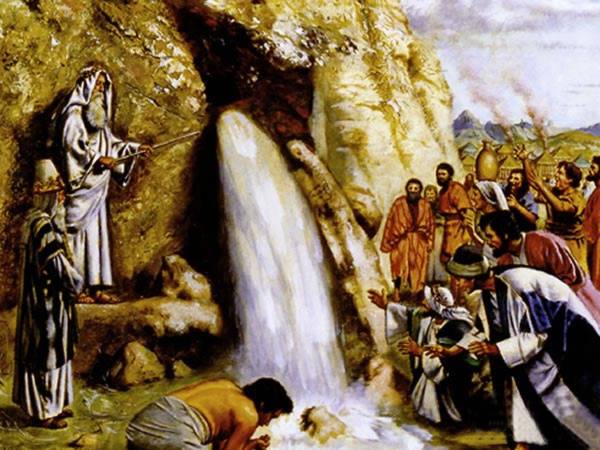
Imagine you’re Moses. You’ve just led the people of Israel through the Red Sea (Exodus 14), seen bitter water made sweet (Exodus 15), and seen bread fall from the sky (Exodus 16).

Then in Exodus 17, the people are thirsty, so God tells you to strike a rock and he’ll make water come out of it. You have seen firsthand the miraculous at work.

Many, many years later, things have changed. You’re wandering in circles, people are complaining, and in Numbers 20, they’re thirsty and demanding water. God tells you and your brother Aaron to speak to a rock and he’ll make water come out of it again.

And so you go up to the rock, you strike it, and out comes the water. Just like the first time.

Wait a second. God told you to speak to the rock this time. But you struck it instead. You got the result you wanted but you disobeyed God in the process. Instead of taking a risk and letting God display his glory afresh, you stuck with what you knew would work.

Now imagine you’re a worship leader. You’ve been leading your congregation in worship for a while. You’ve seen hard hearts melt, you’ve seen people experience God, and you’ve even made some progress with your team.

And every once in a while you get to see the miraculous at work. You take a risk, God blesses it, and out of a rock you see water gushing out.

And so you’ve learned a new trick. Like Moses, you know that if you do a certain thing, you’ll get a certain result. But at a high cost. Without even realizing it, you’ve entered into the dangerous territory of manipulation, and what you’re seeing happen might not be the result of God’s power at all.

God responds swiftly to Moses and Aaron after they disobey him by striking the rock instead of speaking to it, and begins by saying, “Because you did not believe in me, to uphold me as holy in the eyes of the people of Israel…” and then says he won’t allow them to enter into the Promised Land.

Because you did not believe in me…” Moses and Aaron’s sin was the sin of disbelief. They heard God say to speak to the rock. But the people would think they were idiots if they went up and spoke to the rock and nothing happened. They didn’t believe God was trustworthy.

As worship leaders we can be guilty of this same sin of disbelief. And when we stick with our safe formulas because we know they’ll work, and they’ll satisfy the complaining crowds, we say to God that (a) he isn’t trustworthy, and (b) we’ve got it covered.

God responds with mercy and grace to us in Jesus Christ and says, (a) trust in me, and (b) I’ve got it covered. Yes, striking the rock worked last time. And it was really cool. And maybe he’ll want you to strike it again. But maybe he won’t. Maybe he’ll want you to speak to it instead. Have you asked him? Are you listening? It’s a good idea to check with him and then do what he says. 

You’re At Your Best When You’re At Your Neediest

Several Sunday mornings ago I sounded like a frog. My voice gradually went downhill during the service (and it was a communion service so there were a lot of songs) so that by the end of the service, our sound engineer had turned me down almost all the way in order to spare the congregation from having to hear it any longer.

I wish I had a good reason (like a cold or a cough). I wish I had a Godly reason (like I had been singing praise for so long that my voice was lost). I’d even settle for a natural reason (like I hadn’t warmed up properly or something). The truth is that I sounded like a frog because at 3:00am in the morning, after four hours of trying to get our 21-month-old to sleep after she woke up, I lost my temper. I yelled at her.

I felt horrible. I felt like the worst father in the world. I begged Megan to forgive me (and, by God’s grace, she did and didn’t even know what I was talking about when she woke up). I was confident that God had forgiven me. But, the damage had been done, and since I had yelled, I had hurt my voice so much that I lost it during the service. And I lost it good.

Why am I telling you how I sinned a few weeks ago in the middle of the night by getting angry with my precious little girl? First, because it’s good for my pride. And secondly, because I had a choice on Sunday morning what to tell my worship team.

I had a few options. First, I could lie. I had already sinned by getting angry with Megan, so why not continue the trend and make up something Godly sounding? I figured that wasn’t a good idea. Second, I could just not mention it. Sure, I sounded terrible and needed the other vocalist on the team to pick up the slack, but they didn’t need to know, right? Wrong. So my last option was the best option and I let them know that their esteemed worship leader had just, 5 hours earlier, been an idiot.

This was good on a number of levels: it was a chance to “be real” with my team, it gave them permission to “be real” back, it was an object lesson in how much we need God’s grace and how freely he gives it even to bad-tempered-Fathers, and gave me an acute sense that morning of how much I needed God’s Spirit to fill me and empower me. I certainly couldn’t fake it that morning.

We ended up having one of the sweeter times of worship during our communion set that I can recall ever having. We finished “Mighty to Save”, and then, froggy voice and all, I sang a spontaneous song before we went back into the chorus. I heard numerous comments from people who were really affected by that time.

If I could go back and do it all over again, I certainly wouldn’t yell at Megan. But in a way, I’m grateful for this lesson. It taught me a lot about Fatherhood, about worship leading, about being real with my team, and about how much better things go on a Sunday morning when I’m really needy.

And here’s how it sounded. Not pretty, but real.

Singing and Prompting

It’s the little things that make a big difference when you’re leading worship. One of those little things is whether or not you keep your volume consistent when you’re singing and when you’re prompting the congregation.
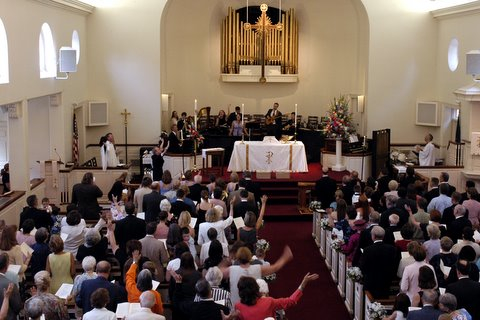
I’ve heard some worship leaders who sing at a good volume, but then when they give direction (i.e. “let’s sing that again” or “from age to age he stands”) you can’t hear what they’re saying. They back off the mic, they speak softly, and they confuse more than they help.

More often than prompting too quietly, worship leaders really crank up the volume when it comes time to give some direction. They sing at a certain volume but then all of the sudden they loudly interject. Of course this is distracting to the congregation, not to mention frustrating for your sound engineer, and it’s something that many worship leaders don’t realize they do.

Your sound engineer can help you maintain a steady volume between singing and prompting by making sure you’re using good mic technique and also utilizing compression at the board. But worship leaders still have a responsibility to avoid changing their volume on a whim and suddenly either dropping out of the mix or jumping in really loudly.

This might not be such a big thing to worry about if you’re leading in a room that has a good sound system with a skilled sound engineer who knows how to dial in compression to help the worship leader’s voice be heard, not too loud, and not too quiet.

But oftentimes worship leaders are leading in small rooms, and the “sound system” might either consist of a microphone, some speakers in the ceiling, and a mixer designed circa-1983, or maybe no sound system at all. It’s all the more essential in these kinds of settings that you make sure you’re singing at a good strong volume, and then when you prompt the congregation, they can hear what you say without having to strain to hear you, or without feeling like you’re barking at them.

Every human voice is unique, every room in which you’ll lead worship is unique, and every church has a unique combination of sound engineers (paid or volunteer) and equipment. Combine all of these factors, and worship leaders have to take a lot into account when they step in front of a group of people on an any given morning or evening.

Regardless of the setting, always be mindful of the little things, the basic things, that make a big difference. Having a consistent volume and being easy to follow is essential to effective worship leading. 

Leading Worship at Weddings – Part 2

A couple of weeks ago I shared some tips about leading worship at weddings. For me, it’s a relatively normal thing to have worship songs at a wedding, and my post assumed it was normal to you too. But I received an email from someone with a question about this, which showed me that it might not be such a normal thing to people after all. He said:

Hey man I’m getting married this fall. Until you mentioned it, I never heard of singing WORSHIP SONGS at a wedding – like for the congregation. Never heard of that. Can you describe that a little more? Like give an example of a couple songs that are “wedding appropriate.” How does it fit into the ceremony? 

Thanks man! I kinda like this idea…. 

Here’s a bit of what I shared in reply.
Some wedding ceremonies are short, sweet, and to the point. You’re there to see the bride walk up the aisle, hear the preacher say some nice words, maybe hear a ballad of some sort, hear the bride and groom say their vows, see them kiss, and see them walk down the aisle as a married couple. 20 minutes and you’re done. The real party (the reception) can now begin! Not much room for worship songs in there.
There are benefits to that kind of wedding ceremony. But the two main negatives that I can see are that (1) it makes the bride the center of the universe and (2) it’s not a worship service.
I’m of the mind that a wedding should be a worship service, and that Jesus should be the center of it. This makes it a bit longer, makes non-Christian friends/family feel a bit more uncomfortable, and adds new questions/needs to a couple’s already long list.
In the Anglican church, here’s how this looks. (You can see the liturgy here.)
Pre-service:
Instrumental music is played while the guests arrive and are seated.
Procession:
When the bride enters, the people stand, and a more robust (and brief) musical piece is played until she reaches the front
Opening words:
The pastor address the congregation and the couple. He explains that God established the covenant of marriage, that it signifies the union between Christ and his church, that it is meant to last through prosperity and adversity, if God wills it to produce children, and not be entered into lightly or unadvisedly. He then gives the congregation and the couple one last chance to name any reason why the marriage should not go forward. (This is always a fun moment.)
Declaration of consent:
The pastor asks the bride and groom if they will have each other to be their spouse for the rest of their lives. He then asks the congregation if they will support the couple.
Songs of praise:
It is here where a time of worship can be included. The wedding party can step down from the platform and stand in the front row while the bride and groom either step to the side or also down from the platform. It can be just one song, or several, whatever works best. I would recommend familiar, truth-filled songs. This is a great way to preach the gospel to your non-Christian friends and family. What are they going to do? Walk out of your wedding?
The ministry of the word:
2 or 3 scripture readings are presented by family members. You can do special or congregational songs in between them if you’d like, or if you think this is a better place than after the declaration of consent.
The homily
A fancy word for “short sermon”.
The marriage:
The man and woman exchange their vows. Then they exchange rings. Then the pastor joins their hands together and prays a blessing over them, ending with “Those whom God has joined together let no one put asunder”.
Prayers:
The very first thing that happens after the couple is married is not a kiss or a song or a party – but a prayer. This is symbolic. Usually the Lord’s prayer is prayed (unless the service ends with communion, in which case it’s omitted), before moving on to a time of prayer that either the pastor can lead, or friends and family can lead. In some wedding, parents and siblings will come up and lay hands on the couple.
The blessing:
The husband and wife kneel, and the pastor prays a final prayer of blessing. Then the couple may kiss, the congregation usually celebrates, the music kicks up, and the couple and the wedding party process back down the aisle and the service is over.
If you want to include communion in your service, it would happen here. Instead of processing down the aisle, there would be what we call “the passing of the peace”, a special song, then a time of communion. This is another place where songs of praise can be sung.
The result is a longer, more complicated wedding ceremony. But hopefully it helps set a tone for your wedding day, your marriage, and your family, that God’s glory is the priority, and Jesus is the center, even on the most important day of your life.