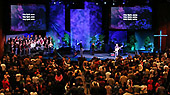
 Yesterday I shared some things I learned after spending a Saturday at Mariners Church in Irvine, California. It’s a church that is different from my church in many ways, but it is possible (and a good idea) to learn new things even from a church that is completely different from yours, and even when there might be things you’d rather not emulate. There has got to be something you can see or hear that will help you think about how stay fresh.
Here are a few more things I learned:
Don’t rehearse right up to the minute the service is about to start
Mariners builds in enough time to their rehearsal schedule to allow the band to be finished a good 30-40 minutes before the service start time. This gives the band a break and means the congregation doesn’t walk into the middle of a sound check.
Invest in good equipment
Too many churches own lousy equipment, have poorly designed sound systems, use the wrong microphones, replace a piece of equipment only when it breaks, and replace that broken equipment with new lousy equipment. Whether your church meets in a living room, a cafeteria, a traditionally designed church building, or a 3,000 seat auditorium, make sure you buy the best equipment you can possibly afford.
Train and deploy volunteers in technical areas 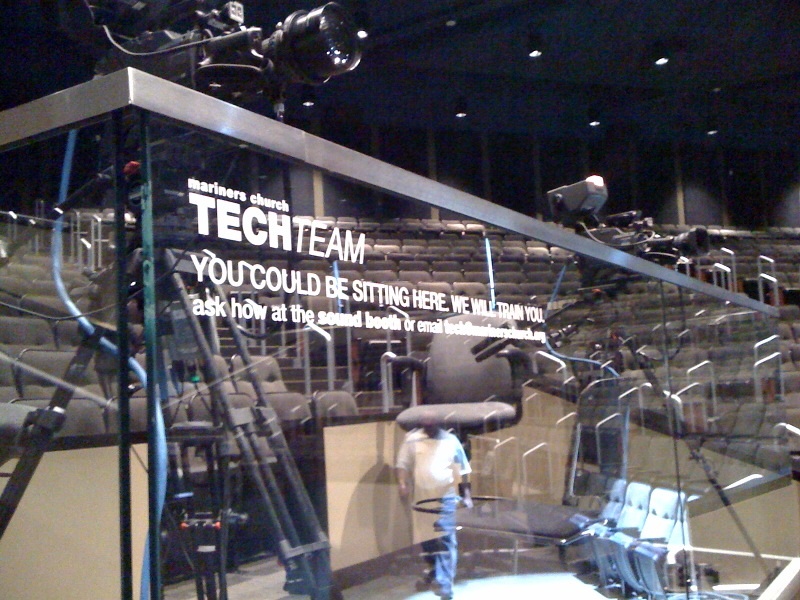
While Mariners has a very large staff, larger than many churches in fact, they depend on a large number of volunteers to help in technical areas. I loved this creative way of recruiting volunteers to run cameras: it says “you could be sitting here. We will train you. Ask how at the sound desk or…” Great idea. Who wouldn’t want to wear a cool headset and run a camera? Recruiting isn’t as hard as we make it seem sometimes.
Have fun
All of the rehearsals, production meetings, and run-throughs that I watched were, most importantly, efficiently run and fruitful. But they were also full of laughter and good-natured ribbing. No one took themselves too seriously. This seemed to make the long rehearsal schedule seem less tedious, break tension, and help foster humility. When Tim Timmons introduced me at rehearsal and said we “met online”, he received a fitting amount of roasting and mocking.
Getting a good electric guitar sound is possible
One of the highlights of my time at Mariners was meeting Russell Crain, their electric guitarist. I’ve always really appreciated Russell’s skill, creativity, visible engagement in worship, and musical taste. I also love the sound he gets out of his guitar. His overdrive is full and smooth, his reverbs/delays/echos are subtle and just-right, and his lead work cuts through the mix without being piercing. Russell is a humble guy and was kind enough to show me how he gets his sound. I’d like to do a post later on detailing his equipment and set up, but for now I’ll just say that he uses a Line-6 M13 stompbox modeler, volume pedal, and then one another pedal I can’t remember. This is fed into a Marshall amp that is backstage in a sound-absorption enclosure. They mic this amp in some creative ways that I’ll share later. The lesson I learned was that it is possible to get a good electric guitar if you have a skillful and humble player, the right pedals, the right amp, and the right mics.
Here is a video I took of Mariners beginning their 3:15pm Saturday run-through.
So as you can see, like I said before, this is a different kind of church than the one in which I serve. But there is always something to learn – if you take the time to look.
 If worship leaders (who lead from guitar) had to list their number one most-dreaded moment, breaking a guitar string would most likely be at the very top.
 Worthily Magnify