 I live in Northern Virginia – one of the most expensive, pressure-filled, busy, and traffic-riddled areas of the country. The millions of people who live in Washington D.C. and its suburbs have become accustomed to a pace of life that says: never slow down, never take time off, and pride yourself on working as hard and long as humanly possible. Even though right now we’re in the middle of summer, that sense of busyness and burden of pressure is still there. I feel it – even though I try to resist it – and it’s exhausting. Weeks are long, commutes are slow, mornings are too early, and vacation is too far away.
You may not live in an area like Northern Virginia/Washington D.C., but it’s a pretty safe bet that you know what I’m talking about. We all have busy and tiring weeks, crowded schedules, full inboxes, long to-do lists, evening meetings, and the ever-present traffic.
Those of us who lead worship, whether we’re full or part-time, paid or volunteer, know how it feels to wake up on Sunday morning with no desire or energy to rehearse the band, lead the congregation, handle the unexpected, have conversations, or do anything other than to just roll over and go back to sleep. The previous week has left us wiped out and drained. We arrive at church on an empty tank.
It’s a familiar and unfortunate scenario. How do we avoid this as worship leaders? How can we make sure that we’re not only prepared to lead worship but also enthusiastic about it?
Depend on the Spirit
In John 7:37-38, Jesus says: “If anyone thirsts, let him come to me and drink. Whoever believes in me, as the Scripture has said, ‘Out of his heart will flow rivers of living water”. Verse 39 tells us that he was talking “about the Spirit, whom those who believed in him were to receive…” There is no reason for us to go on feeling drained and exhausting, allowing the busyness of our lives to dry us up and leave us feeling empty. We may have long weeks, but because of the Holy Spirit, we can have “rivers of living water” flowing out of our hearts. Depend on the Spirit. Every morning, every night, every day – pray that your thirst would be quenched. He’ll answer your prayer and you’ll be able to tell a difference.
Resist the Devil
While it’s natural to feel tired after a 12 hour day of meetings and more meetings, our “adversary the devil prowls around like a roaring lion, seeking someone to devour” (I Peter 5:8). We’re encouraged in James 4:7 to “Submit yourselves therefore to God. Resist the devil, and he will flee from you.” Seeds of discouragement, burn-out, and just plain tiredness – if not resisted – can be used by Satan in destructive ways. While “the thief comes only to steal and kill and destroy…” Jesus “came that they may have life and have it abundantly” (John 10:10). Resist Satan and keep Jesus central and you’ll be able to lead worship out of abundance, not an empty tank.
Keep the Congregation in Your Heart
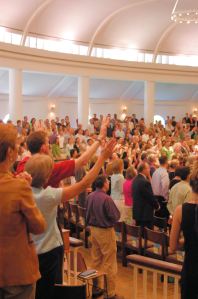
I have a blown-up picture of our congregation from a few years ago (shown above) in a time of corporate worship at our 11:00am service on my wall in my office. I have it there on purpose. During the week it’s very easy for me to get caught up in a whole host of things that end up distracting me, whether it’s the day-to-day responsibilities of emails, phone calls, meetings, planning, and work or other things like difficult conversations, unexpected interruptions and managing volunteers. If I’m not careful – I can go days without remembering that I’m here to serve the congregation. The picture in my office is one way I remind myself why I come in to work every day. Try to foster a love for your congregation in your heart. While you’re at work during the week, think of them and pray for them, looking forward to being with them on Sunday. Stay focused on loving and serving your fellow sheep.
Take Care of Your Soul
“For God alone my soul waits in silence; from him comes my salvation. He only is my rock and my salvation, my fortress; I shall not be greatly shaken.” (Psalm 62:1-2)
Long weeks, busy days, and full schedules are inevitable. Being exhausted by the time Sunday morning rolls around is not. Take care of your soul by waiting “for God alone”, “in silence”. Don’t wait until just before the service to have a quick time of prayer. If you do that – you’ll almost certainly show up feeling frazzled and hectic and unprepared. Be intentional about having quiet time with God before you lead worship.
Take Care of Your Body
This sounds simple – but you’re not exactly setting yourself up for success if you only get 4 hours of sleep and skip breakfast before you come to lead worship. It may mean leaving a Saturday evening dinner party early or missing a movie with friends – but try to make plans to be at home at a good hour on Saturday night with time to get good sleep. And while a donut or two on Sunday morning tastes good – leading worship can be a lot of work. Feed your body with good sleep and good food and your congregation will be grateful that you’re not cranky.
Have an Enthusiastic and Supportive Team
Do all that you can to foster a worship team that is not just there for musical back-up, but for passionate and heartfelt leading of God’s people in worshipping Him in song. When you have energy – they’ll be right there with you. When you’re a bit worn out and needing a vacation – they’ll be there to support you and you’ll be glad you can lean on them.
When we look out over our congregations this coming Sunday, we will be looking at some people who are well-rested, happy, fresh from vacation, and ready to encounter God. Others will be tired, discouraged, needing vacation, and feeling far from God. Some might not even know how they’re doing – they’re just at church. We will not serve our congregations well if we stand before them exhausted, unprepared, and counting down the minutes until the service is over so we can go home. Save your best for Sunday morning. With the Holy Spirit’s filling and power, we’ll serve our congregations with God’s joy as our strength.

 Unfortunately, many worship leaders in the Church have gained a reputation for not only being long-winded, but also insensitive to the clock during a worship service. Service times get affected, kids get rowdy, nursery workers go crazy, the preacher gets hurried, and everyone gets hungry – all because the worship leader just had to do 9 songs.
 Every worship leader has a mental checklist of what needs to happen before they get up to lead worship. Some worship leaders’ checklists are a bit fuller than others, but we all share certain responsibilities that have to be fulfilled prior to the beginning of the service.
 God’s word is the sword of the Spirit (Ephesians 6:17). It will never pass away (Matthew 13:31). It is “God-breathed” and “useful for teaching, rebuking, correcting, and training in righteousness…” (II Timothy 3:16)
  Worthily Magnify