
Thinking Surgically When Leading Liturgically: Recognizing the Danger

Some people love liturgy. They can’t get enough of the stuff. The more prayers, creeds, incense, call-and-response stuff, vestments, and pageantry the better.

I am not one of those people. I like a lot of it, but I also don’t like a lot of it. I’ve lived with it all my life so it’s lost its novelty with me. I see a lot of the good, but I also see a lot of the bad. 

Some things I like (in no particular order of importance).

  • The church year. I love how it tells the story of Jesus.
  • The liturgy for the burial of the dead (i.e. a funeral). I love how it starts off with the proclamation from the back of the room: “I am the resurrection and I am Life says the Lord…”
  • The Maundy Thursday service ending with the reading in darkness of Jesus’ arrest and betrayal while all of the adornments in the church are stripped away.
  • The Easter Vigil service where the service begins in darkness with songs and readings and prayers telling the story of redemption all the way from Genesis, culminating in the great Easter acclamation and a celebration of Jesus’ resurrection.
  • The Easter acclamation: “Alleluia! Christ is risen!” to which we reply “The Lord is risen indeed. Alleluia!”
  • The prayer for purity.
  • The prayer of humble access.
  • The Gospel truth that is soaked through so much of the liturgy and prayers, to help protect the church from doctrinal error.

Some things I don’t like.

  • The robotic, monotonous, heartless repetition that it can instill in so many congregations. Amazing truths can be spoken and sung with so much familiarity that they don’t affect the heart.
  • “We can’t do ____ because the prayer book says we have to do ____.”
  • The elevation of tradition to a place of inerrancy that only Scripture should hold.
  • The pomposity that can accompany it.
  • The impression it gives that prayers should always (a) be fancifully worded and (b) professionally offered.

But if I had a choice to lead worship either at a totally non-liturgical church or a liturgical church for the rest of my life, I have to say I’d pick the latter. In spite of all the things about the liturgy that frustrate me, I think I would find myself longing for its structure after a while.

I’m in a bit of a dilemma with liturgy. I like it when it works. I don’t like it all the time. But in my church, it’s used nearly all the time, whether I happen to think it works or not!

Maybe you’re like me and you’re a liturgy-lite person. Maybe you’re the person I described who can’t get enough or it. Or maybe you can’t stand liturgy at all and just have to tolerate it.

Whatever your personal feelings for liturgy, there is a temptation that lurks: it becomes empty words, empty acts, empty rituals, empty movements, and empty prayers.

You might love liturgy or you might hate it. Or, like me, you might be confused about what you think about it. Regardless, if you’re not careful, and if your church’s leadership isn’t careful, it loses its power.

Good drivers know the dangers of driving. Good doctors know the danger of bad medicine. Good builders know the danger of their tools. Same principle applies for worship leaders. Good worship leaders know the danger of familiarity, i.e. liturgy.

So the first step towards “thinking surgically when leading liturgically” is to recognize its danger. Only then can you see its potential.

It’s not all wonderful (for those of you can’t get enough) and it’s not all terrible (for those of you who can’t stand it).

Liturgy is like a box of chocolates. Some bits of it are filled with tasty filling. Some bits are terrible. Too much of it will leave you in a coma.

The danger is that it all becomes empty. And that’s where you come in. More later.
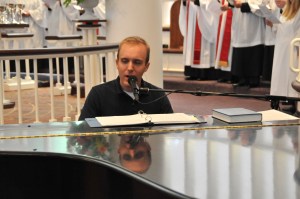
Thinking Surgically When Leading Liturgically

Every church has its own liturgy.

Some forms of liturgy are obvious: a book of common prayer, a prescribed order of service, processionals, the creeds, collects (corporate prayers in unison), the church year (i.e. Advent, Christmas, Epiphany, Lent, Easter, Pentecost, Ordinary time), etc.

Some forms of liturgy are less obvious: the worship leader always starts the service by inviting people to stand, the sermon is at the end, the announcements are before the sermon, we sing upbeat songs then sing slower songs, etc.

So here’s fact number one: There is no such thing as a non-liturgical church. Some are more so than others, but every church has its own customs, its own traditions, and its own normal pattern for corporate worship.

But there is a big difference between what a non-denominational service looks like when compared to a Presbyterian service. It doesn’t take a rocket scientist to figure out that some services are fairly loose and informal, while other services are more structured and formal.

And in those churches that employ a more liturgical form of corporate worship are worship leaders who are struggling with how to work within those constraints. It’s a struggle. There isn’t as much wiggle room and freedom in a highly liturgical church as there is in a “non-liturgical” church (although even those churches do have liturgy).

Here’s fact number two: it’s more difficult to lead worship in the context of a formal liturgy.

That’s a bold statement, I know. But I believe it’s true. Every church presents its own challenges, and every worship leader faces different circumstances. But speaking specifically to the exercise of leading people in corporate worship in song: it’s harder to do within the confines of formal liturgy.

I was born and raised in the Episcopal Church. Every Sunday of my life, from birth through my sophomore year of college, the service format was a by-the-book (Book of Common Prayer, that is) Holy Communion service. I know the book. I know the liturgy. And I’ve learned to love the liturgy, and see its structure not as being a constraint on my worship leading, but as providing scaffolding on which I can stand.

These next several posts are geared entirely toward people who lead worship in a church that utilizes a more formal liturgy. If you’re in a more informal church, you might not find a lot that applies to you. But if you serve in a church where the pastors are called priests, the lobby is called a narthex, your board of elders is called a Vestry, your green room is called a sacristy, your stage is called the chancel, your opening song is called a processional, you have hard-covered books of common prayer/common worship in the pews (not seats), and you know what a Sanctus is, then I hope you find some of what I have to say helpful.

So while I do believe that it’s more difficult to lead worship in the context of a formal liturgy, I want to encourage those of you who do, and help you thrive within the confines (and know when they can be broken out of).

I’ve titled this series: “thinking surgically when leading liturgically”. It’s a clever name and it rhymes, but I hope it makes a point. And that’s fact number three: you can work with the liturgy to make a service come alive.

It takes careful and prayerful planning. It takes getting familiar with the liturgy. It takes some boldness. And it takes knowing when to tinker and when not to tinker. But it can work. Liturgy doesn’t have to be a force of lethargy and robotic deadness in your services.

Your congregation can experience vibrant, Christ-centered worship in a liturgical setting. It’s more difficult, but it’s possible. Trust me. Tomorrow we’ll start looking at how.

How Often Should I Introduce New Songs?

How often worship leaders should introduce new songs is an incredibly important question.

Someone recently wrote and asked me this question and here’s how I answered:

Week one: Teach Song A

Week two: Do Song A again somewhere in the service. If it’s a slow song, do it during communion or at the end of a set. If it’s an upbeat song, do it first thing, and ease into it.

Week three: Teach Song B.

Week four: Do Song A again. Do Song B again somewhere in the service where it fits.

Week five: Don’t teach anything new. Give people a break.

Week six: Teach Song C.

Week seven: Do Song A or Song B again. Repeat Song C again somewhere in the service.

Week eight: Do one of the three new songs you’ve taught. Don’t teach anything else.

So in the course of roughly two months, you’ve taught 3 new songs, and repeated each one at least twice. This gives you enough experience with the song to know whether it’s a keeper, whether it should be put on the bench, or whether it should be canned.

Out of those three new songs you’ve done in two months, two might stick around in your repertoire. More realistically, out of three new songs, only one will really become a regular song. There are exceptions, of course.

As I look back over a year, usually I’ve added 6-8 solid new songs to the repertoire. Another 4-6 are in the repertoire but still needing some time to simmer. Another 4 – 6 songs are put back on the shelf.

Adding too many new songs overwhelms a congregation. Not introducing any can deaden them. Find the right balance for your congregation of building their confidence by singing familiar songs, and spending some of that capital you’ve earned on stretching them with new songs.

Breaking Out of Worship Leader Prison – Pt. 4

“Guilty people make people feel guilty. Free people make people feel free.” This is one of the first things Dr. Steve Brown shared at a class he taught last week, before he shared the twelve prisons that entrap Christians and that are deadly to pastors.

I’ve shared nine of these prisons (part one, part two, and part three), and the underlying issues. Today I’d like to share the last three.

10. Rules
Believe it or not, people will try to manipulate you. They might not even realize they’re doing it, but they are. Don’t be manipulated by the rules people try to set for you. If you want to stay out of the prison of these other-people-imposed rules, you’ll need to set boundaries.

You might recognize some of these:
– Jerry needs a worship leader for his Tuesday night men’s ministry meeting. He asks you. If you say no he won’t have anyone. So you say yes even though it means you’ll be away from home for a fourth straight evening.
– Your bass player refuses to use the online rehearsal resource that the rest of your worship team uses. So you print out chord charts and mail him a CD and spend an extra two hours just on him.
– Amy Amison, a woman who has always sung solos at your church, wants to sing “O Holy Night” this Christmas Eve. She’s not very good. But she’s always sung. You’d rather not have her sing, but you hear from several people that you don’t really have a choice.

So rules get imposed on you. You have to lead worship for the men’s ministry meeting. You have to cater to your uncooperative bass player. You have to let Amy Amison sing.

Why? Because you have to.

No you don’t. You’ve been manipulated.

Being a Christian, and being a worship leader, doesn’t mean you lose your right to set boundaries, to say “no”, to go against unhelpful traditions, and to ruffle feathers. You will burn out more quickly than you can imagine if you allow the prison of rules to keep you locked up.

11. Religion
Leading people in magnifying and exalting the greatness of God in Jesus Christ by the power of the Holy Spirit is exciting. Leading musicians in using their gifts to passionately, skillfully, and humbly lead the congregation in singing praise to God is a joy.

But presenting people with a safe, predictable, and polite collection of songs is robotic. Playing chords and melodies to please the ear and manipulate emotions is dangerous.

In the first example we have a picture of the church gathering to celebrate the glory of God. In the second example we have a picture of a religious institution that wants nice music.

When people get really excited about Christianity as an institution, then they’re in prison. The same principle applies to worship leaders. When they get more excited about presenting a polite collection of impressive songs than they do helping people encounter and exalt God’s greatness, they’re (no pun intended), behind bars.

If you find yourself dreading leading worship or coming into the church office to prepare for services and rehearsals, that might be a red flag that you’re in a prison of religion and need to be refreshed and amazed again by the freedom of God’s grace in Jesus Christ.

Jesus elicits our worship. Religion elicits our duty. If you’re duty-bound, then you really are bound. Worship Jesus, not the institution.

12. Gurus
The last prison that entraps worship leaders is the prison of gurus.

There is no shortage of worship gurus out there. To learn from them, be mentored by them, and follow their example is a good and healthy thing (depending on the guru). To worship at their altar is not healthy. In fact, it’s idolatry.

We all have people we put on a pedestal. We think that by emulating them and following them we’ll be more sanctified. But we’re not. We’re less so. We’re fake and in bondage.

There really is incredible bondage in worshipping other worship leaders. There is freedom in worshipping Jesus. Be intentional in seeking out good role models. But be careful not to cross the blurry line into idolizing them.

My prayer for myself, and any worship leader who reads this blog, is that God would continue to break the chains of bondage that seek to hinder our effectiveness in ministry, and that we would be set free, by his grace, more and more every day.

Breaking Out of Worship Leader Prison – Pt. 3

The good news of the Gospel is that we who were dead in sin are now alive in Christ. We who were once in bondage have been set free. Jesus has secured for us eternal peace with God. We live in the freedom of God’s grace. But do we?

Sadly, too many Christians don’t know this freedom. They live their lives feeling guilty, not forgiven. They live their lives in a constant pursuit to make God happy with them, not in gratefulness for his unmerited favor. They pretend to be perfect. They try to make everybody happy. They’re in prison.

This is particularly dangerous for people in ministry, and worship leaders are not immune. The underlying problem is that people see us up in front and think we’re wonderful or expect us to be. We aren’t living in the freedom of God’s grace so, either we carry our guilt and pretend to be wonderful, or do all sorts of silly things in order to seem wonderful. We start pretending, and this puts us in bondage in all sorts of ways.

Last week I shared six different prisons Christians get stuck in as a result of all this (part one, part two). Now three more:

7. Fear
In 2 Timothy 1:7 we’re told that God has not given us a spirit of fear – but a spirit of power and love and self-control. Why, then, are we so afraid of so much, and afraid so often?

There are some worship leaders who constantly live in a fear of shame, conflict, the unknown, difficult people, new ideas, being exposed, losing their job, missing God’s will, ruining a service, etc. The list goes on. This prison of fear kills worship leaders. We have to break out of this one so God can use us.

Sometimes God puts us in situations that cause fear because then we can realize where we need to trust him more. If we didn’t have a Savior who had known excruciating fear but persevered all the way to the cross for our sake, we would have reason to be afraid. But Jesus took care of any reason to fear. He is our Redeemer and Mediator, our Father is sovereign and good, and the Holy Spirit is the Comforter. So relax and get out of the prison of fear.

8. Needing approval
Dr. Steve Brown, whose class I attended last week at RTS and who spoke on each of these twelve prisons, gave us a list of six “nevers” for people in ministry.

–       Never grovel (kiss up)
–       Never apologize when you’re right
–       Say no more than twice
–       Never lie
–       Never pretend to be someone’s mother
–       Never take responsibility for something that isn’t your responsibility

I don’t know about you, but each one of those points resonate with me and are incredibly freeing to consider. What is he getting at in each one of these “nevers”? Get rid of your need for everyone’s approval.

Living in the freedom of God’s grace doesn’t mean being a jerk, insensitive, undiscerning, un-pastoral, harsh, arrogant, sharp-tongued, or politically stupid. Not by any means.

What it does mean, though, is that once we know – really know – that because of Jesus Christ we are completely loved, accepted, ransomed, redeemed, covered, and freed, then we don’t need man’s approval in order to feel like we have worth.

I love the line from “Be Thou My Vision”: “riches I heed not, nor man’s empty praise, Thou mine inheritance now and always”. What an inheritance we have in Jesus. We don’t need man’s empty praise.

9. Obligation.
No one told me, when I first started leading worship, how often I would end up come face-to-face with various problems over the years.

Some problems are small: the music stands are broken, the chairs are in disarray, the website hasn’t been updated, the piano tuner needs to get into the church but it’s locked, etc.

Some problems are big: the drummer is disrupting rehearsals with his bad attitude and sometimes vulgar language, a small coalition of longtime members are petitioning the pastor to get your music out of the service, etc.

Worship leaders will face lots of problems over the course of their ministry. They get in trouble when they think they’re the solution to each one of those problems.

Repeat after me: I am not the solution to every problem.

Feel better? You should. That’s what God’s grace will do to you.

There are three more prisons that I’ll share tomorrow, just in case none of these first nine have convicted you yet 🙂