
Checking for Ticks

tickYou may not know this, but it’s a fact that those of us who lead worship are targets for ticks. Without realizing it, ticks can latch on to us and survive unnoticed for years.

There is a wide variety of tick species to look out for. Check yourself before you lead worship next time for any one of these:

Here we go!
One of the sneakiest ticks around, it causes a worship leader to exclaim into the microphone something more appropriate for the beginning of a road trip to Yosemite than the transition into the bridge of a song.

Come on everybody!
The brother of the previous tick, its victim unwittingly uses a crowd-rousing technique first developed by Richard Simmons in an attempt to infuse enthusiasm into a service.

I just really want to…
Native to youth groups, this tick has spread into a wide variety of settings. The afflicted worship leader begins any personal word with this preface, followed by sentences of varying levels of competency, depending upon the amount of preparation devoted.

Yes Lord!
A difficult tick to remove once it has become attached – the “Yes Lord” tick presents itself before, during, or after songs, oftentimes with a high number of repetitions. While a declaration of agreement and affirmation may be effective and appropriate on occasions, this tick causes the statement to become so common that it is ignored.

Sing it like you mean it
Native to Sunday school and VBS, this tick is able to multi-task by being patronizing, insulting, distracting, and counter-productive all at the same time.

Amen
This is perhaps the most common species of tick to attach itself to worship leaders, Amen?

Put your hands together!
A potentially dangerous tick. An infected worship leader could cause mass confusion. “OK, I put my hands together… Now what do I do with them? Can I take them apart yet?” Unfortunately, the worship leader is not thinking about what he or she is asking the congregation to do. Very sad.

Oh, oh, ohhhhhhh!
Rearing its ugly head in between lines of a song, this tick causes a worship leader to employ a vocal flourish more suited for a 1980’s power ballad. Severe cases have been reported in which worship leaders attempt the highest note they can hit before fainting for no apparent reason.

Mmm, mm, mmmmmm
The descendent of “oh, oh, ohhhhhhh”, this tick has slightly different characteristics. While still rearing its head in between the lines of a song, the resulting vocal flourish is more suited for a 1960’s sappy love song. Most common to worship leaders who forget the lyrics to the second verse.

If you ­­­___ then let me hear you ___
The distant cousin of the “sing it like you mean it” tick – this species causes its host to insert any combination of words, resulting in groans and rolled eyes in the congregation. “If you love Jesus, then let me hear you shout!” “If you came ready to worship then let me hear you sing it loudly!” Swift action should be taken to remove this tick before its host is harmed by angry church members.

Ask trusted friends to examine you for any evidence of these ticks or any mutation. Long-term infection is unwise. Recovery time is quick for the former host and enjoyable for the congregation.

Please Step Away From The Desk

cityThis past Wednesday I had the joy of eating lunch with one of the piano players on the worship team at my church. He’s a great guy, a godly man, and a good friend. We try to get together every 5 or 6 weeks to catch up, usually near his office in Washington D.C. I managed to find a parking spot downtown and we walked to lunch at a packed-out sandwich shop near the White House. For a politics nerd like me, this was a lot of fun.
We talked about what was going in our lives, and then I asked him how he’s been feeling about how things are going on the worship team and at Sunday services. He had a number of really helpful thoughts, observations, encouragements, and insightful critiques. He even took the time to email me some more detailed thoughts later on that afternoon about some of what we had talked about.

Getting together like this with worship team members who I know and trust has been an amazingly helpful thing through the years for several reasons.

First, it gets me outside the church bubble. I work full-time at the church and am on campus six days a week. It’s good for me to get out and see how members of the congregation and my worship team spend their week. It’s busy and intense where these guys spend their days and I’ll serve them more effectively if I know what they have to deal with. I’ll be more understanding when they’re late to an evening meeting, can’t come to an event, respond slowly to an email, or need some time off. I’ll also be more grateful when I see what a sacrifice they make to give up an evening away from home for a rehearsal or give up a vacation day to go on a conference. If I really want to care for and lead my team well, it’s good to get outside my church bubble and make time to be with them where they are.

Secondly, I need to hear what they have to say. Hearing answers to my questions like, “how have you felt about the last few services on Sunday mornings?” or “do you think we’ve been doing the right kinds of songs?” helps me not become isolated, unapproachable, or prideful. Ask questions. They don’t have to be complex. They can be quite simple. The more input you can receive as a worship leader, from all angles, the better off you’ll be.

Third, your team shouldn’t always come to where you are. If the only place you see your volunteers is at church, you’re missing out on actually having a relationship with your team. They’ll see their role as just filling a slot, and you’ll see them as people who just fill slots. Your team will only invest themselves in ministry if you invest yourself in them.

Finally, it gives you perspective. Hearing what’s going on the lives of people on the worship team, what they’re dealing with at work, how they’re spending their time, and what’s on their minds helps me remember that much of what I stress out about as a worship leader isn’t all that important at the end of the day.

I encourage you to build relationships with the people on your team. Make time to go to where they are and even share a meal with them. Find out what’s going on in their lives and ask them for their thoughts on rehearsals, services, music, worship, etc. You’ll be more effective the farther out of your bubble you can get.

Save Your Best for Sunday

congregationworshippingI live in Northern Virginia – one of the most expensive, pressure-filled, busy, and traffic-riddled areas of the country. The millions of people who live in Washington D.C. and its suburbs have become accustomed to a pace of life that says: never slow down, never take time off, and pride yourself on working as hard and long as humanly possible. Even though right now we’re in the middle of summer, that sense of busyness and burden of pressure is still there. I feel it – even though I try to resist it – and it’s exhausting. Weeks are long, commutes are slow, mornings are too early, and vacation is too far away.

You may not live in an area like Northern Virginia/Washington D.C., but it’s a pretty safe bet that you know what I’m talking about. We all have busy and tiring weeks, crowded schedules, full inboxes, long to-do lists, evening meetings, and the ever-present traffic.

Those of us who lead worship, whether we’re full or part-time, paid or volunteer, know how it feels to wake up on Sunday morning with no desire or energy to rehearse the band, lead the congregation, handle the unexpected, have conversations, or do anything other than to just roll over and go back to sleep. The previous week has left us wiped out and drained. We arrive at church on an empty tank.

It’s a familiar and unfortunate scenario. How do we avoid this as worship leaders? How can we make sure that we’re not only prepared to lead worship but also enthusiastic about it?

Depend on the Spirit
In John 7:37-38, Jesus says: “If anyone thirsts, let him come to me and drink. Whoever believes in me, as the Scripture has said, ‘Out of his heart will flow rivers of living water”. Verse 39 tells us that he was talking “about the Spirit, whom those who believed in him were to receive…” There is no reason for us to go on feeling drained and exhausting, allowing the busyness of our lives to dry us up and leave us feeling empty. We may have long weeks, but because of the Holy Spirit, we can have “rivers of living water” flowing out of our hearts. Depend on the Spirit. Every morning, every night, every day – pray that your thirst would be quenched. He’ll answer your prayer and you’ll be able to tell a difference.

Resist the Devil
While it’s natural to feel tired after a 12 hour day of meetings and more meetings, our “adversary the devil prowls around like a roaring lion, seeking someone to devour” (I Peter 5:8). We’re encouraged in James 4:7 to “Submit yourselves therefore to God. Resist the devil, and he will flee from you.” Seeds of discouragement, burn-out, and just plain tiredness – if not resisted – can be used by Satan in destructive ways. While “the thief comes only to steal and kill and destroy…” Jesus “came that they may have life and have it abundantly” (John 10:10). Resist Satan and keep Jesus central and you’ll be able to lead worship out of abundance, not an empty tank.

Keep the Congregation in Your Heart
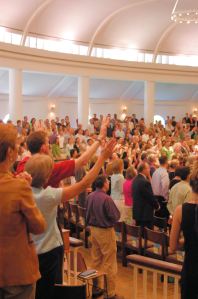
I have a blown-up picture of our congregation from a few years ago (shown above) in a time of corporate worship at our 11:00am service on my wall in my office. I have it there on purpose. During the week it’s very easy for me to get caught up in a whole host of things that end up distracting me, whether it’s the day-to-day responsibilities of emails, phone calls, meetings, planning, and work or other things like difficult conversations, unexpected interruptions and managing volunteers. If I’m not careful – I can go days without remembering that I’m here to serve the congregation. The picture in my office is one way I remind myself why I come in to work every day. Try to foster a love for your congregation in your heart. While you’re at work during the week, think of them and pray for them, looking forward to being with them on Sunday. Stay focused on loving and serving your fellow sheep.

Take Care of Your Soul

“For God alone my soul waits in silence; from him comes my salvation. He only is my rock and my salvation, my fortress; I shall not be greatly shaken.” (Psalm 62:1-2)

Long weeks, busy days, and full schedules are inevitable. Being exhausted by the time Sunday morning rolls around is not. Take care of your soul by waiting “for God alone”, “in silence”. Don’t wait until just before the service to have a quick time of prayer. If you do that – you’ll almost certainly show up feeling frazzled and hectic and unprepared. Be intentional about having quiet time with God before you lead worship.

Take Care of Your Body
This sounds simple – but you’re not exactly setting yourself up for success if you only get 4 hours of sleep and skip breakfast before you come to lead worship. It may mean leaving a Saturday evening dinner party early or missing a movie with friends – but try to make plans to be at home at a good hour on Saturday night with time to get good sleep. And while a donut or two on Sunday morning tastes good – leading worship can be a lot of work. Feed your body with good sleep and good food and your congregation will be grateful that you’re not cranky.

Have an Enthusiastic and Supportive Team
Do all that you can to foster a worship team that is not just there for musical back-up, but for passionate and heartfelt leading of God’s people in worshipping Him in song. When you have energy – they’ll be right there with you. When you’re a bit worn out and needing a vacation – they’ll be there to support you and you’ll be glad you can lean on them.

When we look out over our congregations this coming Sunday, we will be looking at some people who are well-rested, happy, fresh from vacation, and ready to encounter God. Others will be tired, discouraged, needing vacation, and feeling far from God. Some might not even know how they’re doing – they’re just at church. We will not serve our congregations well if we stand before them exhausted, unprepared, and counting down the minutes until the service is over so we can go home. Save your best for Sunday morning. With the Holy Spirit’s filling and power, we’ll serve our congregations with God’s joy as our strength.

Acoustic Guitar Tutorial

worshipcentralWorship Central has posted a really good acoustic guitar tutorial video on their website. One of the best I’ve seen.

David Clifton, the music director at Tollington Parish in North London is the teacher. Great tips on how to lead well on the acoustic guitar – especially when you’re all by yourself.

Check it out.

Watch the Clock

clockUnfortunately, many worship leaders in the Church have gained a reputation for not only being long-winded, but also insensitive to the clock during a worship service. Service times get affected, kids get rowdy, nursery workers go crazy, the preacher gets hurried, and everyone gets hungry – all because the worship leader just had to do 9 songs.

Some are oblivious.
They completely lose track of time and don’t realize that they’ve gone on for 45 minutes when the pastor had asked them to only go 20. They send the message that they are undisciplined and unaware they aren’t the only person in the room.

While it is definitely easy to lose track of time when you’re singing, there is a very simple way to get over this: buy a watch. I started leading with a watch on my music stand a few years ago and was amazed at what a difference it made. We’ve also installed a big digital clock at the back of our Sanctuary that I can see and the preachers can see. It’s easier to watch the clock when you’re watching a clock.

Some are arrogant.
They know full well how long they were asked to go, but they choose to go however long they want to anyway. They send the message that they can’t be trusted and that they view themselves as being answerable to no one.

While it can be difficult when you’ve prepared six songs to be told there’s only time for two, the way to handle this is very simple. Only do two songs. Arrogantly ignoring the time allotment and doing your own thing is one sure way to disrespect your pastor and your congregation and in the process grieve the Holy Spirit. There is a time and place to discuss how many songs will be sung, how much time will be allotted for music, etc. Once the decision is made, be a team player and a humble servant by doing your best to stay in the time limit.

Worship leaders (of all people!) should be willing to serve – in whatever capacity and in whatever time allotment given – with joy and humility. Make an effort to find out exactly how much time you have, and roughly how many songs you’re being asked to lead. Once those parameters are set, do your best to stay within them. Yes, God is at work in our services in ways we cannot always anticipate. But God is also at work in our planning and will lead us as we prayerfully seek to bring him glory and watch the clock at the same time.