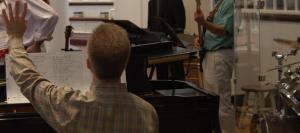
 At the recent worship conference hosted by Sovereign Grace Ministries, Bob Kauflin taught a seminar on the importance on physical expressiveness in corporate worship titled “Let the People Be Glad: Corporate Worship and Expressiveness”. It was a biblical, balanced, challenging, and important message. You can download the message here and I suggest that you do!
Recently on his blog Worship Matters, Bob posted on “The Passionate Preaching of John Piper” to provide an example of the kind of expressiveness worship leaders should seek to model. A reader left a comment on that post and said:
“I attend a very non-expressive church with traditional/formal music where physical expression would seem out of place to a lot/most people. I’ve held back much of the physical praise my heart has desired to show out of fear and am just now realizing how much the fear of man has hindered my worship to God. The question I have to wrestle through now is how do I worship God with my whole being as I long to do, yet also be aware and sensitive to the body of Christ that I worship with? There is a balance of edification and focus on God and I’m seeking to find it in my specific context!”
Having been born and raised in the Episcopal/Anglican church, I know how this reader feels. I’d like to suggest how a person who attends a church where physical expression in worship is not the norm could respond.
First, humility.
In John Piper’s recent sermon, “Greatness, Humility, Servanthood”, he explains why humility is of the utmost importance to Christians:
“Every good thing in the Christian life grows in the soil of humility. Without humility, every virtue and every grace withers. That’s why Calvin said humility is first, second, and third in the Christian faith. And he could have said fourth, fifth, sixth, and more. It is pervasively effective.”
It’s frighteningly easy for me to become proud when, as someone who is comfortable with physical expressiveness in corporate worship, I am in a room full of people who are not. Within a matter of seconds I can size them up to be spiritually dry, uninterested, hard-hearted, and stubborn. I immediately consider myself more “worshipful” than them, and allow arrogance to fester in my heart.
When presented with this scenario – being in a worship service with people who are not physically expressive – my first, second, and third priority needs to be humility. Only in that soil will a love for them grow. Once I love them, I won’t be afraid of them, and my desire will be to serve them.
Second, priority.
In 2 Samuel 6:5-23, When David danced in the streets as the Ark of the Covenant was brought back into Jerusalem, his wife not only “despised him in her heart” (verse 16), but she mocked him to his face saying “how the King of Israel honored himself today… as one of the vulgar fellows shamelessly uncovers himself!” (verse 20). David’s reply is astounding. “It was before the Lord, who chose me above your father and above all his house, to appoint me as prince over Israel, the people of the Lord – and I will make merry before the Lord. I will make myself more contemptible than this, and I will be abased in your eyes” (verse 22a).
There are, at least, two important things for me to learn from what David says to Michal.
My physical expressiveness should be “before the Lord”. People might look at me strangely. I may become known as “that person who always lifts his hands”. It doesn’t matter. It is “before the Lord”.
Am I willing to become “more contemptible than this”? This is a reputation-shattering statement – and that’s the point. My own glory is meaningless when I am caught up in the glory of God. May my own glory – as pitiful as it is – matter less and less and less – so that I might be free to even dance “with all [my] might” (verse 14b).
Third, sensitivity.
If I’m attending a Sovereign Grace worship conference, I can lift my hands, dance, shout, and clap, (maybe even do it all at the same time!) and most likely no one will notice. Physical expressiveness is the norm, so I’m probably more likely to stand out if I’m sitting down with my arms folded.
However, if I’m attending an 8:30am service at a traditional church and I start lifting my hands, dancing, shouting, and clapping during the opening him, I could not only disrupt the service, but I could distract those around me. Sensitivity is key, and sensitivity is a form of wisdom. Since “the Lord gives wisdom” (Proverbs 2:6), ask him to show you what to do.
Only you, with the help of the Holy Spirit, can discern at what point your physical expressiveness crosses the line between heartfelt, God-centered expressiveness and heartfelt, God-centered, carried away-ness.
I would suggest that, to start with, you would only go one step beyond where the congregation is. If there is zero physical expressiveness happening, start with your countenance. Then the next week, maybe lift a hand or two. Slowly, you’ll get more comfortable and bold with being expressive in that environment, the people around you will not be distracted by your eagerness and all-at-once approach, and you may be surprised that others start feeling more free to express themselves in similar ways because you have broken the ice.
Fourth, patience.
It’s highly unlikely that your church will change overnight from one in which physical expressiveness is not the norm to one in which it is. It’s probably even unlikely that it will change drastically in a year. I’ve been at my church for five years and we still have a long way to go. But, thanks be to God, we have grown in this area.
Paul says in 1 Corinthians 13:4 that “love is patient…” Love your congregation by being patient with them.
Finally, boldness.
When Sunday morning rolls around, the opening hymn starts, and no one around you is displaying even the slightest hint of physical expressiveness except for when they sneeze, lifting one hand or clapping on one measure will take a tremendous amount of courage. Be encouraged by 2 Timothy 1:7, that: “God gave us a spirit not of fear but of power and love and self-control”.
Those are three of the things you’ll need the most in that moment. The power to express yourself physically when no one else is, the love to look at those around you not with arrogance but with humility, and the self-control to know how to be sensitive.
Martyn Minns was my pastor for many years when I was in high school and college, and now he’s my bishop. I’ve always respected and admired his ability to model physical expressiveness in the context of a more formal church. He isn’t afraid to move his body, lift his hands, and bang on his tambourine. He faces his fair share of criticism for it – but God uses his example to change the climate in churches.
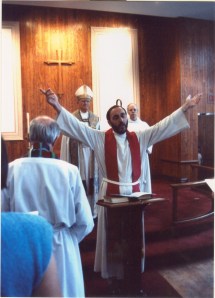 This picture of him from the late 1980’s shows what I’m talking about. There he is, as the new pastor of a church in downtown New York City, front and center, with his hands lifted in worship. And there’s his bishop behind him, looking at him like he has three heads.
I love it.
Those of us who stand in the congregation or stand in leadership at a church where physical expressiveness is not the norm are there for a reason. Sunday by Sunday, God will use our humble example for his glory.
 I can always tell when I’m holding a document in my hand if it’s a copy of a copy or if it’s an original. A copy of a copy has a worn-out, old, slightly fuzzy look to it – kind of like the worksheets you get in middle school that you’re sure your teacher has used for the last 45 years. An original is crisp and up-to-date – like the first page you print after you’ve installed a brand new printer.
 We’ve all been there. After the service someone comes to tell you, with tears in their eyes, how you “sing with the voice of a thousand angels” (I’m exaggerating a bit with that one) or “took us right into the holy places” or “brought God’s presence down”.
 Worthily Magnify