
Lessons from the Blizzard of ‘09

I left work this past Thursday evening around 7:00pm after a long day of finishing up plans for this past weekend’s lessons and carols services. It had been a long and busy week, preparing for what are probably the most musically intensive services of the year for the worship team and me. I was tired but really excited for the weekend.

I got in my car, turned on the news station (I’m a news junkie, by the way), and was quite surprised to hear that a major east-coast blizzard was forecast to bombard the Washington D.C. area with two feet of snow beginning late Friday night and continuing into Sunday morning.

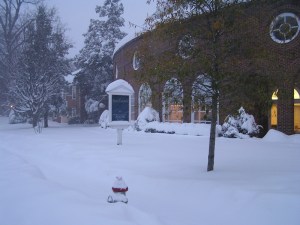
By Friday morning it was clear that this blizzard was indeed going to give us a direct hit – and that the services for which I had prepared so diligently were most likely going to be snowed out. Sure enough, on Saturday afternoon, with snow falling at a rate of 4 inches per hour, the decision was made to cancel all weekend services.

Many of you who read this blog will never have to deal with a blizzard forcing your church to cancel all weekend services. (Jonathan in the Philippines – I’m thinking about you.) But whether it’s a blizzard or a hurricane, are you prepared for a weather emergency?

(This isn’t the most exciting question that worship leaders face, but it just happens to be on my mind today.)

In those rare circumstances, a worship leader needs to be able to keep his volunteers informed, stay (very) flexible, and remember that God is sovereign. Our planning and preparation are critically important, but we need to hold to them loosely.

A few other practical tips for dealing with service-altering weather events:

Be prepared to lose your email capability
On Friday morning, I realized I didn’t have one of my vocalist’s cell phone numbers. I emailed her and asked for it, just in case I needed it. Sure enough, on Saturday afternoon in the middle of the blizzard, our church email servers went down. But since I had everyone’s phone number, I was still able to communicate the news that all services were canceled. My email is still down, by the way.

Stay cool (no pun intended)
I stayed late every night last week. 2,000 bulletins were printed. Extra equipment had been rented and set up in the Sanctuary. A ton of administrative work had been done. Special arrangements had been written. Hours of rehearsal had been spent. But then along came a blizzard.

If I had been given the opportunity to pick one weekend when a blizzard would cause all services to be canceled, this past weekend would have been very last on my list. But I didn’t have that opportunity. There was nothing I could do. Stressing out about it and lamenting the timing of the blizzard would be futile.

Stay flexible
A number of things could have happened this past weekend. We could have canceled the Saturday service but kept the Sunday services. We could have had only one combined Sunday morning service. We could have canceled all weekend services except for Sunday evening. I had no idea. No one did. One thing I did know for certain was that this weekend was not going to be normal and I was definitely going to have to adjust my plans somehow.

Don’t let your preparation go to waste
The songs and arrangements I had intended to use this past Sunday? I’m totally using them this coming Sunday. The bulletins we printed for the lessons and carols services? I’m putting them in a box and using them next year. (It helps that we didn’t put dates on them). The lyric projection files? Saved. The hours we spent rehearsing? They made us better musicians.

This time last week I was preparing for services that would never happen. Now I’m preparing for Christmas Eve services, end-of-December services, and first weekend of January services. They’ll probably happen as scheduled, but they may not. If they happen or if they get snowed out, I’ll try to be as prepared and ready as I can.

Photos of The Falls Church taken by Justin Wills. Used by permission.

What Do I Pray After a Song?

Sometimes it’s hard to know what to pray after a song, if, as the worship leader you’re expected to pray in order to conclude a time of singing or transition into a different part of the service.

There are many ways you can handle this. Sometimes you can leave a period of silence, to encourage people to wait on the Lord and cherish his presence. After some time passes you can briefly pray and encourage people to be seated afterwards. Other times you might feel led to thank God for something you’ve been made freshly aware of as you’ve sung. Sometimes I don’t think I need to add anything at all, so I’ll just say “amen” after a few seconds of lingering on the last chord of a song.

But you don’t always have to make something up on the fly. Reading from Scripture is a great way to “pray” after a song, or reading a pre-written prayer.

This past Sunday we finished our opening time of singing with the familiar Tim Hughes song “Here I Am to Worship”. I would typically be the one to pray after the last song, but on this particular Sunday I looked over at John Yates, my pastor, and he signaled that he wanted to pray instead.

He got up and read an ancient prayer, called the Te Deum laudamus, In the Anglican church this is found in our Book of Common Prayer and in many churches it’s read almost every Sunday. As he prayed, I kept playing piano just to help give a bit of support. (I don’t always play background music when I or someone else prays, but sometimes it seems like it would be helpful.)

Here’s a clip of the song ending and then John closing the time of singing with the prayer.

You are God: we praise you; You are the Lord: we acclaim you;
You are the eternal Father: All creation worships you.
To you all angels, all the powers of heaven,
Cherubim and Seraphim, sing in endless praise:
Holy, holy, holy Lord, God of power and might,
heaven and earth are full of your glory.
The glorious company of apostles praise you.
The noble fellowship of prophets praise you.
The white-robed army of martyrs praise you.
Throughout the world the holy Church acclaims you;
Father, of majesty unbounded,
your true and only Son, worthy of all worship,
and the Holy Spirit, advocate and guide.
You, Christ, are the king of glory,
the eternal Son of the Father.
When you became man to set us free
you did not shun the Virgin’s womb.
You overcame the sting of death
and opened the kingdom of heaven to all believers.
You are seated at God’s right hand in glory.
We believe that you will come and be our judge.
Come then, Lord, and help your people,
bought with the price of your own blood,
and bring us with your saints to glory everlasting.

Don’t get into a rut of praying the same thing every Sunday after a time of singing. There is a time for silence, for spontaneous prayer, for expressing gratefulness to God, for reading Scripture, and for taking advantage of the amazing prayers that have been passed down from generations of faithful Christians.

Handling Awkward Moments – When a Song Bombs

Sometimes you teach a new song and it really clicks.

Sometimes you teach a new song and it just takes a while for it to catch on.

But other times you teach a new song and it bombs.

It sounded great on the CD and you liked it a lot when you sang it at a conference you attended, but in the context of your congregation it just doesn’t work at all. If the song were a TV show it would be canceled. If it were a politician it would be voted out of office. If it were a Washington Redskins quarterback… well never mind.

It can be awkward when you introduce a new song and it bombs. I had a guy come up to me one day after we taught a new song that fell incredibly flat and he said: “I thought to myself during that song you taught ‘I could learn this song if I really wanted to’ but then I decided I didn’t really want to”.

When a song “bombs” it might be because it was the wrong song for your particular congregation, it was the wrong time to introduce it, your worship team wasn’t quite able to pull it off, the congregation couldn’t hear the melody so they decided to not even try, or it wasn’t a very good song in the first place.

Whatever the reason may be for a song “bombing” – it’s awkward when you’re the one who’s imposing it upon the congregation.  What do you do?

If it’s the wrong song – let it go
Maybe the musical style is too far outside your congregation’s comfort zone. Maybe the melody is too complicated. Maybe the content doesn’t resonate. Yes, we want our congregations to grow and be comfortable with a wide variety of songs – but by forcing songs on them for which they’re not ready, we’ll make that growth happen more slowly.

If it’s the wrong time – put it on the bench
Once in a while I’ll introduce a new song and feel that it’s just not the right time. It’s a good song, but for some reason I just need to wait on it a bit longer. These songs get put “on the bench” – not thrown off the roster.

If your worship team can’t pull it off – don’t try
It might be a great song, and your congregation might be ready for it, but if your musicians can’t lead it confidently, it’s probably wise for you to wait until they can. Be honest with yourself and realistic about what kind of songs your worship team is able to lead well. Err on the side of deference to your volunteer musicians’ abilities – not what you hear on the CD.

If it bombed the first time – but you still think it could work – give it a second try
Don’t be afraid to be persistent with a song you really feel could work with your congregation, even if it did bomb the first time. It’s probably a good idea to get a few other opinions before you try it again, but oftentimes a song (especially one that’s a bit different than the norm) will take a while to gain traction with a congregation.

Tee it up it better
When I taught Tim Hughes’ “Happy Day”, I took a minute before we sang it to tee it up. I explained that we were going to learn a song that helped us celebrate how Jesus defeated death and rose from the grave, how that was indeed something to be “happy” about, how that kind of happiness isn’t a shallow, Hallmark-card “happy”, and that at the end of one the verses we would take a moment to lift up a shout of celebration together, and take it as an opportunity to rejoice in the fact that Jesus is alive. Then we learned the song and people weren’t completely caught off-guard. If I had just plowed right into it, it might not have gone over as well.

Don’t stress out about it
I can be tempted to spend some time licking my wounds after a song I introduce bombs. There’s no reason to do that. It’s an unrealistic expectation that every song of every service on every Sunday will be met with whole hearted enthusiasm by the congregation, and a sign of a sinful and prideful desire to come across as perfectly polished.

Two things remain true regardless of what songs I choose, and how enthusiastically they’re received. First, my only boast is in the cross, and second, God is great and greatly to be praised.

Getting Ready for the Worship Team Christmas Party

Tonight Catherine and I will be having the entire worship team and their spouses to our house for dinner. We’re providing the main dish (i.e. I’m picking it up and paying for it out of my church budget) as well as drinks, and inviting everyone else to bring a side, a salad, or a dessert. There will be a lot of people squeezed into our house, a lot of food, a lot of noise, and a lot of fun.

Our worship team gets together at the church every month (every fourth Monday night) for what we call “tune-up nights”. We eat pizza and snacks, have an unhurried time of singing and prayer, and have a teaching on some aspect of worship leading. A couple times a year, (usually December and June) in place of a tune-up night, we’ll have a worship team dinner/party at someone’s home. We usually don’t have monthly meetings in July or August.

As this is the first time we’ve hosted one of these dinners at our house, I’m realizing just how much work it is. But it’s worth it in so many ways. It’s so good for a worship team to get together regularly, to eat together, laugh, pray, and just hang out.

Here are a few things I’ve learned about how to have good and fruitful worship team dinners:

Don’t underestimate the power of a silly game to help your team bond
Somehow we’ve gotten into a tradition of playing a round of “Catch Phrase” with the entire worship team at our dinners (most of the time). Men versus women. 35 people in a giant circle. Mass chaos. Laughter. Tension. Taunting. You name it. It’s just a silly game but it helps the team bond. There are other, and probably better, games you can play with your team (your youth pastor will have ideas), but the point is to do something that will foster an atmosphere of family.

Take the opportunity to serve your team in practical ways
Take their coats. Pour their drinks. Take their plates when they’re done. Get them refills. Offer them dessert or coffee. Find small, practical ways to serve your team members and their spouses. It will bless them, and it will remind you of what your role really is.

Sing together
Every single time your worship team gets together, you should be singing together. Don’t just sing when you’re up front or plugged in. It might feel a bit uncomfortable for some people but it will get less awkward each time you do it. Getting a worship team to be comfortable worshipping together is crucial and will increase your effectiveness in leading the congregation in unity.

Let people connect with each other
If conversation is going well and people are enjoying one another’s company, don’t interrupt it. Worship team rehearsals and monthly meetings should be well planned-out and structured, but it’s OK for a dinner to be more relaxed and less structured. When people have finished eating and you can tell they’d be OK with being interrupted, that’s a good time to call them together for a few minutes if you’d like.

Invite spouses
Worship team spouses are the ones who have to get all the kids to church when their husband is playing drums or their wife is singing. They have evenings when the worship team member they’re married to isn’t home because of a rehearsal or a meeting. Make sure they know they’re invited to your dinners, and even your monthly meetings if they’d like to come, and make a point to thank them for their sacrifice and support.

Budget for it
It’s helpful if your church can cover the cost of food and supplies. Just a couple hundred dollars will go a long way.

Planning and organizing worship team dinners: A lot of work.
Buying paper plates, cups, and plastic ware: $20.00.
Providing a main course: ~$100.00.
Drinks: ~$30.00.
Catch Phrase“: $29.99.
A worship team that is actually a “team”: Priceless.

Video Clip – Paul Baloche on Choosing a Drummer

Last month I shared a video by Paul Baloche on “choosing a bass player“. Here’s another video with him explaining what he looks for when choosing a drummer. Some quotes that stood out to me:

“It’s better to have no drummer than to have a bad drummer.”

“You’re looking at the heart and you’re looking at the skill… anytime you’re looking to pick a musician.”

“It’s easier to add to a team than to undo a team.”

“I’m amazed by how many people have said ‘oh man, this dude is such a good drummer’ and then I hear them and it’s like they don’t do the number one thing a drummer is created for and that is to keep good time.”