Since this blog started in July, we’ve looked at a number of ways we can serve our congregations more effectively by making sure our projected lyrics are projected with excellence. So far we’ve covered line breaks, font size, keeping things in context, avoiding little mistakes, where to put the song title, not using all caps, and alignment.
One important topic we haven’t covered yet is what to do with the copyright information (i.e. author, copyright date, publishing company, etc.). This may not seem like the most exciting topic in the world – but it’s important that in everything we do, including trying to obey copyright laws, we’re seeking to honor God. There are rules to follow here, and choosing to ignore them or continue to be ignorant of them is a problem.
Step one: Get a CCLI license. Every church should have its own license, which costs a small annual fee, allowing it the freedom to duplicate song lyrics and music, project lyrics, record services, and more. It is against federal law to copy song lyrics or music in any form without permission. This license is the easiest way to get that permission.
Step two: Before projecting lyrics to a song, find out the (1) song title, (2) author’s name, (3) year of copyright, (4) copyright notice (i.e. company), and (5) your church’s CCLI license number.
Here’s an example of how it should look from the CCLI website:
“Hallelujah.” Words and music by John Doe. © 2000 Good Music Co. CCLI License # 0000.
It’s not very difficult or complex.
Step three: Put all of that information on the bottom of the first slide of the song. It’s not necessary to put it on every single slide, and I’ve found that having it on the last slide means that the congregation begins to think that whenever the copyright information appears it means the song is almost over.
Here’s how it looks on our slide for the first verse of Stuart Townend’s song “Beautiful Savior”.

And a close-up.
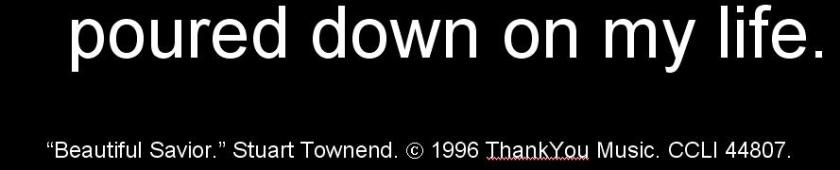
On our slides, the font size for the lyrics is 38. The font size for the copyright information is 12, and centered in its own text box. This way it’s readable, fits on one line (most of the time), can be moved to a different slide if needed, and isn’t distracting.
You can read more about this in the FAQ section of CCLI’s website. Click here.

 I met her when I was 15 years old and living in Panama City, Florida. My dad was pastoring a small Episcopal church, and my family had been there for about a year and a half.
 In this instance, it was not being played well. Honestly, it was being played horrendously poorly. That’s probably too kind of a definition. It wasn’t being played at all. It was being used as a weapon of mass distraction. That’s more like it. A bit cheesy but accurate.
 Approach (and ask)
 I was going through some old documents on my computer today and came across this list of bulletin bloopers that I used to read on our church’s Alpha course. Sure, you may have received them in an email forward about fifteen times over the last couple of years, but for me they never get old. Enjoy:
 Christmas 2009 has come and gone. Now worship leaders can sit back and relax.
 Worthily Magnify