Why Be Sly?

I really enjoy watching other churches’ worship services online. It might sound a little weird but it’s true. Sitting at my desk, I can visit churches all over the world, without having to pay for airfare or a hotel. It’s great. It bores my wife to tears, but I think it’s fascinating to see how other churches do things, how their worship leaders lead, what kind of songs they’re singing, how their services are structured, and how the congregations seem to respond.

I have to be careful not to be overly critical of the churches I watch online – since it’s easy to criticize when I’m watching a service on my computer screen – but I have to say that there are far more things I see that concern me than encourage me.

By far, the most common criticism I would have is that worship teams seem to be much more interested in performing songs and putting on a show than they are in leading people to exalt and magnify the greatness of God. I get the feeling I’m watching a Disney production – slick, overly rehearsed, and seamlessly choreographed. And I can’t quite understand why worship leaders and their vocalists stare into the congregation, scanning from left to right, with a smile on their face at all times, with an occasional head-nod or finger-point.

But that’s not my main point. One other common criticism I have is that churches, and specifically their worship leaders, seem either incapable or unwilling to make the truth of the gospel plain in the songs they sing. They’re sly about it. Under the guise of creativity, the clear message of the good news of Jesus Christ gets covered over by confusing lyrics, subtle references, and sparse objective biblical truth. Everything is foggy.

I’m reminded of a quote by Northrop Frye, a literary critic, who said in reference to the writings of Jacob Boehme, a 17th century German theologian: “…his books are like a picnic to which the author brings the words and the reader the meaning.”

The same could be said about the songs so many churches are singing. The time of singing is the picnic, the worship leader brings the words, and the congregation is asked to deduce the meaning on their own.

Why be sly? Why “beat around the gospel bush” as Bob Kauflin puts it. Why would we, as worship leaders, squander any opportunity to present people with the glorious truth of the Gospel? It doesn’t make any sense and it’s tragic.

A large church in Indiana opened their Easter service with the song “When the Morning Comes” by OK Go. Here are the lyrics to the first two verses:

You know you can’t keep lettin’ it get you down
And you can’t keep draggin’ that dead weight around.
If there ain’t all that much to lug around,
Better run like hell when you hit the ground.
When the morning comes.

You can’t stop these kids from dancin’.
Why would you want to?
Especially when you’re already gettin’ yours.
‘Cause if your mind don’t move and your knees don’t bend,
well don’t go blamin’ the kids again.
When the morning comes.

What does this have to do with Easter? What does this have to do with Jesus conquering death and being raised to life? I don’t get it. And my guess is that a lot of people that morning didn’t get it either. 

While this is one of the more egregious examples of a song that, rather than making Jesus plain, is murky and lightweight and confusing, it isn’t too far off from the kinds of songs other churches are singing.

They might have great melodies, be in the CCLI top 25, be really modern, have a great groove, or be a congregation-favorite. But is the message clear? And what is that message exactly?

Paul said in Romans 1:16: “…I am not ashamed of the gospel, for it is the power of God for salvation to everyone who believes…”

If the power of God is found in the gospel of Jesus Christ, then let us not be ashamed in making that gospel clear every single Sunday, every single service, and every single song. Let’s not be sly or subtle about it. And try to stop scanning the room and nodding your head if you can help it.
Do You Take Requests?

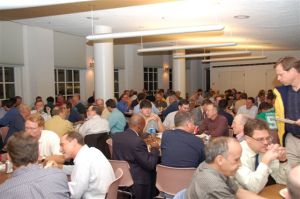
Tonight is the monthly men’s ministry gathering at my church, when about 100 or so guys get together for some food, a time of corporate worship, teaching, and prayer. I usually lead about 20 minutes of singing at the beginning of the meeting, and try to pick songs that men from the various different services will know, or learn easily.
This happens to be a very busy week, with a bishop visiting this weekend for baptisms and confirmations, Palm Sunday the following weekend, then Easter, then Student Sunday, then a big conference in mid-April, and then finally a little break in about five weeks. I’m happy to lead a few songs tonight, but don’t have an awful lot of time to devote to choosing songs.

So I was quite glad to receive two emails this morning – one from the guy who will be playing piano, and one from the speaker – each requesting a particular song for tonight.

My pianist requested “I Come by the Blood” by Steve and Vikki Cooke, and the speaker requested “Give Us Clean Hands” by Chris Tomlin, Both good songs, both familiar, and both seem like they’ll work well tonight. 

There are days like today when I’m very glad to take song requests and, since they’re requesting good songs, go ahead and use them. The guys who requested them will feel honored, I have two less songs to have to pick, I’m trusting that God is using their good suggestions to guide my selection of songs, and praying that God uses these songs for his glory.

But there are also days when I get an email or a phone call or a request after church when someone asks me to use a song that I don’t particularly like. Most of the time it’s because the lyrical content isn’t great, but sometimes it’s more a subjective response and I just don’t like it.

What do you do when you get song requests?

If the song they’re requesting has bad theology, or wouldn’t work in your specific setting, I’d just thank them for their suggestions, encourage them to share suggestions any time they want, but be specific (and brief) and kind about why you don’t think you’ll use that song.

But if the song they’re requesting is a fine song and you just don’t happen to like it, I would thank them, encourage them to share more suggestions, and then either go ahead and use the song, or just tell them you’ll keep it in mind. I’ve gotten suggestions for songs that I haven’t liked at the time, but eventually I warm up to the song, or a service comes along when their suggested song would actually work really well.

Just because someone asks for a song doesn’t mean you have to do it. But when you get a request, honor the person by seriously considering it and letting them know what you think. And if you’re like me, and you get two good requests in one day, your life will be a little easier.

Questions to Ask When Choosing a Sermon Response Song

The song that follows the sermon, especially if it immediately follows it, is one that should be prayerfully and intentionally chosen. Following up a sermon with a completely unrelated song can distract people from what they just heard, using a song that might actually contradict the sermon can confuse people, and using a song that is just randomly chosen will come across as, well, just random.

Here are some questions I ask every week when I’m trying to choose a sermon response song.

– What is the sermon’s text?
– What is the sermon title?
– Who is preaching?
– In what context is the sermon being preached? Part of a series? On a special day?

For example, I know that this coming Sunday’s sermon text is Hebrews 2:1-8, and Matthew 3:1-11. The sermon title is “Jesus is Supreme: Don’t Neglect His Offer”. Bill Haley is preaching, and it’s part of a year-long study of the book of Hebrews. This is also the first Sunday in Lent.

Once I know this information, I will try as hard as I can to ask the preacher the most important question: “how would you like people to respond in song after hearing your sermon?

This morning I called Bill and asked him that very question. He let me know that he was going to wrap up his sermon with an illustration from the end of the movie “Saving Private Ryan” when the character played by Tom Hanks, who is about to die, says to Private Ryan “earn this”. His point will be (I think) that the Gospel says something completely different to us. We can’t earn it. It’s been done. We have been given salvation.

So Bill encouraged me to choose a song that people would feel like singing if they were standing at the foot of the cross and wanted to respond to what Jesus had done. I chose “The Power of the Cross” by Stuart Townend and Keith Getty. I might change that before Sunday, but at this point it’s what I’m planning on using.

Here is what a sermon response song doesn’t need to accomplish:
– Summarize every point in the message
– Enable people to sing the sermon back
– Be a perfect fit

It’s usually helpful if the sermon response song enables people to respond to what they’ve just heard. It isn’t a random song or a completely off-topic song. It’s a song chosen after praying and reading through the relevant scripture texts, talking with the preacher, looking at a few options, and then settling on a song you think is the best fit.

Too Many Songs in the Same Key = Boring

Yesterday morning my church held one 11:00am service for those able to make it out of their houses. We had about two and a half feet of snow dumped on us over the weekend, and most streets were either impassable or dangerous. Instead of canceling all services like we did back in December, we decided to have one service for anyone who could come. About 200 people ended up braving the icy and snowy roads, and I led a handful of songs from the piano with my sister-in-law singing with me. It was a simple communion service and we sang mostly familiar hymns and a couple newer songs too.

When it came time for communion, we sang three songs in a row: “Here is Love Vast as the Ocean”, “How Deep the Father’s Love for Us”, and “Alleluia Sing to Jesus”. I picked these songs for this spot in the service because they were familiar and they flowed well with each other.

One of the reasons, besides their theme, that they flowed well together was that they were all in the key of E major. This makes things easy since you can just slide from once song to the next without having to think about how to get from one key to the next. I’ll often do two songs back-to-back in the same key for this reason.

But doing too many songs in a row that are in the same key can be a bad idea sometimes. After singing in the same key for five or ten minutes, it can start to feel like we’re stuck on one really long song. By the end of the second song, whether people realize it or not, they’re a bit tired of hitting the same notes and hanging out in the same range, and they’re ready to move somewhere else. And unfortunately, when people get tired of singing in a certain range, they can become disengaged with the words they’re singing.

So instead of doing all three songs in the key of E, we did “Here is Love Vast as the Ocean” in the key of E, “How Deep the Father’s Love for Us” in D, and “Alleluia Sing to Jesus” in E, modulating to F on the fourth verse. This kept all three songs in singable keys, but varied their ranges just enough so that there was distinction between them.

It took some maneuvering between songs to get from one key to the other, but I’m fairly comfortable doing that, so it didn’t feel awfully jolty. I try to avoid stopping and starting between songs if at all possible. If you’re not comfortable doing this, I would recommend you practice, practice, practice, and listen to how other worship leaders and musicians transition between keys. You’ll get better at it, and someday it will come naturally to you.

There’s a lot to think about when choosing and leading songs. What keys you’re singing your songs in should be up towards the top of the list. Keeping your keys in comfortable congregational ranges (i.e. not too high and not too low) is important, and not singing a bunch of songs in a row in the same key also helps keep things from feeling tired. 

What Are Your “Go-To” Songs?

Fill in the blanks:

When I really want to get a service started off strong, we’ll sing _____.

On Easter Sunday we always start off by singing _____.

When the sermon has been on the topic of mission, I love to sing _____.

If we want to sing a song about being “in Christ”, then _____ is perfect!

If we sing _____ then I love following it up by singing _____.

_____ is my go-to song for starting off communion.

We all have our “go-to” songs. We’ve tried them and they’ve worked. Not only have they worked but they’ve worked really well. I love starting off a service with “Beautiful One” by Tim Hughes or closing a communion service with “Let Your Kingdom Come” by Bob Kauflin, or singing “O Come All Ye Faithful” as the opening hymn on Christmas Eve. It’s nice to fall back on those tried-and-true songs when I can’t think of anything better to use or don’t have the time or energy to try something different.

I’ve been realizing lately that my tendency to gravitate towards the same songs in the same slot time after time can contribute to a staleness and predictability in our services. God never ceases to be indescribably great and beautiful, but singing the same song about him being the “beautiful one” can become monotonous and seem rote. God’s greatness is unsearchable, but singing about “how great” our God is with the same song once a month for four years can get boring. I’ve likened it before to making a copy of a copy – you gradually lose crispness and vibrancy with each one.

I’m learning that in order to help people be aware that we can never sing enough about the cross, I need to help them articulate praise to the Lamb who was slain in as many combinations of words and melodies as possible. To help people come into a worship service reminded afresh of God’s greatness and kindness we can’t sing the same three songs on a rotating basis. If I want a Christmas Eve service to help shake people out of their last-minute-shopping-stress-coma, I need to think about whether “O Come All Ye Faithful” really is the best opening hymn, or if something else would be more effective.

Newness and creativity for the sake of being new and creative is idolatry. But newness and creativity for the sake of helping people see and encounter the glory of God afresh is worth the time and worth the effort, and one of our jobs as worship leaders.

Look for different and varied sources of congregational worship songs from which you can draw. Visit other churches or watch their services online. Put your most frequently sung songs “on the bench” for six months and force yourself to sing something different. Take a risk. Instead of starting off a service with a fast song, start it off slow. Read an appropriate Psalm corporately in between verses of a song. Anything to help you avoid doing the same song you always do in the same way you always do it.

What are your “go-to” songs? Try “not-going” to them for a while. It’s a good exercise in staying fresh.