When to Give Verbal Cues – Pt. 2

Yesterday I shared some examples of when it can actually be helpful, and not annoying, for worship leaders to give verbal cues (i.e. say the upcoming lyrics before they’re sung). When it’s just a bad/nervous habit, it can be distracting and irritating. When it’s done sparingly and necessarily, then it can actually serve people.

Here are some more instances when you might want to give a verbal cue to the congregation:

When it’s not clear when they should start singing again
Most people know that after you sing the first half of a line, you immediately sing the second half. They don’t need your help to figure that out. But occasionally there might be an instrumental interlude, or a longer-than-usual pause, or a non-congregational portion of a song. It can be helpful to cue your congregation that you’re about to start singing together again, especially when that entry-point might not be so intuitive for the average person.

When the next line is the key line
Since people can easily tune out and be thinking about what’s for dinner instead of what’s coming out of their mouths, it can be helpful to draw their attention to a key line of a song to help draw their attention to it. If done sparingly, this can be effective. If done too frequently, it’s not effective at all.

For example, if I’m leading “How Great Thou Art”, I might jump in on the second verse and say “…my burden gladly bearing…” just before we sing it. It helps underline that what was accomplished on the cross was that Jesus took my burden on sin upon himself.

When a cue helps emphasize Gospel truth, it’s an effective cue.

Try to think carefully about when and why you give a prompt of upcoming lyrics so that they’re as effective and helpful as possible. Just put yourself in the shoes of the congregation and be as mindful as you can of doing practical things to help lead them, in a clear way, in magnifying and exalting the glory of God.

When to Give Verbal Cues – Pt. 1

There are few things more annoying in corporate worship than a worship leader who feels the need to give a verbal cue before almost every line. It’s almost as if the congregation didn’t have the words in front of them in the bulletin or on the screen, and were completely dependent on the worship leader to announce the upcoming line’s first two or three words.

It’s a habit worship leaders develop either out of nervousness or out of a desire to fill the empty space between lines. In that empty space – maybe a beat or two – almost on autopilot, he or she speaks out “mountains bow down!” or “opened my eyes let me see!” or “clothed in majesty!”

It’s a bad habit and is usually unnecessary. But… when is it helpful for worship leaders to give verbal cues? Here are some instances I can think of:

When the lyrics operator falls asleep
It’s a good idea to keep an eye on the screen as you’re leading worship. If you notice the slide hasn’t been advanced, it might be a good idea to prompt the person running the slides and help the congregation out by feeding them the next few words.

When you’re going against printed/projected instructions
If I want to repeat the verse of a song instead of going back to the chorus, and the congregation is following a printed bulletin where the instruction after a verse is: “(chorus)”, then after that verse I’ll say something like “let’s sing that verse again”. It helps keep everyone together.

Or if I want to skip past a “repeat” instruction either in a bulletin or on the screen, I might say the first few words of the section I want to jump into in order to cue people that we’re moving forward and not going back.

Tomorrow we’ll look at some more instances when it’s actually helpful to give verbal cues.

When People Don’t (And Won’t) Sing Along

One of the most fascinating events in American politics is the annual State of the Union address. The pomp and circumstance is higher that night than almost any other night in the nation’s capital.

The president arrives to thunderous applause from both parties, and finally begins his speech when the hoopla dies down. Once he starts, the real fun begins. After every point, the members of congress from his party stand in loyal and heartfelt applause. The opposition party, however, remains seated and firm in their disapproval. Only when the president says something non-partisan or fairly neutral will both parties stand in approval.

Believe it or not, many churches look like this on Sunday morning.

The worship leader stands up to lead some songs. There might be an initial display of unity, but once the songs start, the real “fun” begins. There are those in the room who sing along to every song and do so with enthusiasm. Then there are those who will only sing along if the song meets their criteria. Then there are those who, in protest, won’t even stand.

I’ve seen this up close. In the same church where I encountered an opinionated craft guild ambassador, I also encountered members of the congregation who, for various reasons, refused to stand or sing during the songs I led. It was a not-so-subtle act of protest and was something for which I was completely unprepared.

While not on such a large scale, from time to time I’ll still encounter people who refuse to sing, or just remain seated, or maybe even leave the room. It’s not common, but you see all sorts of things when you’re in ministry. This is a hard one to deal with. Here are just a couple of thoughts:

Remember that building trust takes time
People will follow you if they trust you. Building that trust takes time. For some people in the congregation, it will take them half of the first song to realize they can trust you. For others, it takes longer. You won’t build those people’s trust in you by forcing it, by demanding it, or by showing them your frustration in not having it. It will take weeks, months, and years. Some may never trust you, but that’s why this next point is important:

Don’t make it about you
If you’re leading worship and notice people not singing and/or showing their disapproval, you have to be very careful not to take it personally. Keep leading, press on, don’t get distracted or discouraged, and look at those people with as much love as you can muster. Only God knows what their issues are – whether they’re judging you, will only worship God on their own terms, or maybe they’re just immature – and you can’t allow yourself to get defensive as if it’s all about you. It’s usually not. And even if it is, you’re not the one to do anything about it. You have to keep going, be faithful, and pray.

Go to your pastor
If there people who won’t sing along, and if it’s the same people consistently, you need to mention this to your pastor. The pastor is the main worship leader of the church, and this is something he needs to pray about addressing.

Any president who stands before the Congress for the State of the Union address knows that there will be some people who will be with him the entire hour, and others who won’t be with him at all. The same could be said of worship leaders on Sunday morning, but hopefully with less pomp and circumstance

The big – really big – difference, of course, is that during a State of the Union address, all eyes are on the president. He is analyzed, examined, the star of the show, and the one everyone is coming to see. When and whether people stand up, sit down, applaud, or protest, is all up to him.

Thank God that I am not the star of the show on Sunday morning. My job is to help people fix their eyes on the Lamb who was slain, the Savior of the world, the image of the invisible God, and the one before whom one day we will all bow our knees. But here on earth, and on Sunday mornings, when and whether people stand up, sit down, applaud, or protest, is not up to me.

Song Sheets Can Be Your Friend

A lot of worship leaders are under the impression that in order for people to “really worship”, then the words to the songs must be projected. Projecting lyrics can become not only a non-negotiable, but also an idol. PowerPoint will make our service more alive! MediaShout will get people’s hands in the air! Song sheets are the enemy!
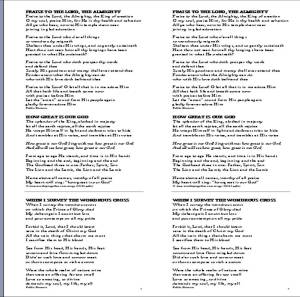
I’ve come to learn that sometimes, song sheets can be your friend.

Now don’t get me wrong – I prefer projecting lyrics to printing them for several reasons. Here are just a few:

  • It gives me flexibility to make last-minute changes
  • It allows people’s heads and eyes to be lifted up
  • It frees people’s hands to be expressive (as the bible encourages)
  • It saves money by reducing the cost of paper, copying, and ink
  • It makes lyrics easier to disseminate to large numbers of people
  • It prevents waste of un-used paper
  • It avoids the problem of not printing enough copies of the lyrics
  • It helps promote unity in the congregation by physically pointing people in the same direction.

Most worship leaders would agree with those pro’s of projecting lyrics. The problem is when the pro’s of projecting lyrics blind us to the con’s.

The cons range from the practical:

  • The ceiling is too low
  • The church can’t afford a laptop and projector
  • The room is too bright
  • The sight-lines aren’t good
  • You’re leading in an open field

To the pastoral:

  • Some members of the congregation have threatened to leave if a screen ever appears in the general vicinity of the church
  • Projecting lyrics is more of a distraction than an aid

Worship leaders need to be able to be honest and objective enough to know when projecting lyrics would be a hindrance to people singing to God. In those instances, song sheets can be your friend.

In what we call the “main sanctuary” at my church, projecting the lyrics is a no-brainer. The screens, projectors, and computers are all permanently installed in the room and easy to use. But in our “historic church”, a civil-war era colonial-looking building, there aren’t any screens or projectors installed, and until we find a way to do that without disturbing the beauty of the space, projecting lyrics requires a good deal of work. After a couple years of going through all that trouble, I finally realized it was more trouble than it was worth. Deciding to just go ahead and use song sheets has been incredibly freeing.

Sometimes if the song sheet is for a home group, or a staff meeting, or an informal gathering where I’m just leading a couple of songs, I’ll put the songs on one half of a 8 ½ by 11 piece of paper. This way I can get two song sheets out of one piece of paper, and it’s not very big.

Other times, if the song sheet is for something more formal, like a healing service in the historic church, we’ll put a nicer looking heading on top of it so that it feels more official.

Here’s how I format the song sheets to make them not only readable but pleasant to read:

  • 12 or 14-point font
  • A readable font that has a bit more character than Arial or Times New Roman. Not too much character to be distracting, but just a little bit
  • Bold-ed song titles
  • Italicized chorus
  • 8-point font for the copyright information at the bottom of each song
  • One 6 or 8-point line between the sections of the song
  • Two full lines of 12 or 14-point space between each song

It’s totally fine (and understandable) to prefer projecting lyrics to printing them. I certainly do. And I look for ways to make rooms more conducive to doing so, since I think the advantages of projecting lyrics are worth some work. But, from time to time, the advantages of printing the lyrics are too great to overlook.

Always Learning

Every single time worship leaders lead worship, there are certain things they could have done better.

This applies to beginner worship leaders and “seasoned” worship leaders. Whether it’s your first time or four-hundredth, there is always at least one thing you can look back on and say “I could have done that differently“.

Beginner worship leaders can run the risk of getting discouraged by all the things they could have done better, and thinking maybe they’re not cut out for it.

More seasoned worship leaders can run the risk of thinking they’ve made every mistake there is to make, and that they’ve mastered the art.

Worship leaders who are just starting out should take comfort in the fact that the process of maturing never stops – and those who have been doing it a little longer should keep that in mind too. No one ever “arrives”.

Tonight I led the music for our monthly men’s ministry gathering. In no particular order of importance, here are some things I could have done differently:

  • The first two songs we sang, “Blessed Be Your Name” and “Come Thou Fount”, felt a bit over-done. I think I’m doing those songs too often, especially at these monthly meetings.
  • The last song we sang, “Here I Am to Worship”, felt really over-done. I should put that song on hold for a while.
  • I got to church too late to do a sound check. Since it was just me leading on guitar, I figured it would work fine this way. My guitar ended up being too loud and my voice too quiet. I should always do a sound check with the sound engineer, if possible.
  • Some of the words on the slides went too far down. Since the ceiling is low, some men had a hard time reading the bottom line or two. We should make sure we adjust the slides when we’re projecting lyrics in that room.
  • I kept my eyes closed for much of the time. I did that this past Sunday night too. I’m getting back into that bad habit.
  • I went too long. I need to be sure I’m wrapping up when I’ve been asked to wrap up.

A lot of these things are relatively minor, and might not have stood out to anyone else in the room. My goal certainly isn’t to make a big deal out of these little issues or beat up on myself. But rather, I’ve found it helpful for my own growth, and a practical way to pursue humility, to be in the habit of asking “what could I have done differently or better“.

Even if there’s only one thing I can point to, and there always is at least one thing, then hopefully God will use that to keep me moving forward on the road of maturity.