Losing Your Cool Isn’t Cool

You’re sitting in a window seat, reading the latest edition of Sky Mall, as your airplane leaves the gate and gets in line for take-off. After a few minutes you’re hurling down the runway at 180 miles per hour and beginning your climb to cruising altitude. You look out the window at the tiny cars for a few minutes before turning your attention back to the combination alarm-clock/onion-slicer that you’re debating ordering.

Then a strange rumbling/screeching noise catches your attention. It’s not a noise you’ve heard before. Maybe it’s nothing. But maybe it’s something. Is the plane about to fall apart into a thousand pieces? What is that noise? You begin to sweat. Profusely. Your life starts to flash in front of your eyes. You look around. None of the other passengers seem to be aware of the fact that their lives are about to end. Now you’re really concerned.

You look for a flight attendant. You can’t see up the aisle, so you turn around and look towards the back of the plane. You see both flight attendants… completely relaxed, reading novels, not sweating profusely, and definitely not strapping on parachutes. The noise goes away. The flight attendants, still relaxed, begin serving that delicious trail-mix.

You know you’re going to be OK when your flight attendants are relaxed. You know you might have a problem when they lose their cool. Flight attendants aren’t supposed to lose their cool.

It took me several years to realize that, to my worship team, I am the flight attendant.

Maybe you can relate to one of these worship leader nightmare scenarios:

The service is five minutes away from starting and none of your monitors are working. The sound engineer has no idea what the problem is but he continues to run back and forth from the sound board, unplug cables, turn different knobs, and look around confused.

You’re introducing a new song to your worship team at rehearsal and it keeps sounding really bad. The singers are singing it the wrong way, the acoustic guitarist doesn’t know half the chords, and the drummer is in a different universe than everyone else.

You have 10 minutes to run through 6 songs before the service starts. You could use an hour.

The computer is plugged into the projector.
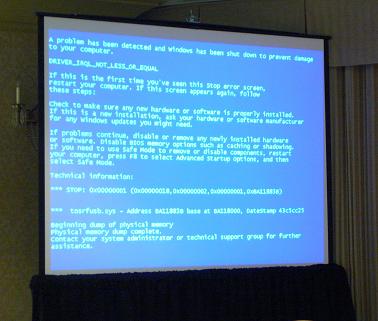
The computer and projector both have power. The computer is displaying the PowerPoint slides. The projector is switched to “computer” as the input. The projector keeps projecting a blue screen. You restart both the computer and the projector. Still a blue screen. You try a different cable. You try a different input. You press a lot of buttons. Still a blue screen. The service was supposed to start three minutes ago.

Half an hour before the service is supposed to start, the power goes out. No sound system. No lyric projection. No lights. No air conditioning.

In these moments, the moments when you wish it was just a bad dream but it isn’t, you are the flight attendant. Your worship team has heard the rumbling/screeching noise, they’re starting to get worried, and they’re looking around for some reassurance that everything is going to be OK. If you lose your cool, it’s going to be a very bumpy ride for everyone. People won’t think clearly, they’ll overreact, and they may even start sweating profusely.

Without the help of the Holy Spirit, you won’t be able to keep your cool when you hit some turbulence. Galatians 5:22-23a says: “…The fruit of the Spirit is love, joy, peace, patience, kindness, goodness, faithfulness, gentleness, self-control…” This is one reason why every worship leader, and every worship team member, needs to pray for the filling of the Holy Spirit every single time they get up to lead worship.

Worship leaders: your worship team is watching you, especially when things get a little bumpy. It’s incredibly important that you model a Holy Spirit-enabled “coolness”.

We might not have monitors. We might not sound polished. We might have to sing from memory or from 30 year-old songbooks lying in a closet. We might not have electricity. None of that matters. We’ll do what we can, in the power of the Spirit, all for the glory of God.

Handling Awkward Moments: Leading Songs After a Lousy Teaching

wordI am incredibly grateful to serve in a church where, week after week, God’s word is preached strongly by those who tremble at it, and where the teachings are consistently biblically sound, convicting, and Holy Spirit-empowered. In this environment, the songs I’m choosing and leading are helping people hear and respond to what God is saying through his Word and by His Spirit.

In contrast, many worship leaders serve in churches where the teaching is weak and ineffective, or worse, heretical and unbiblical.

What’s a worship leader to do in that environment?

I recall one occasion when I was asked to lead worship for an event held somewhere away from my church. I felt I knew enough about who was hosting the event to feel comfortable saying yes, so I did. I prayerfully chose the songs, prepared for the event as well as I could, prayed a lot, and rehearsed with the worship team. The event finally arrived, the opening time of singing went really well, and then the teaching came. It went on for over an hour, and, as my British father-in-law so kindly described it, it was “diffuse”. I might describe it as “lousy”.

Leading songs after a lousy teaching can be awkward. Here are some ideas on how a worship leader can handle it, particularly if it’s unexpected.

Pray
If you’re listening to the teaching and beginning to realize it’s going off-track, pray and ask God for wisdom about what to do. Especially if your songs come immediately after the “teaching”, how you respond will be critical.

Ask for advice
If you’re near anyone you know you can respect as someone who loves God and his Word, just ask them: “what do I do?” I did this at the event I mentioned above, and the advice I received was the way God chose to answer my prayer for wisdom.

Be prepared to call an audible
In American football, the quarterback will call “an audible” (a last-second switch to a new play) when he sees that the play he had originally chosen just won’t stand up against the defense’s formation.

If you’re leading songs after a lousy (i.e. weak or heretical) teaching, you’ll most likely need to call an audible. You’ll need to communicate this to your musicians, the lyrics operator (if you’re projecting them), and the congregation (more on that later).

Proclaim Truth
You have an opportunity to infuse the truth of God’s word into a service in which it’s lacking. You do not want to do this in an arrogant and preachy way, but in a humble and gentle way. I would gravitate towards songs that preach the Gospel. Some ideas are “On Christ the Solid Rock I Stand”, “In Christ Alone”, or “How Deep the Father’s Love for Us”. Anything that presents the Gospel clearly would be one of my first choices.

Hopefully, by responding to a lousy teaching with Christ-centered, God-glorifying songs, I can help people walk away from the service with at least some measure of truth being planted in their hearts.

Do it pastorally
When I stepped onto the platform after the “diffuse” teaching I mentioned, I looked out on a congregation that looked really confused. It would have been the worst idea in the world to say what I was thinking, which was: “how in the world did (so-and-so) let that just happen?” Instead, I said something like: “We’re going to spend some time now responding to God by singing to Him, and celebrating what he’s done for us in Christ. Our ‘hope is built on nothing less than Jesus’ blood and righteousness’, so let’s stand and proclaim that together.”

It’s easy to call this kind of audible when you’re projecting lyrics and you have musicians who are comfortable being spontaneous. If you don’t have either of those things, you can still infuse God’s truth into the service by turning to a different hymn in the hymnal (just call out the page number), singing a song of response all by yourself, encouraging them to a simple (but truth-filled) song sing from memory, reading from scripture, repeating a good song from earlier in the service, or just continuing on with what you’ve planned.

(If you serve in a church where this is a weekly occurrence – not just once in a blue moon like it is for me – plan ahead and choose music that will subtly yet clearly, correct error in the teaching. Also, check out this clip of John Piper answering a worship pastor’s question along these same lines.)

What Would I Say If This Guy Auditioned For The Worship Team?

I recently came across this video of a guy who claims to be able to sing “five octaves on the piano”. See for yourself.

I’ve auditioned some people who are clearly musically gifted and called to serve the church on the worship team, some whose giftedness and calling to serve is less clear, and from time to time people (like the guy in the video) who are clearly not gifted, not called to serve on a worship team, and completely oblivious. Those auditions are always a challenge.

What would I say if this guy auditioned for the worship team?

First, I’d lay a foundation before I ever heard him sing a note (or something resembling a note). It’s important that before anyone sings or plays an instrument in an audition that they understand they’re not “trying out” for a band – they’re entering into a discernment process regarding the gifts that God has given them. I do this by pointing people to Paul’s picture of “one body with many members” in 1 Corinthians 12. Every “member” of the body has a specific role and function. God arranges the parts of the body and decides who gets certain varieties of gifts. When someone auditions for the worship team, my job is to help them discern where their specific gift might be best employed.

After that foundation had been laid – the last thing I would say before hearing them sing or play would be something like: “Now, because of that, I want you to know that I’m going to be honest with you. I’m here to help you discern what gifts God has given you to serve the church. Do I have your permission to be honest with you?

If this guy had agreed to all of the above, here is how I would handle it:

Thank him
I need to recognize and express my thankfulness for this guy giving up part of his day, being vulnerable enough to do this, and for sharing his “gift” with me.

– Prepare him
Before giving my honest assessment of his giftedness, I’d briefly remind him that (a) this isn’t about his worth as a person, (b) this is about whether or not God has gifted him musically to serve the body of Christ on the worship team, and (c) I owe it to him to be honest with him.

Be honest with him
I would follow the K.I.S.S. rule here (keep it simple, stupid). There is no need for me to go on and on and pile on my honest assessment of his gifting. Briefly, gently, and simply, I would say something like: “My impression is that your strongest gifting is not in the area of singing. You had a difficult time matching pitch, and you struggled to stay in key. I know this might be a bit difficult to hear, but I need to be honest with you and tell you that, in my view, serving on the worship team isn’t the best match for your gifts.” That’s enough of that.

– Affirm him
Immediately after this honest assessment of his gifting, I would attempt to honestly and genuinely affirm what gifts I might have seen on display. Even if, in our short time together, I had only noticed one thing I could possibly affirm, I would point out that one thing. This isn’t a sneaky trick intended to make him forget what I had just said, but a heartfelt attempt at reminding him that just because he’s not gifted in one way doesn’t mean he’s not gifted in others.

– Talk with him
The last thing I would do is ask him what other ways he could imagine serving the church. Get him thinking and talking about what other gifts he might have and try to connect him with other opportunities for him to serve the body.

– Pray for him
I would ask “before you go home, do you mind if I pray for you?” I’d seek to thank God for giving me these 10 minutes with this guy, ask God to show us both some ways the guy could serve, and ask God to bless him. It’s important that this guy leaves the audition with a fresh reminder that God has indeed given him certain gifts.

No worship leader enjoys having to tell someone that they aren’t gifted musically. It can be awkward, a bit tense, and unpleasant if the person responds immaturely. But through your faithful and loving care for your congregation – even those who think they can sing five octaves on a piano – God will use you for his glory.  

Handling Awkward Moments: When Someone Misses a Modulation (Or Plays in the Wrong Key)

trainwreckA few months ago, one of the pianists on our worship team (let’s call him Steven Hill) forgot to modulate on the last chorus of Keith and Kristyn Getty’s “There is a Higher Throne”. This was awkward for three reasons: First, everyone else modulated but he didn’t. Second, not only did he not modulate from F to G, but he remained in F with a flourish. And third, we had practiced this modulation several times during rehearsal and made jokes about how this particular pianist had missed a modulation with a flourish previously.

This pianist, Steven (as we’re calling him), is an excellent musician. He could probably play most pieces of music put in front of him. But at this particular moment, his attention drifted just long enough to create what can only be described as a cacophony of noise.

What do you do when someone misses a modulation or plays in the wrong key?

If, like in this instance, only one member of the team forgets, then the rest of the team just has to keep plowing ahead until the renegade realizes the errors of his ways. Hopefully after a few unharmonious measures he’ll realize that the strange sounds are coming from him.

If you’re the one who forgets, and you’re in the middle of a song, you can’t stop. Just smile, switch to the right key when you remember, and keep going. If you start a song in the wrong key, you’ll probably just need to (1) stop, (2) laugh and say “oops,  I’m sorry about that. Let’s try again”, and (3) move on. Don’t make a huge deal of it.

See a great demonstration of how to handle this awkward moment here.

The main thing to remember if you or someone else misses a modulation or plays in the wrong key is to not take it too seriously. Relax and laugh about it. Odds are that the person didn’t do it on purpose! (If they did, that’s called sabotage.)

After the service was over and I was able to talk with “Steven” about his missed modulation, we just laughed and made a joke about it. When we played it at the next service he nailed it and I was sure to give him a grin when we arrived at that point in the song. Good humor will go a long way towards helping you handle awkward moments like this.

Ultimately, moments like this are good and necessary reminders that we’re not leading worship to impress the congregation or display our musical genius. We’re offering our gifts, as well as we can, to serve the church for the glory of God.

Handling Awkward Moments – When the Lyrics Operator Falls Asleep

SpaceBarWe’ve all been there.

You’re leading a song on Sunday morning when all of the sudden everyone stops singing. You look over at the screen and realize the lyric operator (or whatever you call the person who controls the projection software) has not advanced the slide. You start to sweat. You can feel yourself growing impatient. You look back at the person and they’re oblivious. You feel like screaming “PRESS THE SPACE BAR!” but decide (wisely) that’s not a good idea. Finally after what seems like eighteen minutes, the lyric operator wakes up and advances the slide and everyone in the room breathes a collective sigh of relief.

How do you handle this situation?

First, a few suggestions of what not to do.

Don’t allow yourself to get angry
I saw this happen once when I was visiting a church in the UK. When the slide didn’t advance, the worship leader stopped singing (thereby making everyone else stop even though they knew the song by heart), let out a huge sigh, looked back at the lyric operator and gave him the kind of glare that said “I want to kill you”. This is a bad idea for several reasons. First, it embarrasses the lyric operator. Second, it magnifies the distraction, as opposed to minimizing it. Third, it could result in the congregation getting angry and wanting to kill the lyrics operator too. You turn a late-advancing slide into a major crisis.

Don’t stop singing if you’re in the middle of a verse or chorus
Nothing screams “we are completely dependent on the screens” like stopping during a verse or chorus that’s already started. Just go ahead and finish whatever section of the song you’re in, hoping that most people will either know it by heart, or just patiently wait until the slide progresses again.

Don’t take it too seriously
If it happens all the time, you’ll need to talk with your lyric operator and ask them to be a bit more attentive. But if it happens once, just let it go. As someone who has operated the projection software from time to time, I know how easy it is to forget to advance the slide when you’re singing along, when a member of the congregation interrupts you, or when your mind wanders. Extend grace to the lyric operator and don’t take it too seriously.

Now, a few suggestions of what you can do.

Offer a subtle prompt to the lyric operator by talking to the congregation
Instead of saying “Sally, will you please advance the slide?” – try saying “let’s sing the next verse together”. If that doesn’t work, try saying “this next verse says ‘O for a thousand tongues to sing my great Redeemer’s praise…’” By prompting the congregation, you just might jolt the lyric operator back to life.

Offer line prompts to the congregation
With a gentle and calm voice, call out the line before it’s sung. If you sound relaxed and like this was planned all along, you’ll minimize how much of a distraction is caused by the late-appearing slide.

Make a small joke out of it
In my post “When is it OK to Use Humor”, I suggested that, on occasion, the worship leader can use humor to break tension. When a room full of people is staring at a screen, and staring, and staring some more, it might get a little tense. Instead of feeding into it by being tense yourself, you can break it by making a small joke.

I had to do this when I led worship for an event in Bedford, Texas, with a few hundred pastors and bishops in a big tent, singing the hymn “Jesus Shall Reign”. I didn’t have the words in front of me, and was relying completely on the screen, which wasn’t such a good thing when I couldn’t remember how the third verse started. Neither could anyone else. We all stood there for about 10 seconds just waiting. Finally I made a joke and said something like “what do you all say we try singing the next verse now?

On the inside I was begging the person to “just press the space bar!” but, by God’s grace, I was able to relax, make a little joke out of it, break some of the tension, jolt the lyric operator to life, and help the congregation feel comfortable.

Go back and sing the verse or chorus again once the slide comes up
If we’ve gone through nearly an entire verse or chorus without the right slide (and the slide finally comes up at the very end), I’ll usually say “let’s sing that again”. In a way, it kind of redeems the fact that everyone stood there waiting for it the first time through.

Just wait for a few measures
The lyrics operator might get the hint if he or she realizes no one is singing. If we’ve ended a chorus and the next verse hasn’t come up yet, I might just play for another measure or two. Oftentimes that does the trick.

Connect with the lyrics operator before the service
This is something I could improve in. Take a few minutes before the service to connect with the person who will be in control of the lyric projection and let them know of any repeats you know about, any new songs you’re teaching, etc. This will help them be more alert and aware that you’re depending on them – and the congregation too.

Ultimately, if your lyric operator falls asleep during a song, you have a split-second decision to make: How big a deal am I going to allow this to become? If you want to make it a big deal, then stop the song, look angry, embarrass the volunteer, and distract everyone in the process. If you don’t want it to be a big deal, just relax, keep leading worship, offer some more prompts than usual, and don’t overreact.