Projecting Excellence – Making it Easier for the Congregation to Sing

I’m a big believer in making sure the lyrics that are projected during corporate worship are done so with care and excellence. If worship leaders really want to remove distractions, oftentimes one of the first places they could look is the screens. Lyrics that are thrown onto a slide and projected onto a screen with little thought given to how well they serve the congregation will usually communicate a certain degree of confusion and messiness.

I’ve written before on the importance of line breaks, font size, keeping things in context, typos, where to put the title, whether to use all caps, alignment, and copyright info. Today I want to touch more on the issue of line breaks – especially how to place line breaks intentionally to help the congregation follow along.

This Sunday at my church we’re teaching the song “Revelation Song” by Jennie Lee Riddle. It’s a beautiful song, and while it’s a very simple song, has some tricky parts.

Listen to the second verse – and while you do, read along to the slide below:

A bit confusing, isn’t it?

Now listen to the verse again but follow along to the slightly tweaked slide below:
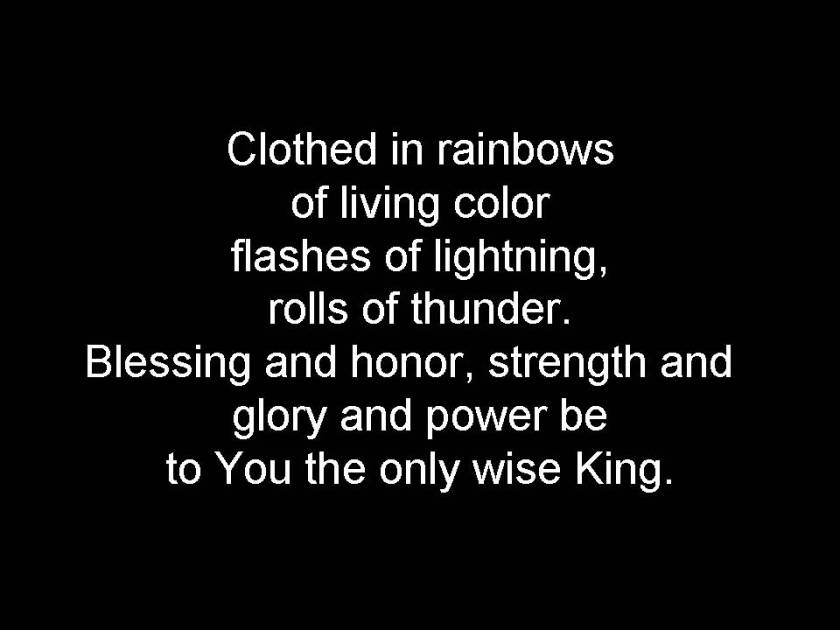
In the first example, the lines keep running on even though there is supposed to a break in singing. In the second example, where the melody line rests, the line breaks. It’s easier to follow along and prompts the congregation to either keep singing or take a break.

While most people in the congregation might not be able to point specifically to the line breaks as helping them learn the song – it can actually help a great deal whether they realize it or not.

It takes some forethought and someone who cares enough to listen to and sing through the song, to make the slides present the lyrics in a way that will serve the congregation. It will make a difference in how comfortable your congregation is with joining in on songs, especially new ones. 

The Wonderful Relief of Not Having to Dress Cool

I only own one plaid shirt. And I feel silly wearing it. Sort of like a farmer but for some reason farmers can actually pull it off. Oh, and cool people. Sure, I know plaid shirts are “in” but I just can’t do it.

And tight jeans? The jeans that make your legs look like twigs? No way would I ever even try those things on. I can tell you right now I’m not cool enough to wear them.

Last July, when the national worship leader conference was taking place in Kansas City, I remember following what was happening at the conference on Twitter and seeing a slow but steady stream of comments on how many worship leaders were wearing plaid shirts. Someone referred to them as the “staple of the cool worship leader uniform”. That and thick-rimmed glasses.

And for a moment, I found myself thinking, “I don’t dress like a cool worship leader”. And I was right. I don’t. And I felt self conscious about it. For a few minutes.

There is a wonderful relief that comes from not having to dress cool. A pair of khakis and a blue shirt never get old. Nor do jeans and a polo shirt. Hey, I’ve even been known to wear crocs to a Saturday evening service from time to time. They’re comfortable. Horribly ugly, but comfortable.

By the way, I was roundly mocked by members of my worship team for wearing socks with crocs. Apparently that is not cool. I did take their advice on this one.

In the words of my old youth pastor, I say all of that to say this: worship leaders shouldn’t feel the need to dress cool. Once you start down that road, it never ends. There will always be a new fashion trend, a new shirt you have to buy, a new pair of cool shoes, a graphic tee, glasses frames, and maybe even a tie if you’re fancy. And it’s not worth it. Who does it impress? And why does it matter? Why spend all the time and energy on something so fleeting?

(Caveat: being too far on the “un-cool” side of things can be just as great a distraction as being “too cool”. Rocking a Santa Claus sweater at Christmas time, sporting a nice pair of knee-high black socks with flip flops and jean shorts, or showing off your 1970’s era orange bell-bottoms might not be a good idea either.)

I would argue that worship leaders should be comfortably neutral in what they wear. Be yourself, be modest, be mindful of your context, and beware the temptation to “dress to impress”.

If I accomplish “dressing cool”, but in the process cause the man in the third row to be distracted by trying to read what my shirt says, then I’ve failed. I’d rather fail at dressing cool and succeed in not getting in the way of God receiving people’s attention. Khakis and a blue shirt. You can never go wrong.

How Would You Handle This?

Worship Central posted a video today of a “horror moment” that occurred at one of their recent events when Martin Smith was wrapping up a time of corporate worship.

I wasn’t there, but from the looks of it, they’ve finished the last song and are leaving a bit of space. Martin decides to read from his bible and sets it down on the keyboard in front of him. By doing so, he accidentally hits a button that triggers a drum beat to play loudly and distractingly. By the time he realizes it’s his fault, he decides to not read from his bible, and hands it over to the emcee. Watch it here:

I’m glad that the guys at Worship Central posted this because we can learn from watching it. And I’m glad it didn’t happen to me because I can imagine it would be pretty embarrassing. Hindsight is always 20/20 – especially when it’s at someone else’s expense!

Briefly, here’s what I think Martin did well:

  • He calmly looked around to see what was happening.
  • He didn’t lose his composure.
  • He quickly realized it was his fault and took care of it.
  • He laughed at himself.
  • He didn’t try to pretend no one had noticed. They had ALL noticed.

But, from my vantage point, here is how I wish this video had ended:

  • He realizes it was his fault and takes care of it.
  • He laughs at himself and lets everyone else enjoy the moment too.
  • He lets the laughter die down naturally and then says: “what I was going to read from scripture was…”

I can imagine he was flustered. Really flustered. I would have been too. There’s no way to know if I would have handled this any differently if I had been in Martin’s shoes. I might have. Or I might not have. Who knows.

But when things like this happen (and they are bound to happen at some point when you least expect it)… consider whether “I think it’s time I hand it over” is the best thing to say, or whether it’s a better idea to get back on track, focus, and go where you had been going.

When to Give Verbal Cues – Pt. 2

Yesterday I shared some examples of when it can actually be helpful, and not annoying, for worship leaders to give verbal cues (i.e. say the upcoming lyrics before they’re sung). When it’s just a bad/nervous habit, it can be distracting and irritating. When it’s done sparingly and necessarily, then it can actually serve people.

Here are some more instances when you might want to give a verbal cue to the congregation:

When it’s not clear when they should start singing again
Most people know that after you sing the first half of a line, you immediately sing the second half. They don’t need your help to figure that out. But occasionally there might be an instrumental interlude, or a longer-than-usual pause, or a non-congregational portion of a song. It can be helpful to cue your congregation that you’re about to start singing together again, especially when that entry-point might not be so intuitive for the average person.

When the next line is the key line
Since people can easily tune out and be thinking about what’s for dinner instead of what’s coming out of their mouths, it can be helpful to draw their attention to a key line of a song to help draw their attention to it. If done sparingly, this can be effective. If done too frequently, it’s not effective at all.

For example, if I’m leading “How Great Thou Art”, I might jump in on the second verse and say “…my burden gladly bearing…” just before we sing it. It helps underline that what was accomplished on the cross was that Jesus took my burden on sin upon himself.

When a cue helps emphasize Gospel truth, it’s an effective cue.

Try to think carefully about when and why you give a prompt of upcoming lyrics so that they’re as effective and helpful as possible. Just put yourself in the shoes of the congregation and be as mindful as you can of doing practical things to help lead them, in a clear way, in magnifying and exalting the glory of God.

When to Give Verbal Cues – Pt. 1

There are few things more annoying in corporate worship than a worship leader who feels the need to give a verbal cue before almost every line. It’s almost as if the congregation didn’t have the words in front of them in the bulletin or on the screen, and were completely dependent on the worship leader to announce the upcoming line’s first two or three words.

It’s a habit worship leaders develop either out of nervousness or out of a desire to fill the empty space between lines. In that empty space – maybe a beat or two – almost on autopilot, he or she speaks out “mountains bow down!” or “opened my eyes let me see!” or “clothed in majesty!”

It’s a bad habit and is usually unnecessary. But… when is it helpful for worship leaders to give verbal cues? Here are some instances I can think of:

When the lyrics operator falls asleep
It’s a good idea to keep an eye on the screen as you’re leading worship. If you notice the slide hasn’t been advanced, it might be a good idea to prompt the person running the slides and help the congregation out by feeding them the next few words.

When you’re going against printed/projected instructions
If I want to repeat the verse of a song instead of going back to the chorus, and the congregation is following a printed bulletin where the instruction after a verse is: “(chorus)”, then after that verse I’ll say something like “let’s sing that verse again”. It helps keep everyone together.

Or if I want to skip past a “repeat” instruction either in a bulletin or on the screen, I might say the first few words of the section I want to jump into in order to cue people that we’re moving forward and not going back.

Tomorrow we’ll look at some more instances when it’s actually helpful to give verbal cues.