
Oh Magnify My Face With Me

1On Monday I posted “Are We Headed For a Crash? Reflections On The Current State of Evangelical Worship“. In addition to being the longest title for one of my blog posts over, it’s also garnered the most discussion. It’s been a good discussion, and a few people kindly disagreed with a few of the things I encouraged worship leaders to do: lead their original songs in moderation, keep the lights in the room up, and get their faces off the big screen. I wanted to explain more of why I think worship leaders should get their faces off the big screen.

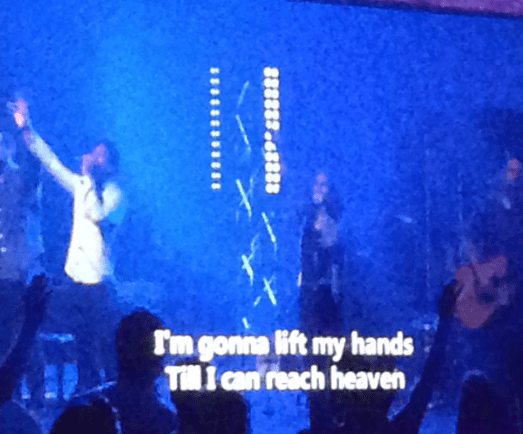
In case you don’t know, in many evangelical churches (and conferences) around the world, particularly large ones, the screens are used not only to project the song lyrics, but also the people on stage. During the sermon you’ll be able to see a magnified image of the preacher. And during the songs, you’ll be able to see a magnified image of the worship leader, and the band members, with occasional close-ups (perhaps) of the drummer, or the electric guitarist’s hands, or the bass player’s tattoo, all while the lyrics to the song are projected on the bottom of the screen, in one-to-three line segments.

Here’s why I think it’s a bad idea for the worship leader’s face (and the musicians too) to be projected during worship.

It constantly keeps you in people’s consciousness
Throughout the time of singing, everyone in the room is constantly aware of you, your movements, your mannerisms, your outfit, your sweaty nose, and your personality.

It forces people to look at you
They have no choice but to look at your face. They can either close their eyes or look at your face. What if they don’t want to look at your face? Too bad for them.

It detracts from the focus of the songs
For about 15 – 25 minutes each Sunday, worship leaders have the weighty privilege of deciding what to focus their congregations on. If you happen to employ your screens during those 15-25 minutes, the odds are that your congregation will focus on what’s on them. Gospel-drenched, God-glorifying, Jesus-exalting lyrics? Or your face?

It makes you even more of a celebrity
People are conditioned to treat a person on a screen as a celebrity. Worship leaders are already on enough of a pedestal as it is, that having a congregation stare at their magnified face can only make it worse.

It changes the way you behave (and not in a good way)
I’ve led worship in settings where my face is projected and it just plain out feels awkward. Oops I just licked my lips. That looked weird. Will this shirt look good on screen? Oops they just caught me looking over at myself. Oh wow I really am losing my hair. For goodness sake, there are enough things for us to worry about while leading worship, that how we look on a massive screen shouldn’t be one of them.

It changes the way your team sees themselves
Now your worship team is thinking about all of those same things. They already feel self-conscious enough, and now they have to worry about looking camera-ready. That Mom who just gave birth four weeks ago, that electric guitarist who spilled coffee on his shirt, that drummer who sweats profusely in the shape of a T-Rex on his back, now they’re all thinking about their appearance. 

It prevents you from decreasing
It’s awfully hard for you to decrease when your face is the size of a Honda Civic.

It ensures that you are central
For the duration of the sung worship time, your face is the number one trending topic in the room. 

It necessitates breaking the song lyrics up
The context of the lyrics we’re singing matters. “Upward I look and see Him there who made an end to all my sin” makes more sense when we can see what precedes it: “When Satan tempts me to despair and tells me the guilt within”. It’s helpful to let people see the different chunks of the song in context. It already flies by as it is, and even more so when we chop the chunks up even smaller.

It’s completely unnecessary
So your room is large. So people standing in the back won’t be able to see you very well during worship. So what?

Let me try to preemptively try to answer some questions/address some disagreements:

What about when you’re talking or praying?
This makes more sense to me. When you welcome people, or when you speak to them, or when you’re praying/transitioning in between or after a song, it can definitely be helpful for your face to be projected. At that moment you do want a connection. You do want people to pay attention to what you’re saying. You do want your leadership to be more present. But when the song begins again, the screen can fade to full-screen lyrics. At that moment your role changes and you need your face to disappear.

But why is it OK to project the preacher?
The role of a preacher is to preach the word of God. To communicate the Word of God to the people of God. It is very much a communicative role (duh). The role of a worship leader is not the same. Yes, it’s a pastoral role, but it’s not a preaching role (though songs do preach). Our role is the role of a facilitator. And an effective facilitator facilitates. Facilitating and communicating are two very different roles. Having your face on a screen indicates that you’re on the screen to communicate. Having your face off the screen indicates that you’re there to facilitate. So get your beautiful face off the screen and do some facilitating.

But people will feel so disconnected from the worship leader
First, so what. Second, that’s the point.

But people need to see who’s leading them
They can see you just fine. And if you want, they can see you projected during the speaking bits. But when the singing starts, they don’t need to see whether or not you shaved this morning.

But it’s so boring just to project lyrics
Then make sure you’re projecting lyrics that pack a punch.

So what do you do if your church is currently projecting your face during the songs?

Stop doing it
It’s not a good practice. It’s something that’s increasingly prevalent in large evangelical churches and conferences, and it’s adding to the trend towards performancism that’s resulting in tuned-out congregations. 

Use it as a huge teaching opportunity
Imagine a congregation hearing something like this:

“For years here at (insert your church name here) we have projected the worship leader and worship team on the screen during corporate worship. Our tech crew have done an excellent job at this, and we know that in this large room, many of you have appreciated being able to see what’s going on on stage. But, starting today, we’re not going to project the people on stage on the screen during worship anymore. You’re going to see full-screen lyrics. You might see the worship leader’s face when he speaks or prays, but when we start singing, you’ll just be seeing lyrics only. Why are we doing this? Three reasons. First, we don’t want you to think that you’re coming to a show on Sunday mornings. We want you to come to worship God. Second, we don’t want to distract you from the amazing truths we’re singing, or the amazing gospel we’re proclaiming, or the amazing God we’re encountering. And third, we want to encourage you to be more engaged with God in worship and less focused on who’s on the screen. So, we’re going to keep the lights up, we’re going to ask that you commit yourself to actively engaging in this time, and we’re going to pray now that the Holy Spirit would help this church worship Jesus with more and more freedom in the weeks and months to come.” 

Sounds good to me.
Are We Headed For A Crash? Reflections On The Current State of Evangelical Worship

1Last week I spent a couple of days attending the National Worship Leader Conference, hosted by Worship Leader Magazine, featuring many well-known speakers and worship leaders. The conference was held about 15 minutes down the road from me, so it was an opportunity I couldn’t pass up. I’m glad I went.

I met some new people, heard some thought-provoking teaching, enjoyed some good meals and conversations with worship leader friends, and experienced in-person some of the modern worship trends that are becoming the norm in evangelicalism. It was eye-opening in many ways.

Over the last few days I’ve been processing some of what I saw and heard.

Worship Leader Magazine does a fantastic job of putting on a worship conference that will expose the attendees to a wide variety of resources, techniques, workshops, songs, new artists, approaches, teachings, and perspectives. I thought of Mark Twain’s famous quote “If you don’t like the weather in New England, just wait 5 minutes”. The same could be said of this conference. It’s an intentionally eclectic mix of different speakers, teachers, worship leaders, and performers from different traditions, theological convictions, and worship leading philosophies. You’ll hear and see some stuff you like and agree with, and then 5 minutes later you’ll hear and see some stuff you don’t agree with at all.

It’s good for worship leaders to experience this kind of wide-exposure from time to time, and the National Worship Leader Conference certainly provides it.

Yet throughout the conference, at different sessions, with different worship leaders, from different circles, using different approaches, and leading with different bands, I picked up on a common theme. It’s been growing over the last few decades. And to be honest, it’s a troubling theme. And if this current generation of worship leaders doesn’t change this theme, then corporate worship in evangelicalism really is headed for a major crash.

It’s the theme of performancism. The worship leader as the performer. The congregation as the audience. The sanctuary as the concert hall.

It really is a problem. It really is a thing. And we really can’t allow it to become the norm. Worship leaders, we must identify and kill performancism while we can.

It’s not rocket science.

Sing songs people know (or can learn easily). Sing them in congregational keys. Sing and celebrate the power, glory, and salvation of God. Serve your congregation. Saturate them with the word of God. Get your face off the big screen (here’s why). Use your original songs in extreme moderation (heres’s why). Err on the side of including as many people as possible in what’s going on. Keep the lights up. Stop talking so much. Don’t let loops/lights/visuals become your outlet for creativity at the expense of the centrality of the gospel. Point to Jesus. Don’t draw attention to yourself. Don’t sing songs with bad lyrics or weak theology. Tailor your worship leading, and the songs you pick, to include the largest cross-section of your congregation that you can. Lead pastorally.

I am a worship music nerd. I listen to a lot of it. I follow the recent developments. I know who’s out there (sort of). I try to keep up (it’s not easy). Even I didn’t know most of the songs that we were supposed to be singing along to at the conference. I tuned out. I sat down. I Tweeted. I texted my wife. I gave up.

You’re not reading the ramblings of a curmudgeony guy complaining about all the new-fangled things the kids are doing these days, with their drums and tom-toms and electric geetars. You’re reading the heart-cry of a normal guy who’s worried about what worship leaders are doing to themselves and their congregations. People are tuning out and giving up and just watching.

This is not a criticism of the National Worship Leader Conference, though I do think they could make some changes to more intentionally model an approach to worship leading that isn’t so weighted on the performance side. As I said, the conference exposes us to what’s out there in the (primarily) evangelical worship world.

It’s what’s out there that’s increasingly a problem.

Worship leaders: step back. Take a deep breath. Think about it. Do we really want to go down this road? It will result in a crash. Back-up. Recalibrate. Serve your congregations, point them to Jesus, help them sing along and sing with confidence. Get out the way, for God’s sake.

My Mom’s Example in Worship

1“Mom, why are you showing Jesus your hands?” I asked her one morning during church when I noticed her lifting her hands to heaven. I don’t remember her answer, but I remember her example. She modeled to her young sons (and now models to her 5 granddaughters too) heartfelt worship springing from a life of love for Jesus. I’m grateful on this Mother’s Day for my Mom’s example in worship.

In church. She sang. She raised her hands. She clapped (even though she has the least amount of rhythm that I’ve ever seen in a human being). She was faithful in getting her three boys to church. She showed her children that she thought Jesus was worthy of praise.

At home. She saturated the atmosphere of our home (and car) with worship. She was (and still is) the first person awake, with a cup of coffee, her bible, and her prayer journal, every morning of the week, reading the Scriptures, praying, and listening. She still does this, and her list is probably several pages long. She made/makes worshipping Jesus not just a Sunday morning thing, but an every day thing.

Through trials. She’s come through profound trials with an even greater tenderness, sweetness, strength, and Christ-likeness. Jesus is her center, her rock, her joy, and her friend. Her love for Jesus causes her to reflect Jesus. She shows that worshipping Jesus will sustain you even through darkness.

My Mom bought me my first guitar, paid for all my lessons, encouraged me to keep practicing, and affirmed me when I began exploring a call to worship ministry. Those were huge contributions. But her greatest and continuing contribution to me (and her family and all who know her) is her example in worship. Not only with her voice, but with her life fixed on Jesus. Now if we can only teach her to clap on the 2 and 4!

Happy Mother’s Day, Mom. Thanks for loving Jesus above all, and through all, and for that first guitar too. I owe you!

The Awkward Salary Conversations

1Several years ago I posted some thoughts on a “worship leader’s job description and pay“. And of all the posts I’ve ever written in almost five years, that one post has gotten the most hits, the most Google searches, prompted the most interesting conversations (especially from one guy who’s apparently sold more records than The Beatles), and emails to me from various worship leaders from around the country asking for advice about how to negotiate their salary.

Since I am not currently having this conversation with my church I thought it might be a good time to share a few thoughts (for whatever they’re worth) on negotiating a salary when you’re serving in full-time ministry. I just received a question from a worship leader about this yesterday, and here’s basically what I said:

1. In principle, your church should pay you around the average income in your area, for a person of your age, with your experience, education, and taking into account whether you’re single, married, and have any children. Wikipedia has this info for most cities, I think! It’s not unreasonable to ask your church to pay you a fair salary. Too many church employees think that it is.

2. Bill Hybels says that “facts are your friends“. So, get your monthly expenses really organized and categorized. Put down what your monthly and/or yearly expenses are. Do it in transparent detail. Rent/mortgage, utilities, groceries, bills, savings, gas, insurance, etc. Does your spouse work? Put that down too. Get a complete picture of the facts of your financial situation.

3. Do this so that you can know what you NEED to make in order to be comfortable and to provide for your family. Throwing out a figure, or just guessing, or just wanting MORE is not a good idea. But do some research on the average income in your area. Then get your facts straight. Then put it down in a succinct, to-the-point letter to your boss and your pastor, and have a very specific ask. Ground it in the fact that it’s what you NEED, not what you WANT. Do it humbly but don’t feel guilty.

If they respond positively, then well done. If they respond negatively, then you’ll need to prayerfully (and with wise counsel) evaluate whether God is calling you to a situation where you’re not paid enough, or whether it might be more wise for you to look elsewhere.

Of course, God calls people all the time to serve in ministries and capacities where the compensation isn’t all that they NEED and they have to rely on raising support, or having a second job, or having their spouse work. If God has called you to this sort of ministry, then he will provide for you

This advice is for the full-time (or even part-time) worship leader who’s serving at a church that’s relatively stable financially, and able to pay him/her a salary. If that’s you, and you’re entering into those awkward salary discussions, then get your facts straight, put it down on a paper (in a memo, not a novel), and ask for what you need. And pray a lot too.

UPDATE: I forgot to add a very important thing: Very often, when churches can’t afford to pay you the average salary for your area, they can make up for it in other ways. Perhaps they have a house you can live in, or perhaps (and this is how my wife and I are able to survive in Northern Virginia) there is a family in the church who will rent you a place for a less-than-market-value rate. These are two examples of ways a church can help you and your family survive and be comfortable, even if they can’t pay you what a spreadsheet says you “need”.

Let’s All Be A Bit More Childish

1I am a big proponent of worship leaders thinking seriously about their role, thinking deeply about their theology, thinking practically about their skills, and thinking critically about current trends and pressures. A lack of introspection, evaluation, and hard conversations will inevitably result in a shallowness and flimsiness that doesn’t serve the Church well. To put it succinctly, worship leaders should always be growing up.

But if there is a downside to all of this serious/deep/practical/critical thinking, it could be that sometimes we lose our childishness.

There is such a wealth (praise God) these days of solid resources/articles/blogs/videos/conferences/books aimed at getting worship leaders to grow up and into their pastoral role and their function as ministers of the gospel. Most of the time it’s all really solid stuff. But sometimes I fear that some of it might run the risk of making us lose our childishness.

In the gospels, we have three different accounts of Jesus embracing children, saying “let the little children come to me” (Matthew 19:14, but also in Luke 18:16 and Mark 10:14). In all three accounts, people bring their children to Jesus, the disciples try to keep the children away, and Jesus tells the disciples to stop. And then Jesus says that he wishes everyone was more like the children!

Fundamentally, we must always come to Jesus like a child. Helpless. Transparent. Needy. Light-hearted. And, yes, clueless. But the thing about a child’s cluelessness is that it’s two sided: (1) they don’t know a lot of stuff that grown-ups know, but (2) they don’t know what they don’t know (and they don’t care). Is it any wonder why Jesus points to childishness as an ideal?

There’s a difference between childishness and immaturity. And to all the resources, articles, blogs, videos, conferences, and books aimed at helping worship leaders grow and mature, I say “the more the merrier”. But when I start to feel like I’m a child being turned away from Jesus because I don’t know enough stuff, I start to get nervous. And so should you.

So where’s the balance?

1. Always pursue growth. And always pursue leading in a more mature, skillful way. That honors the God who gave you the gifts you have (and some gifts you might not know you have).

2. Stay childish. And help your congregation stay childish too. Come to Jesus like little children. You might not know everything, you might not say everything the right way, and (gasp) you might even exhibit joy in your body/hands/feet (children are known to do that from time to time…) But that’s what you do when you’re a child. You’re helpless, transparent, needy, light-hearted, and clueless too.

In the disciples eyes, there seemed to be two different types of people around Jesus: the disciples and the children. Perhaps Jesus’ point was that, if he had his way, there wouldn’t be any difference between the two? Worship leaders, let’s not forget it.