
Avoiding Abrupt Endings

It’s awfully jarring to be riding in the passenger’s seat while cruising 35 mph along a city street when all of the sudden the driver slams on the brakes. One second you’re looking out of your window at buildings and houses – and the next your head is bouncing back and forth against the head rest with no warning. Not very pleasant.

Similarly, it can be awfully jarring to be standing in the congregation, singing a song of worship when all of the sudden the worship leader slams on the brakes, and the song suddenly stops. One second your attention is fixed on God’s goodness and glory – and the next you’re acutely aware that everyone has stopped singing, the worship leader is turning his pages and taking his capo off, and your hands are still in the air. You figure you should put your hands down. Again, not very pleasant, and a bit embarrassing.

It’s probably safe to say that one of the most important goals of any driver is to prevent his passengers from experiencing whiplash. It doesn’t make for a very pleasant experience for them, it won’t exactly make riding with you an attractive option in the future, and it’s not what they’re looking for when they get in your car and strap in.

For the same reasons, it should also be an important goal for any worship leader to prevent his congregation from experiencing whiplash. It’s good to try to avoid abrupt endings.

Here are some ways I’ve found it helpful to avoid giving the congregation the sensation of having the brakes slammed on a song:

Ease on the brakes
Most worship music CDs don’t slow songs down at the ending. Instead, they might fade them out, stop them without slowing down, or cover up a “hard break” with applause. That’s nice for a CD, but usually not ideal for a congregation. While you certainly want to vary how you end songs and transition into the next, and it may be appropriate at times to have a “hard break” or encourage clapping after a song, a congregation is always grateful for a heads up. Start slowing the song down on or near the next to last measure and bring it to a nice smooth landing. Your goal isn’t to impress, but to pastor. This may mean sacrificing a cool sounding ending for a predictable one.

Linger on the last chord for a few measures
If I’m leading a song that’s in the key of G and we’ve come to the end, it might be appropriate to just linger on the G for a few measures, perhaps moving back and forth between that and a Gsus, or some sort of simple and predictable chord progression. I might keep playing the same tempo as the just-ended song, or slow it down, or start playing the tempo for the next song while still in the key of G. This provides a bit of a buffer after a song and helps avoid an abrupt ending.

Sing the last line a few times
Avoid singing the last line of a song just because it seems like that’s kind of what you’re supposed to do. It can become mindless repetition and lose effectiveness if it happens every time you sing a song. But if you’re ending a song and feeling like you’re coming close to slamming on the brakes, just go ahead and let the band cut out, the tempo slow down, linger on a chord or two, and then sing the last line together a few times. Maybe go back and sing the whole chorus, or the first verse, or the bridge. You don’t always have to end on the chorus. Whatever it is, there might be something you can repeat to help soften the ending a bit.

Choose songs in complimentary keys
I’m asking myself a lot of questions when I’m choosing songs – one of which is “will it feel musically natural to move from this one song to the next?” While it’s not the most important question and there may be occasions when it works to move from one song to another in a totally different and non-complimentary key, I will most often try to avoid putting myself and the congregation in a situation where there will have to be a clear break between one song and the other.

I try to keep in mind the Nashville numbering system when considering complimentary keys.

A quick crash course for those who don’t know what this is:
If I’m in the key of D, D is the “1”. E is the “2”, F# is the “3”, G is the “4”, and so on. If I’m choosing a song to follow up this current song, the three keys that lend themselves most naturally to a smooth transition would be stay on the “1”, or move to the “4” (key of G), or “5” (key of A). I won’t have to do an awful lot of maneuvering to get there.

This number system would apply to any key. If in the key of A, A is the “1”, B is the “2”, C# is the “3”, and so on.

I recommend Paul Baloche’s DVD, Music Theory Made Easy, to look at this idea in more detail.

You can get from any key to any key, of course, outside of my little box, and sometimes do it very smoothly. It just takes some thought and practice.

Think through and practice transitions
Don’t just pick 5 or 6 songs or hope they’ll flow well together. Think through and practice how to transition between them both musically and thematically. Choosing good keys and consistent themes make this a whole lot easier. Sing and play through them, in time, visualizing how it would feel on Sunday morning. If you’re not comfortable with it, keep practicing.

Every Sunday as your congregation “gets in the car”, they’re putting a certain degree of trust in you – that you’ll lead them well, that you’ve prepared for the trip, and that they can look out the window at the beauty of God without interruption. Take it easy on the brake and your congregation will be grateful.

Just Because That’s the Key They’re Recorded In…

highI really appreciate Matt Redman’s music. His songs are consistently theologically sound, musically fresh, and congregational. His newest album, “We Shall Not Be Shaken”, is fantastic, and has a number of songs that I could envision using in the context of a worship service.

But many of his songs are written too high. Older songs such as “Blessed Be Your Name”, “Praise Awaits”, “Nothing But the Blood”, and newer ones like “You Never Let Go”, “This is How We Know”, “You Alone Can Rescue”, and “How Great is Your Faithfulness”, are all recorded in the key of B. This usually means that the chorus and bridge sit very high in the vocal range – with D#’s, E’s, and F#’s all over the place.

The key of B is a great one for Matt, but not usually for the average person in the congregation.

I also really appreciate Tim Hughes’ music. I met Tim in Oxford a couple of years ago and was struck by his humility and genuine desire to write songs that serve the Church. His CDs are also dependable sources of good music. But, again, many of his songs are too high.

Newer songs like “Happy Day”, “Everything” and “Jesus Saves” are recorded in the key of C, meaning that the congregation is asked to hit E’s, F’s, and even G’s on a regular basis. Most other songs are recorded in keys that are more suited for Tim’s voice than the average man or woman in the pews.

Many of Chris Tomlin’s songs are good for using in worship services, but are recorded in keys nearly impossible for the congregation to feel comfortable in. “Indescribable” was recorded in the key of B meaning you have to hit an F# about 40 times in the song. “How Great is Our God” in the key of Db, meaning that in the bridge you’re belting out F’s and F#’s. “Holy is the Lord” in the key of Bb meaning the chorus and bridge sit around an F half the time. “Amazing Grace (My Chains Are Gone)” was recorded in the key of G, meaning that you’ve got to hit a high G when the chorus rolls around.

Just because Matt Redman, Tim Hughes, or Chris Tomlin record their songs in those keys, you don’t have to sing them in those keys.

Take some time to figure out the best key for a song. My rule of thumb is “C to shining C” (I’ve mentioned this before), meaning that the lowest a song should generally go is a C (one octave below middle C on a piano) and the highest it should go is one octave up from there. I’ll still use songs that dip a bit lower than a middle C or jump up to a D, Eb, or even an E from time to time, but I want to make sure the song isn’t “hanging out” up in the stratosphere or down in the depths. I think most people are comfortable between a low G and a high C or D. Of course we can’t limit our congregation to only singing notes between a middle C and one octave up. It’s OK to move a bit lower or a bit higher from to time. But make sure it’s not all the time.

Singing all your songs really low can have a deadening effect, removing drive and energy from them. Singing all your songs really high can cause your congregation to stop singing.

Once you’ve figured out what key the song should be in, transpose it down and make a new chord chart up for your worship team. This is a skill you really need to develop if you haven’t already. A basic music theory book should help you learn how to move songs down into more comfortable keys. In the meantime, ask someone for help or use internet tools (CCLI’s SongSelect service does it) to help you out.

Moving “Blessed Be Your Name” down from B to A means that the verses are a bit low (i.e. you dip down to an A once in a while), but the chorus and bridge are comfortable, sitting in an A-B-C# range.

Moving “Happy Day” down from C to A means that the verses are pretty low (you dip all the way down to a low F#) but the chorus and bridge aren’t painfully high.

A lot of worship music CDs that I buy have songs that are written in congregation-friendly keys. I’m always really grateful for those. But others are written in the singer’s “sweet spot”. Those are great to listen to it, but require some extra work on my part. I’ll gladly transpose a song down a few keys to help as many people join in as possible.

Video Clip – Paul Baloche on Choosing a Bass Player

Here’s a great video clip of Paul Baloche explaining what he’s looking for in a bass player.

In this clip Paul focuses almost exclusively on the bass player’s skill. More important than the bass player’s skill, of course, would be his or her heart. Do they love the Lord? Are they passionate about God’s glory or their own? Are they humble? Are they committed to the church? if these answers are “yes”, and the bass player is skillful (like Paul talks about), then sign him (or her) up!

How to Ask Your Congregation to Stand Up

pewsIn the more informal services at my church, the worship leader is usually the one who invites people to stand at the beginning of the service. In other churches or in more formal services, either the church’s pastor will do this, or the first hymn will just start and signal that everyone should probably stand up.
I’ve seen worship leaders invite their congregations to stand in some pretty funny ways.

Some are timid or nervous and don’t quite know what to say. They might say something like “uh, hi everyone, please find your seat, uh, please stand up, and please, uh let’s sing this first song ‘How Great is Our God’”.

Well, if you say so.

Some are overconfident and come across like they had a bit too much coffee to drink. “Hello everybody! I said hello everybody! Alright, that sounds more like it. Now let’s stand to our feet and worship the Lord! I said let’s stand to our feet and worship the Lord! Are you with me? Yeah! One, two, three, four!

I think I might have a headache.

Others just say random things like “get on up!” (reminds me of a James Brown song) or “please rise” (reminds me of a legal proceeding).

When it comes to the very first thing a worship leader says in an entire service, it’s important that they not come across as nervous, annoyingly enthusiastic, flippant, or robotic.

Just relax, make eye contact, and say something simple like “good morning everyone, why don’t we stand together and sing to the Lord”. It’s confident, simple, and clear. Or “let’s stand together this morning and proclaim God’s glory as we sing”. It doesn’t need to be fancy or eloquent. It shouldn’t be more than a sentence or two.

It’s not the most difficult thing in the world – and it may come easily to many worship leaders – but it’s easy to overlook until you get onto the platform on Sunday morning. Just treat your congregation like your family and kindly invite them to stand. An awkward start is just plain awkward. A smooth start makes things easier.

Oftentimes at my church we’ll start playing a few measures of the opening song, and then I’ll ask the congregation to stand before we start singing. Here’s an example of how I did that a few months ago before singing “Praise the Lord” by Bob Kauflin and Doug Plank from Sovereign Grace Music (it’s on their Psalms CD). You’ll hear people chattering at first, and even a bit during the first verse, but slowly people join in, and by the chorus we’re all singing together.

Where’s the Passion?

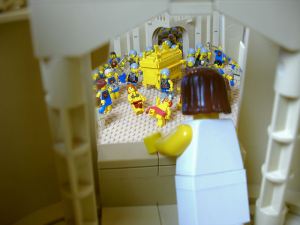
danceIn 2 Samuel 6, when the Ark of the Covenant was brought back into Jerusalem, David “danced… with all his might”. Take that description literally and just imagine how David looked. Undignified enough to draw the mocking of his wife Michal – but not nearly undignified enough for David to think about pulling back.

In Mark 14, a woman pours perfume on Jesus’ head. This perfume is expensive (worth “…more than year’s wages…). She didn’t hold any back (“she broke the jar…”). She drew the mocking of those around her (“they rebuked her harshly”). But Jesus was honored enough to say “she has done a beautiful thing to me”.

When I stand in front of a congregation to lead them in worship, do I resemble David or Michal? Am I worshipping “before the Lord” or too worried about my dignify? Am I willing to become “even more undignified” or do I look upon such behavior as worthy of contempt?

When I leave a service on Sunday morning, can I look back and say that I “broke the jar” – giving my all to worship Jesus? Did it cost me anything? Or did I hold back for fear of rebuke or for fear of giving up too much? Do I resemble Mary, whose worship was “beautiful” to Jesus, or the people who look upon such extravagant worship with suspicion?

Where’s the passion when I lead worship?

God deserves my whole-hearted, enthusiastic, God-glorifying, genuine, and even full-bodied singing.

The congregation is served by my example of a David-like abandon and Luke 14-like devotion.

I become a more effective worship leader when my passion for the glory of God is contagious and spreads into the congregation.

Where is your passion on Sunday morning?

If your passion is the music, it will show. You’ll contribute to a music ministry that exists to perform and a congregation that exists to hear and critique music.

If your passion is perfection you’ll contribute to a music ministry that exists to impress and a congregation that exists to applaud.

But if your passion is the glory of God, you’ll contribute to a music ministry and congregation for whom God’s glory is the goal and delight.

It’s not enough to be a good musician. Break your jar every Sunday, worship with all your might, and do it all “before the Lord”.