Instrumental Music During Prayer Ministry

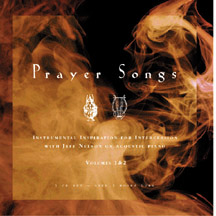
A few years ago I came across a series of CDs called “Prayer Songs”. These are instrumental recordings of Jeff Nelson on piano, and are designed to be played during times of prayer.

From Whole Hearted Worship’s website:

These unique CD’s were recorded in an atmosphere of prayer. As intercessors prayed together in one studio, Jeff Nelson, a gifted keyboard artist, songwriter, and producer, sat at a Yamaha grand piano in an adjoining studio, listening through his headset and musically interpreting the spirit of the prayers. The result is over 4 hours of “fragrant sounds” that will stir your worship & intercession. (The recordings are music only – not the spoken prayers.)

These recordings have served us very well over the years. At a service or a meeting when there is going to be an extended time of prayer ministry, we’ll often play these CDs to provide a buffer of privacy for people, and help people feel more comfortable staying and waiting and praying – not starting conversation or just leaving.

I used to feel like I was stuck playing guitar or piano for a couple of hours while a time of prayer ministry went on. I was thrilled to find these CDs and highly recommend them to you. You can order them through the link to Whole Hearted Worship’s website above.

Do You Have a “Worship Leader Voice”?

I’m always a bit confused when, having just been talking to a worship leader with a normal voice and normal word pronunciation, he proceeds to lead worship and sing with a completely different voice and with strange pronunciation. What just happened? Is that the same person I was just talking to? Is he trying to be cool? Does he have a speech impediment that you can only hear when he sings or prays?

Where we might say “open the eyes of my heart, Lord”, he says: “ohhhpin de ahs of my hearrrt, Lird” (with lots of vibrato for special effect).

Or instead of “better is one day in Your courts” it becomes “bedda is a one deh in yir kirts”.

In some cases when he prays he might alternate between a ultra-breathy and halting whisper or a Shakespearean/Charlton Heston-esque bravado.

I’m not talking about when people with different accents pronounce words differently than my American english (i.e. Kristyn Getty pronouncing “power” as “par” in her Irish accent). I’m talking about when someone takes on a completely different and unnatural voice when a microphone is placed in front of their face.

Some worship leaders don’t realize they’ve developed a “worship leader voice”. It’s just a bad habit they’ve picked up over time and no one has had the boldness to break it to them. Maybe you’re this kind of worship leader. Or maybe you need to break the news to someone who is!

Other worship leaders do it on purpose – thinking that it’s how a lead singer is supposed to sound, it makes them come across as more emotional, or that different pronunciation rules apply when you sing versus when you talk. If you’re this kind of worship leader, may I plead with you to consider leading worship with your normal voice?

When you take on a different identity when you lead worship (which is what I would argue is going on when you change how you talk or pronounce words when you’ve got a microphone in front of you), you are making yourself a much larger presence in the room than you need to be. Some people might not notice what you’re doing – but a lot of people will. And to those people, they will spend half (at least) of the service trying to figure out what’s bothering them, realizing it’s you, and then trying to get past it.

You’re also sending the signal, whether you intend to or not, that you’re up front to perform. Why else would you be pretending that you talk or sing a certain way when in reality you don’t? It gives the impression that there is an aspect of your singing or praying which is artificial or contrived.

Worship leaders should be seeking to be as minimal a “presence” in the room as possible. Not distracting people with a sudden linguistic transformation is one way to do that.

Just be yourself when you lead worship. Don’t take on a different persona or change how you talk or pronounce words with mangled vowels or drawn-out “r’s”. Be the same person and use the same voice when you’re on stage and off. And watch the vibrato.
Song Recommendation – “To See the King of Heaven Fall (Gethsemane)”

With the season of Lent a little over one week away, and Holy Week and Easter in the not-too-distant future, I wanted to recommend an excellent song called “To See the King of Heaven Fall (Gethsemane)”, which was written by Stuart Townend and Keith Getty.

This song would work well all year round, but it seems especially fitting for Maundy Thursday or Good Friday services when a song conveying the terrible sorrow that Jesus endured in being obedient to giving up his life on the cross is needed.

It’s not enough to sing a song that says Jesus was crucified and leave it at that. A sad sounding, minor-key song might set the right mood, but not point people to why Jesus died and what he accomplished on the cross. This song is a gift for worship leaders looking for a song that derives its emotion out of the truth it contains.

Here are the lyrics:

To See the King of Heaven Fall (Gethsemane)
To see the King of heaven fall
In anguish to His knees,
The Light and Hope of all the world
Now overwhelmed with grief.
What nameless horrors must He see,
To cry out in the garden:
“Oh, take this cup away from me –
Yet not my will but Yours,
Yet not my will but Yours.”

To know each friend will fall away,
And heaven’s voice be still,
For hell to have its vengeful day
Upon Golgotha’s hill.
No words describe the Savior’s plight –
To be by God forsaken
Till wrath and love are satisfied
And every sin is paid

What took Him to this wretched place,
What kept Him on this road?
His love for Adam’s curséd race,
For every broken soul.
No sin too slight to overlook,
No crime too great to carry,
All mingled in this poisoned cup –
And yet He drank it all,
The Savior drank it all,
The Savior drank it all.
Stuart Townend & Keith Getty Copyright © 2009 Thankyou Music

You can download the sheet music here, and purchase an mp3 of the song from iTunes here.

Here is a YouTube video of  a live recording of the song from Stuart Townend’s church. This version can be found on Church of Christ the King Brighton’s CD called “Have You Heard”.  The video starts off with a reading of Mark 14:32-36 and an instrumental prelude. The song starts around 1:45.

Too Many Songs in the Same Key = Boring

Yesterday morning my church held one 11:00am service for those able to make it out of their houses. We had about two and a half feet of snow dumped on us over the weekend, and most streets were either impassable or dangerous. Instead of canceling all services like we did back in December, we decided to have one service for anyone who could come. About 200 people ended up braving the icy and snowy roads, and I led a handful of songs from the piano with my sister-in-law singing with me. It was a simple communion service and we sang mostly familiar hymns and a couple newer songs too.

When it came time for communion, we sang three songs in a row: “Here is Love Vast as the Ocean”, “How Deep the Father’s Love for Us”, and “Alleluia Sing to Jesus”. I picked these songs for this spot in the service because they were familiar and they flowed well with each other.

One of the reasons, besides their theme, that they flowed well together was that they were all in the key of E major. This makes things easy since you can just slide from once song to the next without having to think about how to get from one key to the next. I’ll often do two songs back-to-back in the same key for this reason.

But doing too many songs in a row that are in the same key can be a bad idea sometimes. After singing in the same key for five or ten minutes, it can start to feel like we’re stuck on one really long song. By the end of the second song, whether people realize it or not, they’re a bit tired of hitting the same notes and hanging out in the same range, and they’re ready to move somewhere else. And unfortunately, when people get tired of singing in a certain range, they can become disengaged with the words they’re singing.

So instead of doing all three songs in the key of E, we did “Here is Love Vast as the Ocean” in the key of E, “How Deep the Father’s Love for Us” in D, and “Alleluia Sing to Jesus” in E, modulating to F on the fourth verse. This kept all three songs in singable keys, but varied their ranges just enough so that there was distinction between them.

It took some maneuvering between songs to get from one key to the other, but I’m fairly comfortable doing that, so it didn’t feel awfully jolty. I try to avoid stopping and starting between songs if at all possible. If you’re not comfortable doing this, I would recommend you practice, practice, practice, and listen to how other worship leaders and musicians transition between keys. You’ll get better at it, and someday it will come naturally to you.

There’s a lot to think about when choosing and leading songs. What keys you’re singing your songs in should be up towards the top of the list. Keeping your keys in comfortable congregational ranges (i.e. not too high and not too low) is important, and not singing a bunch of songs in a row in the same key also helps keep things from feeling tired.