“Let’s Stand Together and Worship”

Romans12A few years ago, I realized I had developed a bad habit of saying “let’s stand together and worship” whenever I got up to lead some songs. It didn’t matter if it was the beginning, middle, or end of a service. It was what I said to get people to stand and sing after a time of prayer, the sermon, announcements, etc.

Someone finally pointed out to me that by saying “let’s stand together and worship” I was unintentionally sending two messages. First: worship is only singing. Second: what we have just been doing is not worship. Neither are true, of course, but you wouldn’t be able to tell I thought so if you listened to what I was saying.

I was also leaving off one important detail: who we are standing to worship. “Let’s stand together and worship” is not only inaccurate but it’s incomplete.

I can help the congregation see the whole service as a time of corporate worship and be reminded to whom we’re directing our praise by choosing my words carefully even when I’m just asking them to stand up. Here are just four examples:

  • “Let’s stand together and continue worshiping our great God.”
  • “Let’s stand and sing together to declare what Jesus has done for us.”
  • “I’d like to invite you to stand as we respond to God’s word by singing this song of thankfulness.”
  • “As we continue in worship by hearing God’s word read, you can be seated.”

Notice I use the word “continue” a couple of times. This is a gentle reminder to the congregation that “worship” doesn’t stop when the songs stop.

I also try to keep the fact that God is the object of our worship from being assumed. We can very easily just say things like “we’re going to worship” or “you all are really worshipping!” without realizing that we’re subtly teaching that God is a spectator of our worship rather than the receiver.

While the sermon topic may vary from week to week, the worship leader is teaching the congregation how to think biblically about worshipping in song every Sunday. Even the seemingly innocuous wording used when asking the congregation to stand conveys a message and shapes the congregation’s thinking.

Even the title “worship leader” misses the mark. I use it because, like it or not, it’s now a part of the lexicon and is generally understood to refer to the person who leads the singing. But while the title may be inaccurate and a tad misleading, our words don’t have to be!

Checking for Ticks

tickYou may not know this, but it’s a fact that those of us who lead worship are targets for ticks. Without realizing it, ticks can latch on to us and survive unnoticed for years.

There is a wide variety of tick species to look out for. Check yourself before you lead worship next time for any one of these:

Here we go!
One of the sneakiest ticks around, it causes a worship leader to exclaim into the microphone something more appropriate for the beginning of a road trip to Yosemite than the transition into the bridge of a song.

Come on everybody!
The brother of the previous tick, its victim unwittingly uses a crowd-rousing technique first developed by Richard Simmons in an attempt to infuse enthusiasm into a service.

I just really want to…
Native to youth groups, this tick has spread into a wide variety of settings. The afflicted worship leader begins any personal word with this preface, followed by sentences of varying levels of competency, depending upon the amount of preparation devoted.

Yes Lord!
A difficult tick to remove once it has become attached – the “Yes Lord” tick presents itself before, during, or after songs, oftentimes with a high number of repetitions. While a declaration of agreement and affirmation may be effective and appropriate on occasions, this tick causes the statement to become so common that it is ignored.

Sing it like you mean it
Native to Sunday school and VBS, this tick is able to multi-task by being patronizing, insulting, distracting, and counter-productive all at the same time.

Amen
This is perhaps the most common species of tick to attach itself to worship leaders, Amen?

Put your hands together!
A potentially dangerous tick. An infected worship leader could cause mass confusion. “OK, I put my hands together… Now what do I do with them? Can I take them apart yet?” Unfortunately, the worship leader is not thinking about what he or she is asking the congregation to do. Very sad.

Oh, oh, ohhhhhhh!
Rearing its ugly head in between lines of a song, this tick causes a worship leader to employ a vocal flourish more suited for a 1980’s power ballad. Severe cases have been reported in which worship leaders attempt the highest note they can hit before fainting for no apparent reason.

Mmm, mm, mmmmmm
The descendent of “oh, oh, ohhhhhhh”, this tick has slightly different characteristics. While still rearing its head in between the lines of a song, the resulting vocal flourish is more suited for a 1960’s sappy love song. Most common to worship leaders who forget the lyrics to the second verse.

If you ­­­___ then let me hear you ___
The distant cousin of the “sing it like you mean it” tick – this species causes its host to insert any combination of words, resulting in groans and rolled eyes in the congregation. “If you love Jesus, then let me hear you shout!” “If you came ready to worship then let me hear you sing it loudly!” Swift action should be taken to remove this tick before its host is harmed by angry church members.

Ask trusted friends to examine you for any evidence of these ticks or any mutation. Long-term infection is unwise. Recovery time is quick for the former host and enjoyable for the congregation.

Save Your Best for Sunday

congregationworshippingI live in Northern Virginia – one of the most expensive, pressure-filled, busy, and traffic-riddled areas of the country. The millions of people who live in Washington D.C. and its suburbs have become accustomed to a pace of life that says: never slow down, never take time off, and pride yourself on working as hard and long as humanly possible. Even though right now we’re in the middle of summer, that sense of busyness and burden of pressure is still there. I feel it – even though I try to resist it – and it’s exhausting. Weeks are long, commutes are slow, mornings are too early, and vacation is too far away.

You may not live in an area like Northern Virginia/Washington D.C., but it’s a pretty safe bet that you know what I’m talking about. We all have busy and tiring weeks, crowded schedules, full inboxes, long to-do lists, evening meetings, and the ever-present traffic.

Those of us who lead worship, whether we’re full or part-time, paid or volunteer, know how it feels to wake up on Sunday morning with no desire or energy to rehearse the band, lead the congregation, handle the unexpected, have conversations, or do anything other than to just roll over and go back to sleep. The previous week has left us wiped out and drained. We arrive at church on an empty tank.

It’s a familiar and unfortunate scenario. How do we avoid this as worship leaders? How can we make sure that we’re not only prepared to lead worship but also enthusiastic about it?

Depend on the Spirit
In John 7:37-38, Jesus says: “If anyone thirsts, let him come to me and drink. Whoever believes in me, as the Scripture has said, ‘Out of his heart will flow rivers of living water”. Verse 39 tells us that he was talking “about the Spirit, whom those who believed in him were to receive…” There is no reason for us to go on feeling drained and exhausting, allowing the busyness of our lives to dry us up and leave us feeling empty. We may have long weeks, but because of the Holy Spirit, we can have “rivers of living water” flowing out of our hearts. Depend on the Spirit. Every morning, every night, every day – pray that your thirst would be quenched. He’ll answer your prayer and you’ll be able to tell a difference.

Resist the Devil
While it’s natural to feel tired after a 12 hour day of meetings and more meetings, our “adversary the devil prowls around like a roaring lion, seeking someone to devour” (I Peter 5:8). We’re encouraged in James 4:7 to “Submit yourselves therefore to God. Resist the devil, and he will flee from you.” Seeds of discouragement, burn-out, and just plain tiredness – if not resisted – can be used by Satan in destructive ways. While “the thief comes only to steal and kill and destroy…” Jesus “came that they may have life and have it abundantly” (John 10:10). Resist Satan and keep Jesus central and you’ll be able to lead worship out of abundance, not an empty tank.

Keep the Congregation in Your Heart
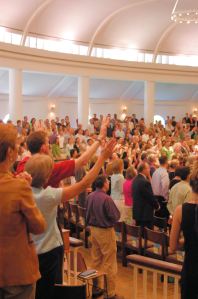
I have a blown-up picture of our congregation from a few years ago (shown above) in a time of corporate worship at our 11:00am service on my wall in my office. I have it there on purpose. During the week it’s very easy for me to get caught up in a whole host of things that end up distracting me, whether it’s the day-to-day responsibilities of emails, phone calls, meetings, planning, and work or other things like difficult conversations, unexpected interruptions and managing volunteers. If I’m not careful – I can go days without remembering that I’m here to serve the congregation. The picture in my office is one way I remind myself why I come in to work every day. Try to foster a love for your congregation in your heart. While you’re at work during the week, think of them and pray for them, looking forward to being with them on Sunday. Stay focused on loving and serving your fellow sheep.

Take Care of Your Soul

“For God alone my soul waits in silence; from him comes my salvation. He only is my rock and my salvation, my fortress; I shall not be greatly shaken.” (Psalm 62:1-2)

Long weeks, busy days, and full schedules are inevitable. Being exhausted by the time Sunday morning rolls around is not. Take care of your soul by waiting “for God alone”, “in silence”. Don’t wait until just before the service to have a quick time of prayer. If you do that – you’ll almost certainly show up feeling frazzled and hectic and unprepared. Be intentional about having quiet time with God before you lead worship.

Take Care of Your Body
This sounds simple – but you’re not exactly setting yourself up for success if you only get 4 hours of sleep and skip breakfast before you come to lead worship. It may mean leaving a Saturday evening dinner party early or missing a movie with friends – but try to make plans to be at home at a good hour on Saturday night with time to get good sleep. And while a donut or two on Sunday morning tastes good – leading worship can be a lot of work. Feed your body with good sleep and good food and your congregation will be grateful that you’re not cranky.

Have an Enthusiastic and Supportive Team
Do all that you can to foster a worship team that is not just there for musical back-up, but for passionate and heartfelt leading of God’s people in worshipping Him in song. When you have energy – they’ll be right there with you. When you’re a bit worn out and needing a vacation – they’ll be there to support you and you’ll be glad you can lean on them.

When we look out over our congregations this coming Sunday, we will be looking at some people who are well-rested, happy, fresh from vacation, and ready to encounter God. Others will be tired, discouraged, needing vacation, and feeling far from God. Some might not even know how they’re doing – they’re just at church. We will not serve our congregations well if we stand before them exhausted, unprepared, and counting down the minutes until the service is over so we can go home. Save your best for Sunday morning. With the Holy Spirit’s filling and power, we’ll serve our congregations with God’s joy as our strength.

What Are You Talking About? – Pt. V

pewsEvery worship leader has a mental checklist of what needs to happen before they get up to lead worship. Some worship leaders’ checklists are a bit fuller than others, but we all share certain responsibilities that have to be fulfilled prior to the beginning of the service.

Most of us wouldn’t ever think of standing before a congregation to lead worship without first choosing the songs. To be so glaringly unprepared would have terrible ramifications and would be such a bad idea in so many ways.

Most of us (hopefully) wouldn’t ever consider replacing the strings on our guitar and then plugging in to lead the band without tuning the strings a few times. To be so careless would be a huge distraction to the other musicians and to the congregation.

Most of us would never show up on Sunday morning two minutes before the service is supposed to start, ask a few people from the congregation to play along on the spot, tell them to guess what key the songs will be in, and tell the congregation to sing along if they know the words. To be so last-minute would be incredibly foolish and dishonoring to the people you’re supposed to be serving.

Yet how many of us never give any thought to how we’ll introduce a song until the moment comes? Or how many of us decide at the last minute that we want to encourage the congregation in some way and start talking with no notes, no idea of where we’re going, no scriptural basis, and no approval from our pastor?

Too many of us.

Every worship leader’s checklist needs to include intentionally thinking through and praying about how they can effectively communicate with the congregation. To be so presumptuous in our own abilities so as to devote no preparation to the important task of speaking to the body of Christ should be unthinkable to any of us who have that responsibility.

This week I’ve proposed four ways we can ensure that we’re communicating (or at least seeking to communicate) well when we lead worship. First, think it through and write it down. Relieve some pressure off yourself and know what you’re going to say before the service starts. Second, submit to your pastor. The pastor is the shepherd and you are one of the sheep. Partner with your pastor as much as you can. Operate under his covering and you’ll both be grateful. Third, use the right tone. Don’t talk to the congregation like they’re in Kindergarten. Respect them. Conversely, don’t talk to the congregation like you’re afraid of them. Relax and be confident yet humble. And finally, base what you say on the living and active Word of God. Your words will pass away – God’s Word never will.

You’ll notice a difference in how you’re communicating on Sunday morning, and the congregation will too. You’ll grow every time you do it and learn lessons along the way. And then, when the time comes when you do have to make something up on the spot – when the Holy Spirit prompts you to say something that you had not planned – you’ll be ready.

What Are You Talking About? – Pt. IV

“For the word of God is living and active, sharper than any two-edged sword, piercing to the division of soul and of spirit, of joints and of marrow, and discerning the thoughts and intentions of the heart.” (Hebrews 4:12, ESV)

biblepageGod’s word is the sword of the Spirit (Ephesians 6:17). It will never pass away (Matthew 13:31).  It is “God-breathed” and “useful for teaching, rebuking, correcting, and training in righteousness…” (II Timothy 3:16)

I might speak to the congregation with the most eloquent and articulate words I can, use the right tone, have thought through and written down what I want to say, and even submit to my pastor. But my words are just words. I pray that my words are inspired by God and that he uses them for His glory – but they’re just words at the end of the day. They will pass away.

If you want to effectively communicate with the congregation when you speak, base it on Scripture.

You say:

  • (1) “Everyone lift your hands.”
  • (2) “Feel free to worship however you want on this next song.”
  • (3) “I just really want to say that I really feel like we should really be giving our all this morning and that we’re really not giving it our all.”
  • (4) “This song was written by a guy who lives on a farm in Kansas and a few years ago he saw a really big tornado and it made him think how great God is. Think about that as we sing this chorus.”
  • (5) “It just makes God smile when we sing loudly because he likes it when we sing loudly because it shows Him we love Him.”

They say:

  • (1) “I don’t want to lift my hands, thank you very much.”
  • (2) “I want to worship by sitting in my chair and checking football scores on my phone.”
  • (3) “You’re talking about me, aren’t you? That’s hurtful. You don’t know what kind of week I’ve had and that my best friend betrayed me.”
  • (4) “A tornado? Are you serious? Tornados kill people and destroy things!”
  • (5) “That’s bad theology. I’m going to email the pastor about you and complain.”

You might laugh – but many worship leaders just shoot from the hip and try to whip people up into responding a in certain way or doing a certain thing or singing at a higher volume by speaking “from the heart” or telling personal stories. This has the opposite effect because most people will become defensive when they’re told how they should be responding or when they get the feeling that the worship leader really wants them to do a certain thing for no good reason. It’s unfortunate on both sides. The worship leader puts him or herself in the middle and becomes the focus.

Worship leaders might wonder why nothing they say seems to get through to people. Oftentimes it’s because nothing they say is based on God’s word. It’s easy to argue with a worship leader’s words when they’re just “from the heart”. It’s harder to argue with God’s word.

As opposed to the examples above, compare these:

  • (1) “Psalm 63:4 says: ‘I will bless you as long as I live; in your name I will lift up my hands.’ This morning as we sing to our God who is ‘greatly to be praised’ (Psalm 145:3) let’s lift not only our lives to Him, but our hands as well.
  • (2) “We’re going to declare that God is good in all situations. Like Job said in the face of great loss: ‘the Lord gave and the Lord took away. Blessed be the name of the Lord.’ Let’s proclaim God’s unending goodness together.”
  • (3) “Let’s take a moment to fix our eyes on the Lord this morning. Let me read to you from Psalm 62, verses 1 through 8.”
  • (4) “This next song declares ‘how great is our God’. As we sing, we join in with all of heaven as they sing ‘worthy are you, our Lord and God, to receive glory and honor and power’ (Revelation 4:11). Let’s join with heaven and sing.”
  • (5) “This morning we’re going to spend some time singing together. In Colossians 3:16 Paul wrote ‘Let the word of Christ dwell in you richly, teaching and admonishing one another in all wisdom, singing psalms and hymns and spiritual songs with thankfulness in your hearts to God.” As those who have been bought by the blood of Jesus, we have a lot to be thankful for and a lot to sing about. Let’s lift our voices and sing with all our hearts of all that God has done for us.”

These aren’t intended to be perfect examples – but I think you’ll agree that they’re an improvement. In each example my goal is to base what I’m saying on God’s word – which is living and active – and put God squarely in the middle (where he belongs) not me.

We have a choice as worship leaders to either be armed with our own words, or instead with the sword of the Spirit – the very word of God. The choice seems clear to me.

So the next time you speak to your congregation, think it through and write it down, submit to your pastor, use the right tone, and base it on scripture. Tomorrow we’ll wrap all of this up.