Things to Keep in Mind When Leading Worship on Christmas

Churches all around the world will meet several times over the next few days – for Christmas Eve, Christmas day, and then the weekend after Christmas. For many worship leaders and music ministries this is one of the busiest times of the whole year. Extra services, concerts, rehearsals, new arrangements, long days, late nights, and a lot of little details.

I’ll be helping to lead the music at a number of services at my church starting tomorrow. I thought it might be helpful to share a few things I try to keep in mind this time of year.

There will be more non-believers in the room than usual
I’ve already received a number of emails from people in the congregation who are bringing their non-Christian family members to our Christmas services. This is incredibly exciting, and my sincere prayer is that these people will not leave the building without having heard the Gospel clearly presented to them through every part of the service.

With a good number of non-believers in the room, I need to be aware as I’m leading that I am going to be looking out at some people who really want to be there, some who don’t want to be there at all, and some who are really nervous about what their brother or sister is thinking of the whole thing. My confidence is not in my ability to change people’s hearts or get a certain reaction – my confidence is in the power of the Gospel and in the work of the Holy Spirit (however obvious or hidden it may be).

We will be singing songs full of rich Gospel truth that people hear while shopping for shoes
“God and sinners reconciled.” “Veiled in flesh the Godhead see.” “Come and behold him, born the King of angels.” “He comes to make his blessings flow, far as the curse is found…” Does Wal-Mart have any idea what amazing bible truth it’s playing through its speakers as people shop for the latest flat-screen TV? Probably not. Do most people give a second thought to the idea that God has reconciled us to himself through Jesus as they sing this song for the hundredth time? Probably not.

Do whatever you can to help people see and celebrate the truth we’re singing. Either by you or your pastor saying something very briefly, or more likely through yours and your worship team’s visible and genuine engagement with God as you sing, you can help these great songs not seem so much like harmless little jingles.

People are more emotionally charged at Christmas time than they are the rest of the year
Family is flying into town. Where will Uncle Steve sleep? Do we have enough ham? Will it feel less awkward this year than it did last year? Why did I put so much on my credit card?

I wish I had a family. Should I invite myself over to someone’s house? What will I say when people ask what I did for Christmas? No one loves me.

Every single person who steps onto this campus tomorrow night will have their own joys, their own sorrows, their own emotions, and their own secrets. I will never know even a fraction of what people are experiencing, whether joyful or difficult.

As a worship leader, it’s good for me to be aware of this for two reasons: First, I’ll lead more effectively and with more sensitivity if I’m seeking to care for and feed my fellow sheep. Secondly, I’ll be more eager to point people to Jesus – Immanuuel – God with us – the one who bore our griefs and carried our sorrows.

Keep Jesus central
Shame on any music ministry or worship leader who set out to dazzle with their creativity, impress with their musical polish, delight with their pomp, or entertain with their talent. They’re like a grand canyon tour guide who can’t stop talking about his shiny name badge. He distracts from the main attraction and reveals his own vanity. Compared to the splendor of the grand canyon, his name badge is nothing. People come to the grand canyon to see the grand canyon, not the tour guide. An effective tour guide points people to the main attraction and steps out of the way.

This Christmas, and all year round, point people to the greatness of God as revealed in his Son Jesus Christ, and then step out of the way. O come, let us adore Him.

What Do I Pray After a Song?

Sometimes it’s hard to know what to pray after a song, if, as the worship leader you’re expected to pray in order to conclude a time of singing or transition into a different part of the service.

There are many ways you can handle this. Sometimes you can leave a period of silence, to encourage people to wait on the Lord and cherish his presence. After some time passes you can briefly pray and encourage people to be seated afterwards. Other times you might feel led to thank God for something you’ve been made freshly aware of as you’ve sung. Sometimes I don’t think I need to add anything at all, so I’ll just say “amen” after a few seconds of lingering on the last chord of a song.

But you don’t always have to make something up on the fly. Reading from Scripture is a great way to “pray” after a song, or reading a pre-written prayer.

This past Sunday we finished our opening time of singing with the familiar Tim Hughes song “Here I Am to Worship”. I would typically be the one to pray after the last song, but on this particular Sunday I looked over at John Yates, my pastor, and he signaled that he wanted to pray instead.

He got up and read an ancient prayer, called the Te Deum laudamus, In the Anglican church this is found in our Book of Common Prayer and in many churches it’s read almost every Sunday. As he prayed, I kept playing piano just to help give a bit of support. (I don’t always play background music when I or someone else prays, but sometimes it seems like it would be helpful.)

Here’s a clip of the song ending and then John closing the time of singing with the prayer.

You are God: we praise you; You are the Lord: we acclaim you;
You are the eternal Father: All creation worships you.
To you all angels, all the powers of heaven,
Cherubim and Seraphim, sing in endless praise:
Holy, holy, holy Lord, God of power and might,
heaven and earth are full of your glory.
The glorious company of apostles praise you.
The noble fellowship of prophets praise you.
The white-robed army of martyrs praise you.
Throughout the world the holy Church acclaims you;
Father, of majesty unbounded,
your true and only Son, worthy of all worship,
and the Holy Spirit, advocate and guide.
You, Christ, are the king of glory,
the eternal Son of the Father.
When you became man to set us free
you did not shun the Virgin’s womb.
You overcame the sting of death
and opened the kingdom of heaven to all believers.
You are seated at God’s right hand in glory.
We believe that you will come and be our judge.
Come then, Lord, and help your people,
bought with the price of your own blood,
and bring us with your saints to glory everlasting.

Don’t get into a rut of praying the same thing every Sunday after a time of singing. There is a time for silence, for spontaneous prayer, for expressing gratefulness to God, for reading Scripture, and for taking advantage of the amazing prayers that have been passed down from generations of faithful Christians.

Losing Your Cool Isn’t Cool

You’re sitting in a window seat, reading the latest edition of Sky Mall, as your airplane leaves the gate and gets in line for take-off. After a few minutes you’re hurling down the runway at 180 miles per hour and beginning your climb to cruising altitude. You look out the window at the tiny cars for a few minutes before turning your attention back to the combination alarm-clock/onion-slicer that you’re debating ordering.

Then a strange rumbling/screeching noise catches your attention. It’s not a noise you’ve heard before. Maybe it’s nothing. But maybe it’s something. Is the plane about to fall apart into a thousand pieces? What is that noise? You begin to sweat. Profusely. Your life starts to flash in front of your eyes. You look around. None of the other passengers seem to be aware of the fact that their lives are about to end. Now you’re really concerned.

You look for a flight attendant. You can’t see up the aisle, so you turn around and look towards the back of the plane. You see both flight attendants… completely relaxed, reading novels, not sweating profusely, and definitely not strapping on parachutes. The noise goes away. The flight attendants, still relaxed, begin serving that delicious trail-mix.

You know you’re going to be OK when your flight attendants are relaxed. You know you might have a problem when they lose their cool. Flight attendants aren’t supposed to lose their cool.

It took me several years to realize that, to my worship team, I am the flight attendant.

Maybe you can relate to one of these worship leader nightmare scenarios:

The service is five minutes away from starting and none of your monitors are working. The sound engineer has no idea what the problem is but he continues to run back and forth from the sound board, unplug cables, turn different knobs, and look around confused.

You’re introducing a new song to your worship team at rehearsal and it keeps sounding really bad. The singers are singing it the wrong way, the acoustic guitarist doesn’t know half the chords, and the drummer is in a different universe than everyone else.

You have 10 minutes to run through 6 songs before the service starts. You could use an hour.

The computer is plugged into the projector.
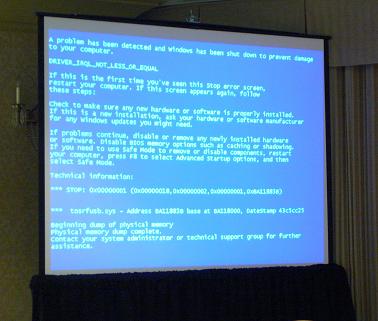
The computer and projector both have power. The computer is displaying the PowerPoint slides. The projector is switched to “computer” as the input. The projector keeps projecting a blue screen. You restart both the computer and the projector. Still a blue screen. You try a different cable. You try a different input. You press a lot of buttons. Still a blue screen. The service was supposed to start three minutes ago.

Half an hour before the service is supposed to start, the power goes out. No sound system. No lyric projection. No lights. No air conditioning.

In these moments, the moments when you wish it was just a bad dream but it isn’t, you are the flight attendant. Your worship team has heard the rumbling/screeching noise, they’re starting to get worried, and they’re looking around for some reassurance that everything is going to be OK. If you lose your cool, it’s going to be a very bumpy ride for everyone. People won’t think clearly, they’ll overreact, and they may even start sweating profusely.

Without the help of the Holy Spirit, you won’t be able to keep your cool when you hit some turbulence. Galatians 5:22-23a says: “…The fruit of the Spirit is love, joy, peace, patience, kindness, goodness, faithfulness, gentleness, self-control…” This is one reason why every worship leader, and every worship team member, needs to pray for the filling of the Holy Spirit every single time they get up to lead worship.

Worship leaders: your worship team is watching you, especially when things get a little bumpy. It’s incredibly important that you model a Holy Spirit-enabled “coolness”.

We might not have monitors. We might not sound polished. We might have to sing from memory or from 30 year-old songbooks lying in a closet. We might not have electricity. None of that matters. We’ll do what we can, in the power of the Spirit, all for the glory of God.

Talking Before a Song Can Be a Good Idea (Sometimes)

A few months ago I shared some thoughts on how worship leaders will serve their congregations more effectively if they take time to prayerfully think through and write out anything they might say before or after songs during corporate worship. Oftentimes worship leaders will spend hours choosing and rehearsing songs, but spend no time preparing what they’ll say. They can end up rambling, fumbling over themselves, and confusing the congregation. (See “What Are You Talking About?” Pt. 1, 2, 3, 4 and 5.

Last night I was asked to lead 4 songs at the beginning of our monthly men’s ministry meeting. We sang “Come Thou Fount of Every Blessing” (key of C and D), “In Christ Alone” (key of D), “Here I am to Worship” (key of D), and “Praise to the Lord the Almighty” (key of D and E).

As I was preparing to lead, I felt like it would be good for me to share an encouragement and also offer a bit of explanation before the first song. I spent a few minutes typing up what I would say to help me think through what I wanted to communicate and how. I read through it a few times, go comfortable with the basic gist of what I wanted to say, and had the paper on my music stand in case I needed it. Here’s basically what I said, and why I said it:

“Well, good evening everybody. In a moment we’re going to stand and sing together, and we’re going to begin by singing a line that’s probably so familiar that we’re in danger of just singing it without even thinking about what we’re singing.”

I wanted to draw their attention to what we were about to sing, especially since it was such a familiar song. It’s easy to get on auto-pilot and sing words without thinking about them.

“We’ll sing: ‘come thou fount of every blessing, tune my heart to sing thy grace’. What a great prayer! I almost wish we could start off every service and every meeting with this song just for that one line. We’re asking God, the giver of every good gift, the ‘fount of every blessing’ to ‘tune (our) hearts to sing (his) grace’, to help us to fix our eyes on what he’s done for us in Christ. He has lavished his grace on us, poured out ‘streams of mercy never ceasing’, and we’re asking him to help us to praise him.”

My goal was to make a simple point that what we were about to sing wasn’t just poetic imagery, but a helpful and necessary prayer to God. I explained the phrase “fount of every blessing”, and the idea of him tuning our hearts to sing his grace. Since “grace” can unfortunately become a churchy word without much meaning, I just tried to highlight it by reminding us all that God showed us undeserved grace ultimately in giving us Jesus Christ, and has shown us unceasing mercy.

“I know that for me, and probably for all of us here, our hearts get out of tune, we get weary, we sin, and we begin to worship other gods. When the music starts at a meeting like this we might stand with a heart far from God and no desire to sing to him, and no concept of his amazing grace.”

At 7:30pm on a Wednesday night, I knew that most of these men had come straight to church from a long day at work, a grueling commute in Washington D.C. traffic, and all sorts of situations and dynamics at home and the office. I also know that we’re all fallen and our hearts become set on our own glory, hardened by sin, and we become easily distracted.

“So as we sing that line, let’s ask the fount of every blessing to tune our hearts to sing about his grace, his streams of mercy never ceasing, and how Jesus sought after us when we were strangers to God. Let’s fix our eyes on our Savior and sing praise to him. We’ll sing about a ‘melodious sonnet sung by flaming tongues above’ – the song that the saints and angels are singing even now around the throne. We get to join in. So let’s stand together and sing.”

By this point I had gone for about a minute and a half, which is on the long side for a worship leader. I wanted to wrap it up, summarize a bit of what I had already said, and explain one more phrase that might be confusing to people. Then we stood to sing and I said very little after that. The songs flowed from one to another naturally and I didn’t really feel like I needed to add a whole lot.

I attempted to keep it brief, keep it engaging, keep it God-focused, and keep it helpful.

Generally, worship leaders shouldn’t talk very much. And if you don’t know what to say, it’s probably better to not talk at all. But if and when there are occasions when it might be appropriate for worship leaders to say something, it’s always a good idea to be as prepared as possible.

Avoiding Abrupt Endings

It’s awfully jarring to be riding in the passenger’s seat while cruising 35 mph along a city street when all of the sudden the driver slams on the brakes. One second you’re looking out of your window at buildings and houses – and the next your head is bouncing back and forth against the head rest with no warning. Not very pleasant.

Similarly, it can be awfully jarring to be standing in the congregation, singing a song of worship when all of the sudden the worship leader slams on the brakes, and the song suddenly stops. One second your attention is fixed on God’s goodness and glory – and the next you’re acutely aware that everyone has stopped singing, the worship leader is turning his pages and taking his capo off, and your hands are still in the air. You figure you should put your hands down. Again, not very pleasant, and a bit embarrassing.

It’s probably safe to say that one of the most important goals of any driver is to prevent his passengers from experiencing whiplash. It doesn’t make for a very pleasant experience for them, it won’t exactly make riding with you an attractive option in the future, and it’s not what they’re looking for when they get in your car and strap in.

For the same reasons, it should also be an important goal for any worship leader to prevent his congregation from experiencing whiplash. It’s good to try to avoid abrupt endings.

Here are some ways I’ve found it helpful to avoid giving the congregation the sensation of having the brakes slammed on a song:

Ease on the brakes
Most worship music CDs don’t slow songs down at the ending. Instead, they might fade them out, stop them without slowing down, or cover up a “hard break” with applause. That’s nice for a CD, but usually not ideal for a congregation. While you certainly want to vary how you end songs and transition into the next, and it may be appropriate at times to have a “hard break” or encourage clapping after a song, a congregation is always grateful for a heads up. Start slowing the song down on or near the next to last measure and bring it to a nice smooth landing. Your goal isn’t to impress, but to pastor. This may mean sacrificing a cool sounding ending for a predictable one.

Linger on the last chord for a few measures
If I’m leading a song that’s in the key of G and we’ve come to the end, it might be appropriate to just linger on the G for a few measures, perhaps moving back and forth between that and a Gsus, or some sort of simple and predictable chord progression. I might keep playing the same tempo as the just-ended song, or slow it down, or start playing the tempo for the next song while still in the key of G. This provides a bit of a buffer after a song and helps avoid an abrupt ending.

Sing the last line a few times
Avoid singing the last line of a song just because it seems like that’s kind of what you’re supposed to do. It can become mindless repetition and lose effectiveness if it happens every time you sing a song. But if you’re ending a song and feeling like you’re coming close to slamming on the brakes, just go ahead and let the band cut out, the tempo slow down, linger on a chord or two, and then sing the last line together a few times. Maybe go back and sing the whole chorus, or the first verse, or the bridge. You don’t always have to end on the chorus. Whatever it is, there might be something you can repeat to help soften the ending a bit.

Choose songs in complimentary keys
I’m asking myself a lot of questions when I’m choosing songs – one of which is “will it feel musically natural to move from this one song to the next?” While it’s not the most important question and there may be occasions when it works to move from one song to another in a totally different and non-complimentary key, I will most often try to avoid putting myself and the congregation in a situation where there will have to be a clear break between one song and the other.

I try to keep in mind the Nashville numbering system when considering complimentary keys.

A quick crash course for those who don’t know what this is:
If I’m in the key of D, D is the “1”. E is the “2”, F# is the “3”, G is the “4”, and so on. If I’m choosing a song to follow up this current song, the three keys that lend themselves most naturally to a smooth transition would be stay on the “1”, or move to the “4” (key of G), or “5” (key of A). I won’t have to do an awful lot of maneuvering to get there.

This number system would apply to any key. If in the key of A, A is the “1”, B is the “2”, C# is the “3”, and so on.

I recommend Paul Baloche’s DVD, Music Theory Made Easy, to look at this idea in more detail.

You can get from any key to any key, of course, outside of my little box, and sometimes do it very smoothly. It just takes some thought and practice.

Think through and practice transitions
Don’t just pick 5 or 6 songs or hope they’ll flow well together. Think through and practice how to transition between them both musically and thematically. Choosing good keys and consistent themes make this a whole lot easier. Sing and play through them, in time, visualizing how it would feel on Sunday morning. If you’re not comfortable with it, keep practicing.

Every Sunday as your congregation “gets in the car”, they’re putting a certain degree of trust in you – that you’ll lead them well, that you’ve prepared for the trip, and that they can look out the window at the beauty of God without interruption. Take it easy on the brake and your congregation will be grateful.