When People Don’t (And Won’t) Sing Along

One of the most fascinating events in American politics is the annual State of the Union address. The pomp and circumstance is higher that night than almost any other night in the nation’s capital.

The president arrives to thunderous applause from both parties, and finally begins his speech when the hoopla dies down. Once he starts, the real fun begins. After every point, the members of congress from his party stand in loyal and heartfelt applause. The opposition party, however, remains seated and firm in their disapproval. Only when the president says something non-partisan or fairly neutral will both parties stand in approval.

Believe it or not, many churches look like this on Sunday morning.

The worship leader stands up to lead some songs. There might be an initial display of unity, but once the songs start, the real “fun” begins. There are those in the room who sing along to every song and do so with enthusiasm. Then there are those who will only sing along if the song meets their criteria. Then there are those who, in protest, won’t even stand.

I’ve seen this up close. In the same church where I encountered an opinionated craft guild ambassador, I also encountered members of the congregation who, for various reasons, refused to stand or sing during the songs I led. It was a not-so-subtle act of protest and was something for which I was completely unprepared.

While not on such a large scale, from time to time I’ll still encounter people who refuse to sing, or just remain seated, or maybe even leave the room. It’s not common, but you see all sorts of things when you’re in ministry. This is a hard one to deal with. Here are just a couple of thoughts:

Remember that building trust takes time
People will follow you if they trust you. Building that trust takes time. For some people in the congregation, it will take them half of the first song to realize they can trust you. For others, it takes longer. You won’t build those people’s trust in you by forcing it, by demanding it, or by showing them your frustration in not having it. It will take weeks, months, and years. Some may never trust you, but that’s why this next point is important:

Don’t make it about you
If you’re leading worship and notice people not singing and/or showing their disapproval, you have to be very careful not to take it personally. Keep leading, press on, don’t get distracted or discouraged, and look at those people with as much love as you can muster. Only God knows what their issues are – whether they’re judging you, will only worship God on their own terms, or maybe they’re just immature – and you can’t allow yourself to get defensive as if it’s all about you. It’s usually not. And even if it is, you’re not the one to do anything about it. You have to keep going, be faithful, and pray.

Go to your pastor
If there people who won’t sing along, and if it’s the same people consistently, you need to mention this to your pastor. The pastor is the main worship leader of the church, and this is something he needs to pray about addressing.

Any president who stands before the Congress for the State of the Union address knows that there will be some people who will be with him the entire hour, and others who won’t be with him at all. The same could be said of worship leaders on Sunday morning, but hopefully with less pomp and circumstance

The big – really big – difference, of course, is that during a State of the Union address, all eyes are on the president. He is analyzed, examined, the star of the show, and the one everyone is coming to see. When and whether people stand up, sit down, applaud, or protest, is all up to him.

Thank God that I am not the star of the show on Sunday morning. My job is to help people fix their eyes on the Lamb who was slain, the Savior of the world, the image of the invisible God, and the one before whom one day we will all bow our knees. But here on earth, and on Sunday mornings, when and whether people stand up, sit down, applaud, or protest, is not up to me.

Song Sheets Can Be Your Friend

A lot of worship leaders are under the impression that in order for people to “really worship”, then the words to the songs must be projected. Projecting lyrics can become not only a non-negotiable, but also an idol. PowerPoint will make our service more alive! MediaShout will get people’s hands in the air! Song sheets are the enemy!
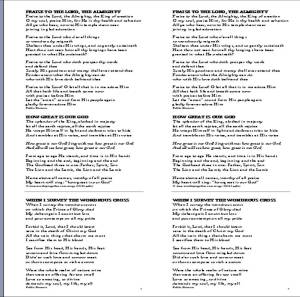
I’ve come to learn that sometimes, song sheets can be your friend.

Now don’t get me wrong – I prefer projecting lyrics to printing them for several reasons. Here are just a few:

  • It gives me flexibility to make last-minute changes
  • It allows people’s heads and eyes to be lifted up
  • It frees people’s hands to be expressive (as the bible encourages)
  • It saves money by reducing the cost of paper, copying, and ink
  • It makes lyrics easier to disseminate to large numbers of people
  • It prevents waste of un-used paper
  • It avoids the problem of not printing enough copies of the lyrics
  • It helps promote unity in the congregation by physically pointing people in the same direction.

Most worship leaders would agree with those pro’s of projecting lyrics. The problem is when the pro’s of projecting lyrics blind us to the con’s.

The cons range from the practical:

  • The ceiling is too low
  • The church can’t afford a laptop and projector
  • The room is too bright
  • The sight-lines aren’t good
  • You’re leading in an open field

To the pastoral:

  • Some members of the congregation have threatened to leave if a screen ever appears in the general vicinity of the church
  • Projecting lyrics is more of a distraction than an aid

Worship leaders need to be able to be honest and objective enough to know when projecting lyrics would be a hindrance to people singing to God. In those instances, song sheets can be your friend.

In what we call the “main sanctuary” at my church, projecting the lyrics is a no-brainer. The screens, projectors, and computers are all permanently installed in the room and easy to use. But in our “historic church”, a civil-war era colonial-looking building, there aren’t any screens or projectors installed, and until we find a way to do that without disturbing the beauty of the space, projecting lyrics requires a good deal of work. After a couple years of going through all that trouble, I finally realized it was more trouble than it was worth. Deciding to just go ahead and use song sheets has been incredibly freeing.

Sometimes if the song sheet is for a home group, or a staff meeting, or an informal gathering where I’m just leading a couple of songs, I’ll put the songs on one half of a 8 ½ by 11 piece of paper. This way I can get two song sheets out of one piece of paper, and it’s not very big.

Other times, if the song sheet is for something more formal, like a healing service in the historic church, we’ll put a nicer looking heading on top of it so that it feels more official.

Here’s how I format the song sheets to make them not only readable but pleasant to read:

  • 12 or 14-point font
  • A readable font that has a bit more character than Arial or Times New Roman. Not too much character to be distracting, but just a little bit
  • Bold-ed song titles
  • Italicized chorus
  • 8-point font for the copyright information at the bottom of each song
  • One 6 or 8-point line between the sections of the song
  • Two full lines of 12 or 14-point space between each song

It’s totally fine (and understandable) to prefer projecting lyrics to printing them. I certainly do. And I look for ways to make rooms more conducive to doing so, since I think the advantages of projecting lyrics are worth some work. But, from time to time, the advantages of printing the lyrics are too great to overlook.

Good Old Bulletin Bloopers – Pt. 2

You’ve probably seen these before, but I can never get enough of them. Enjoy:

Scouts are saving aluminum cans, bottles, and other items to be recycled. Proceeds will be used to cripple children.

Chili Supper, Money goes to missions. $5 a bowel.

The outreach committee has enlisted 25 visitors to make calls on people who are not afflicted with any church.

Evening massage – 6 p.m.

The Pastor would appreciate it if the ladies of the congregation would lend him their electric girdles for the pancake breakfast next Sunday morning.

Low Self-Esteem Support Group will meet Thursday at 7 to 8:30 p.m. Please use the back door.

Ushers will eat latecomers.

For those of you who have children and don’t know it, we have a nursery downstairs.

The Rev. Merriwether spoke briefly, much to the delight of the audience.

The pastor will preach his farewell message, after which the choir will sing, “Break Forth Into Joy.”

Next Sunday Mrs. Vinson will be soloist for the morning service. The pastor will then speak on “It’s a Terrible Experience.”

Due to the Rector’s illness, Wednesday’s healing services will be discontinued until further notice.

The eighth-graders will be presenting Shakespeare’s Hamlet in the church basement on Friday at 7 p.m. The congregation is invited to attend this tragedy.

22 members were present at the church meeting held at the home of Mrs. Marsha Crutchfield last evening. Mrs. Crutchfield and Mrs. Rankin sang a duet, The Lord Knows Why.

A song fest was hell at the Methodist church Wednesday.

Potluck supper: prayer and medication to follow.

Don’t let worry kill you off – let the church help.

Pastor is on vacation. Massages can be given to church secretary.

Bertha Belch, a missionary from Africa will be speaking tonight at Calvary Memorial Church in Racine. Come tonight and hear Bertha Belch all the way from Africa.

The senior choir invites any member of the congregation who enjoys sinning to join the choir.

This afternoon there will be a meeting in the south and north ends of the church. Children will be baptized at both ends.

Tuesday at 4:00 p.m. there will be an Ice Cream Social. All ladies giving milk please come early.

“At the evening service tonight, the sermon topic will be ‘What is Hell?’ Come early and listen to our choir practice.”

On Sunday, a special collection will be taken to defray the cost of the new carpet. All those wishing to do something on the carpet, please come forward and get a piece of paper. 

This being Easter Sunday, we will ask Mrs. Johnson to come forward and lay an egg on the Altar.  

Knowing When to Laugh

“Hi Jamie – do you have a minute?”

“Sure!”

“Well, the craft guild was talking this past Wednesday, and we decided that when we sang that song that says ‘thank you for the cross’ last week, that singing it four times was too much. Two times would have been fine. They asked me to tell you.”

“Oh… well, uh…. OK. Thanks…”

“Oh, you’re welcome. We just think two times is plenty.”

This is an actual conversation that took place after a Sunday morning service when I was a teenager first starting out leading worship at a small church where my Dad was the pastor.

I was putting my guitar away when an older member of the congregation, a woman who had been there for probably about three hundred years, approached me with this report from the “craft guild”.

And for anyone (i.e. everyone) who doesn’t know what a “craft guild” is, then I’ll explain. It’s a fancy word for a group of ladies who get together every week at the church and do crafts (i.e. making potpourri, knitting blankets, and occasionally complaining about things.)

In some circles this would be called “the ladies who make crafts”, but in more liturgical churches we like to use words no one knows the meaning of because it makes things sound impressive. This is why the lobby is called the “narthex”, the lay elders are the “vestry”, and the custodial staff members are referred to as “sextons”. Seriously.

My initial response to this ambassador of the craft guild, sent to convey their unanimous decree that I repeat the bridge to Matt Redman’s song “Once Again” not four times but two, was to be offended and then get defensive. Oh the nerve! She doesn’t understand! She smells like blankets!

Taking criticism is never easy. And how to respond to that criticism depends on many different things. What is the heart behind it? How is it being given? Even though this is hard to hear is it right? Is this something I should ignore? It’s different every time. And sometimes, the best way to respond is just to laugh.

You’ll do well in ministry if you’re able to laugh. And this isn’t a mocking, cynical, arrogant laughter, but a “I refuse to let this get under my skin” laughter. I want to seek to humbly respond to criticism, listen to people with a gracious heart, and love even the people who are difficult. But sometimes those people who are difficult will say things that are hard to take. That’s when it’s helpful to laugh. But not in front of them. You might wind up discovered by a sexton buried under the narthex wrapped in potpourri.