 I really appreciate Matt Redman’s music. His songs are consistently theologically sound, musically fresh, and congregational. His newest album, “We Shall Not Be Shaken”, is fantastic, and has a number of songs that I could envision using in the context of a worship service.
But many of his songs are written too high. Older songs such as “Blessed Be Your Name”, “Praise Awaits”, “Nothing But the Blood”, and newer ones like “You Never Let Go”, “This is How We Know”, “You Alone Can Rescue”, and “How Great is Your Faithfulness”, are all recorded in the key of B. This usually means that the chorus and bridge sit very high in the vocal range – with D#’s, E’s, and F#’s all over the place.
The key of B is a great one for Matt, but not usually for the average person in the congregation.
I also really appreciate Tim Hughes’ music. I met Tim in Oxford a couple of years ago and was struck by his humility and genuine desire to write songs that serve the Church. His CDs are also dependable sources of good music. But, again, many of his songs are too high.
Newer songs like “Happy Day”, “Everything” and “Jesus Saves” are recorded in the key of C, meaning that the congregation is asked to hit E’s, F’s, and even G’s on a regular basis. Most other songs are recorded in keys that are more suited for Tim’s voice than the average man or woman in the pews.
Many of Chris Tomlin’s songs are good for using in worship services, but are recorded in keys nearly impossible for the congregation to feel comfortable in. “Indescribable” was recorded in the key of B meaning you have to hit an F# about 40 times in the song. “How Great is Our God” in the key of Db, meaning that in the bridge you’re belting out F’s and F#’s. “Holy is the Lord” in the key of Bb meaning the chorus and bridge sit around an F half the time. “Amazing Grace (My Chains Are Gone)” was recorded in the key of G, meaning that you’ve got to hit a high G when the chorus rolls around.
Just because Matt Redman, Tim Hughes, or Chris Tomlin record their songs in those keys, you don’t have to sing them in those keys.
Take some time to figure out the best key for a song. My rule of thumb is “C to shining C” (I’ve mentioned this before), meaning that the lowest a song should generally go is a C (one octave below middle C on a piano) and the highest it should go is one octave up from there. I’ll still use songs that dip a bit lower than a middle C or jump up to a D, Eb, or even an E from time to time, but I want to make sure the song isn’t “hanging out” up in the stratosphere or down in the depths. I think most people are comfortable between a low G and a high C or D. Of course we can’t limit our congregation to only singing notes between a middle C and one octave up. It’s OK to move a bit lower or a bit higher from to time. But make sure it’s not all the time.
Singing all your songs really low can have a deadening effect, removing drive and energy from them. Singing all your songs really high can cause your congregation to stop singing.
Once you’ve figured out what key the song should be in, transpose it down and make a new chord chart up for your worship team. This is a skill you really need to develop if you haven’t already. A basic music theory book should help you learn how to move songs down into more comfortable keys. In the meantime, ask someone for help or use internet tools (CCLI’s SongSelect service does it) to help you out.
Moving “Blessed Be Your Name” down from B to A means that the verses are a bit low (i.e. you dip down to an A once in a while), but the chorus and bridge are comfortable, sitting in an A-B-C# range.
Moving “Happy Day” down from C to A means that the verses are pretty low (you dip all the way down to a low F#) but the chorus and bridge aren’t painfully high.
A lot of worship music CDs that I buy have songs that are written in congregation-friendly keys. I’m always really grateful for those. But others are written in the singer’s “sweet spot”. Those are great to listen to it, but require some extra work on my part. I’ll gladly transpose a song down a few keys to help as many people join in as possible.
 In the more informal services at my church, the worship leader is usually the one who invites people to stand at the beginning of the service. In other churches or in more formal services, either the church’s pastor will do this, or the first hymn will just start and signal that everyone should probably stand up.
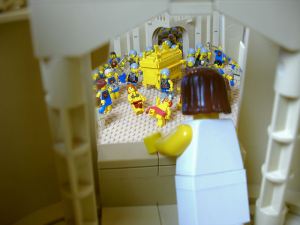 In 2 Samuel 6, when the Ark of the Covenant was brought back into Jerusalem, David “danced… with all his might”. Take that description literally and just imagine how David looked. Undignified enough to draw the mocking of his wife Michal – but not nearly undignified enough for David to think about pulling back.


 Worthily Magnify